
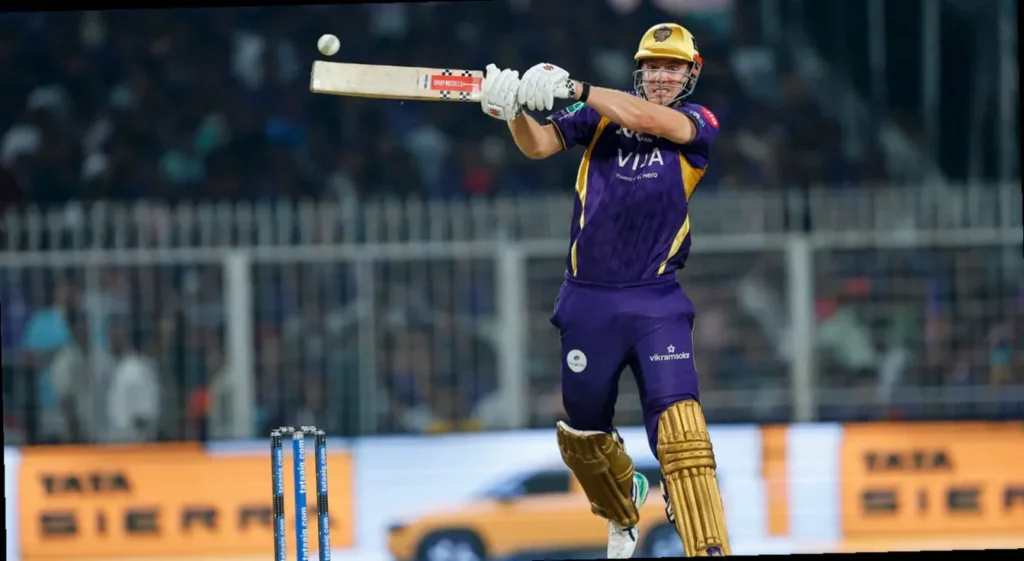
Mukul Choudhary’s turnaround in Match No. 15 of IPL 2026 has become the talk of the tournament—impacting plans, momentum and confidence in one sweep. But what does that mean for Kolkata Knight Riders (KKR)? They currently sit on a single point from four outings. Their most recent setback was the kind of match that looked destined to end in a win, especially after the side posted a total that should have been enough.
“It’s going to hurt,” Dale Steyn said on ESPNcricinfo’s TimeOut show. “And it will hurt more because so much hasn’t quite clicked for the three-time champions so far.”
The loss to Lucknow Super Giants (LSG) followed a spell where KKR’s win chances appeared firmly in their control. Using ESPNcricinfo’s match data, KKR’s probability stood at 76.65% after 15 overs of their defence. It then climbed to 85.79% in the following over, before dipping slightly to 82.23% one over later—only for it to slip away as Choudhary took charge.
Steyn explained why the timing makes the defeat sting. “It is hard to pick yourself up. You have had a rough season. You almost feel like by the 16th, 17th over—at least the 18th over—the game is yours. You sense that if you bowl with a bit of smart cricket, you bowl three balls, you give three extra deliveries to Avesh [Khan, Choudhary’s partner], and the game is done. That’s exactly where it is. But those extra balls went to Mukul. He punished them for boundaries, and that pretty much becomes your season.”
Before the Choudhary surge, KKR had put together a lot of the right ingredients. They made 181 for the loss of just four wickets, a total that suggests they were not able to accelerate at the right moments despite having batters in their ranks. After the powerplay they had reached 56, but the innings never truly gathered speed. Ajinkya Rahane struck 41 at a strike rate of 170.83, yet the rest of the batting struggled to find the same rhythm. Not until Rovman Powell’s late burst did anyone move beyond Angkrish Raghuvanshi’s 136.36 strike rate—Powell finished unbeaten on 39 off 24 balls. Crucially, between overs 11 and 15, KKR managed just 17 runs and lost three wickets.
Aaron Finch pointed to players who looked like they were still searching for their best rhythm. “There was a couple of batters that looked like they were seriously searching for form,” Finch said. “When Cameron Green [32 not out in 24 balls] came in, it looked like he wasn’t sure about his game. Do I go for a big hit? Do I just settle in and accumulate for a bit? And what happens when you do that is you end up losing your intent. You face a lot of dot balls and it builds pressure.
“Rinku [Singh, 4 off seven balls], on the other hand, looked completely out of sorts. It was almost like he wasn’t watching the ball as closely as he could have. He’s trying to play the shot, but his weight is moving away from the ball. It was really unusual—something I haven’t seen from him before. It felt like a batting order that lacked confidence in the middle overs.”
Steyn was also critical of Green’s approach, noting that the all-rounder has been under pressure with low returns with the bat and has not been used as a bowler—until that changed against LSG—after joining the KKR group through a record auction bid.
“Cameron Green, I’m thinking Digvesh [Rathi] bowling to him and he’s literally just blocking it back,” Steyn said. “And I’m hearing the commentators say, ‘he’s waiting for his match-up’. But which match-up? You have to take on the bowlers. Who is the match-up? He’s just patting balls back. In a phase where you feel that even if you face ten or 12 balls, you should be in the game by then—you should be really going. Watching that doesn’t give me confidence.”
Powell suggested KKR’s position on the scoreboard gave them hope as the chase progressed. By the 16th over, LSG had lost seven wickets, and that collapse appeared to tilt the match towards KKR. However, things began to unravel. Green was brought into the attack for the 19th over, even though Kartik Tyagi and Navdeep Saini had each already bowled an over earlier. Vaibhav Arora also had an over available, but he was assigned to the final over. In the end, Green conceded 16 runs in that crucial spell.
In the post-match conference, Powell explained what he believes should happen when a team senses a game is slipping away. “A lot of the time, when you feel the pressure, you need to bring your best bowlers a little earlier than the 19th over, so that when you reach the 19th over you still give yourself a chance. I think that is what happened with us tonight.
“As a bowling unit, we know that if we bowl the ball into the wicket, it’s a good option, and he kept hitting those balls. Maybe we could have gone a touch wider a bit earlier. But we’re sitting here looking back with hindsight, and I’m not someone who talks in hindsight. When you’re out there and the pressure is on, and you’ve got guys telling you what to do—or you already have a plan—it comes down to execution.
“I also feel we could have gone to a wider plan just as they went for the last ball, the last over. We could have switched to a wider plan after we realised he [Choudhary] was hitting those short deliveries. We could have gone to a wider plan a few balls earlier to see how we could get a few dot balls.”
