
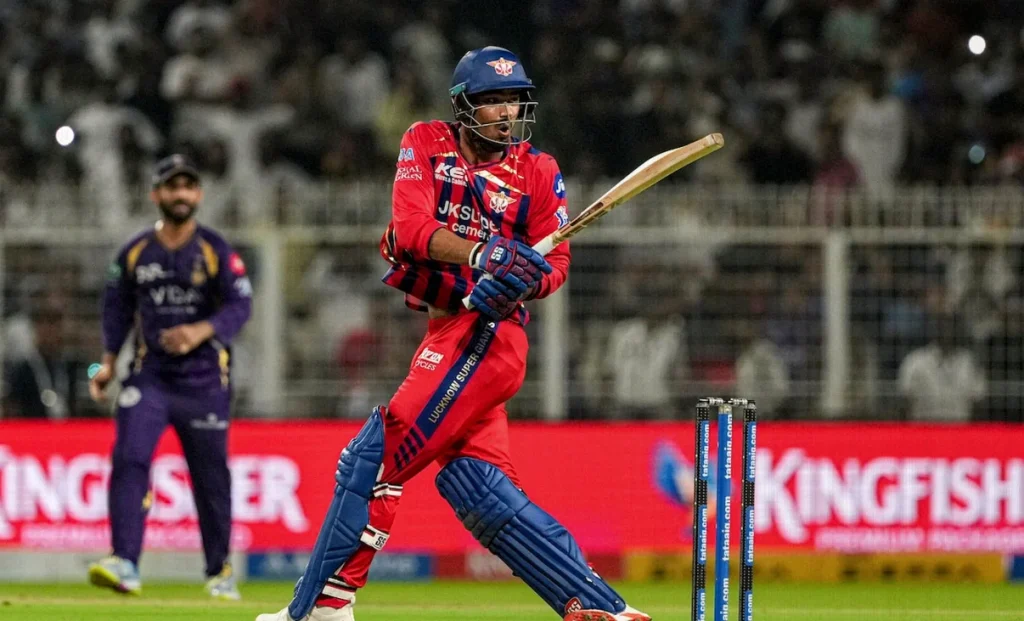
Mukul Choudhary grew up idolising MS Dhoni and specifically the way the veteran closes out tense chases. On Thursday night at Eden Gardens, the 21-year-old Rajasthan batter turned that inspiration into a match-defining reality, striking with authority to steer Lucknow Super Giants to a three-wicket win over Kolkata Knight Riders in a last-over, last-ball showdown. After the innings, Choudhary dedicated his performance to his father and to Dhoni, saying his family always dreamed of him becoming a cricketer and that he studies Dhoni’s finishing style closely. He also highlighted the fact that he plays on the same number as Dhoni. Choudhary made 54 not out off 27 balls, smashing 2 fours and 7 sixes.
Behind the calm look at the crease, Choudhary credited relentless preparation for his ability to clear the ropes. He explained that he has built a routine around hitting at a high volume, emphasising that power comes both naturally and through constant work. “My genes are such and I am naturally built in a way that there is power in my shots, and also I do practice a lot. Everyday I hit around 100-150 sixes. For the last five-six months, I’ve been practising a lot and that has come into me,” he said.
Choudhary also spoke about the Dhoni-like “helicopter shot” that he used to send Vaibhav Arora for a six in the 17th over. He said he had been working on that stroke since childhood, adding that he liked how Dhoni could finish innings even when deliveries were awkward, including when the ball arrived close to a yorker length. “I have practised that shot since childhood… I always liked that, and the way Dhoni finished (an inning). He used to hit a six even off a yorker. If you even hit that kind of a delivery for six, the bowler thinks about doing something different,” he explained.
The label of “scariest finisher” has followed Choudhary, and the reason is becoming clearer with each late-innings cameo. Lucknow Super Giants head coach Justin Langer had earlier suggested he could help transform Choudhary into one of India’s most feared middle-order batters, and Choudhary’s impact against a weakened KKR bowling unit at Eden Gardens underlined that potential.
With the contest turning in the final phase, Choudhary produced a surge that swung the game decisively. The match began with Lucknow carrying a chase that had reached 128/7 after 16 overs, but he struck 54 runs in the last four overs to complete the turnaround and keep his side on course for the win.
Choudhary said Langer’s faith played a role in his mindset. “If such a great coach says something about you, he must have seen something in you. He showed me his belief and I wanted to do it,” he added. He also detailed how the coach’s involvement went beyond words into daily preparation. “He made me practice as well. He made me work with him for 10-15 minutes every day. He made me understand everything and that is my job. I did my job and he showed me his trust,” Choudhary said.
That belief and ability have been building for a while. In December last year, Choudhary was in a high-pressure situation in the Syed Mushtaq Ali Trophy against Delhi, needing 25 runs from the final over. He almost pulled off a remarkable chase, bringing it down to five runs required off the last ball, and that innings helped bring him into the IPL conversation. Soon after, Lucknow Super Giants snapped him up for Rs 2.60 crore.
Recalling that moment, Choudhary said he had carried confidence into the final over because he had faced similar situations before. “25 runs were needed from the last over and five runs from the last ball. Ayush (Badoni) was bowling. I did that previously so I had the belief. I got picked from that innings,” he said.
Five months later, on the larger IPL stage, the script began to feel familiar. Choudhary suggested he sensed it could become a turning point, giving him a “new identity.” In what was only his third IPL game, he took control with an aggressive, breathtaking burst against KKR.
Choudhary explained his approach during the chase, stressing that his focus was always on carrying the innings forward rather than worrying about the result. “I never thought about the result, just wanted to take the match till the end and take it close and in the end it became clear that ‘yes I can do it’.”
His composure under pressure, he revealed, comes from a mental routine built on deep breathing. “I used to be in a hurry before 1-2 years. But after 1-2 years of practice, I have kept in mind that I have to play as long as I can. If I take the game to the end, I will win.” He added that when too much is happening around him, he tries to slow everything down, take a short pause, and then concentrate purely on the ball. “When there are many things going around, I want to sit down peacefully for five seconds and take 2-3 deep breaths, just watch the ball and play the ball.” That calm routine was visible again in the final over when he briefly went down on his haunches to reset before finishing the job.
Choudhary also acknowledged the fine margins of the last over, suggesting he expected a mistake and planned to punish it. “I knew he would err on one ball and I had to hit it for six,” he said.
Father’s sacrifice
Choudhary’s path has been shaped as much by family sacrifice as by raw talent. He explained that his father, Dalip, had decided even before marriage that he would make his son a cricketer. Dalip left a teaching job, sold his portion of the family home, and shifted the family’s base to help support Choudhary’s training, while his mother Sunita reorganised her life around his cricket commitments.
At the Aravalli Coaching Centre in Jaipur, Choudhary began his development as a medium pacer. “I was a medium pacer, so I became a keeper as there was no one around.” However, coaches soon identified his natural capacity to hit with power and guided him toward batting. Even when his early domestic cricket years in the 2022-23 season were difficult—his first stint did not produce the kind of returns he expected—Choudhary maintained his belief.
Now, as attention grows, he says he is still trying to stay grounded. “Yes, there is pressure. It’s my first season. Even during practice matches there is pressure to perform as the team has shown trust in you.” He added that the pressure is present even beyond the IPL, but that success at this level changes a player’s public identity. “Even in domestic cricket you perform to reach here. But if you do it here, you will get a different name and different identity. I just look at that aspect by taking a deep breath and focus on the process.”
Choudhary also reflected on how pressure can arrive for every player, regardless of how many games they have played. “There will be pressure for everyone even if you play five matches or 50. But it’s about keeping the distractions aside and believe in yourself… I’m learning it but have to keep learning.” He said that belief was demonstrated by his skipper Rishabh Pant from the beginning, even after Choudhary made a slow 2 not out off five balls.
He finished by recalling a conversation with Pant after a quiet start in another game. “In the last match, I was not able to hit well after 4-5 balls and Rishabh bhaiya told me that ‘don’t think so much, just do what you have been doing’.”
