
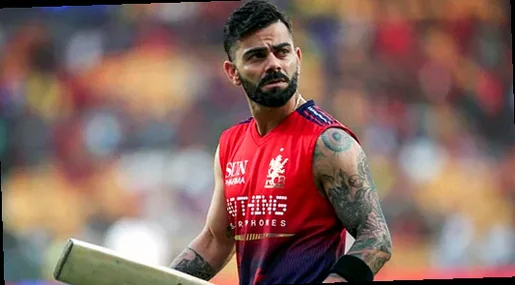
Virat Kohli has started IPL 2026 in confident fashion, giving Royal Challengers Bengaluru a glimpse of the kind of batting impact that can decide matches. Early in the tournament, he has looked comfortable in his rhythm, clearly intent on asserting control during the powerplay. Whether it’s stepping out into the line or taking the aerial route when the field allows, Kohli’s approach at the top of the order carries a distinct sense of purpose this season. In the next game, that mindset will be tested against a familiar hurdle: Sandeep Sharma.
Kohli vs Sandeep: the long-standing battle
The matchup has often tilted in the bowler’s favour across IPL history. Sandeep has dismissed Kohli seven times, a record that underlines how often the Rajasthan pacer has found ways to get the breakthrough. Yet Kohli’s response has been anything but cautious. Against Sandeep, he has amassed 132 runs at a strike rate of 150, suggesting he’s prepared to take the risk and force the confrontation rather than merely survive it.
Former India all-rounder Irfan Pathan broke down the matchup dynamics, drawing attention to how Sandeep’s threat has shown up differently against two senior hitters—Kohli and Rohit Sharma. Pathan noted that while Sandeep has been a difficult opponent for both batters, the recent outcomes and scoring patterns have varied.
- Pathan recalled that Sandeep Sharma has removed Virat Kohli seven times in IPL contests.
- He pointed out that Sandeep was also used against Rohit Sharma, after Pathan had suggested the selection for that specific matchup.
- In the rain-affected game in Guwahati, Rohit was dismissed by Sandeep for the sixth time in that head-to-head context.
- Pathan then contrasted the scoring rates, saying Rohit’s strike rate against Sandeep has hovered around the 100-mark, while Kohli’s has risen to roughly 150 in recent encounters.
Continuing his tactical assessment, Pathan highlighted a noticeable evolution in Sandeep’s style. In his view, the pacer appears to lean more on variation rather than sheer aggression, and he also suggested that the bowler’s opening-ball pattern has become easier to spot. That, he argued, is critical because a batter of Kohli’s calibre is unlikely to miss such cues for long.
“He steps out, tries to put pressure on the bowler, and it feels like Sandeep Sharma’s peak is now behind him. These days he looks a bit more defensive, trying to find ways to survive. He has always been a smart bowler, but a pattern has been noticed. In all three recent matches, Sandeep Sharma has used a slower delivery on the very first ball. The question is, does Virat know this? I am sure he does, because he is a top player,” Pathan said.
Can Kohli turn the early cue into a weapon?
Pathan also framed the next phase of the contest as a battle of adjustments. If Sandeep is relying on a consistent early plan—especially the slower ball delivered right at the start—Pathan believes Kohli’s current form gives him the tools to respond effectively. The former all-rounder set up several possible tactical sequences, imagining how the duel could swing based on what happens on the first delivery and how each batter reacts across the over.
“Will Kohli step out on the very first ball and try to put Sandeep under pressure throughout the over? Or will Sandeep think that he needs to try something different against Kohli? Because Anshul Kamboj got him out when he stepped out, and he has pace. So can Sandeep do something different? Can he keep the length a bit fuller, avoid slower balls and instead go for swing? Can he bring the wicketkeeper up? There will be many tactical moves in this battle. It feels like Virat Kohli, the way he is batting, might be able to counter this,” Pathan added.
With Kohli’s intent at the top and the tactical questions surrounding Sandeep’s opening approach, the contest is set to hinge on early decisions—how quickly the batter picks up the pattern, and whether the bowler can disrupt it with a clear change of plan.
