
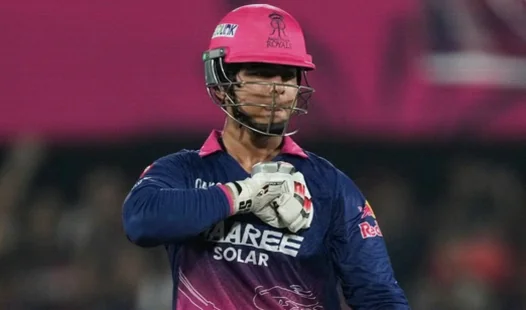
One more IPL evening has delivered the same familiar heartbreak for opponents: a bowling unit getting torn apart by India’s newest teenage sensation. Against Royal Challengers Bengaluru, Vaibhav Suryavanshi made the contest feel less like a youngster enjoying a glamorous first taste of the tournament and more like someone arriving with a serious, long-term plan. In only 26 deliveries, he struck 78, reached a fifty in 15 balls, and lifted his IPL 2026 run total to 200 from his opening four matches. By the time the innings ended, the conversation around him had shifted. This was no longer about novelty. It was about scale.
There is a particular brand of thrill the league typically reserves for young players. It often arrives fast, breathless, and sometimes before the performances have had time to settle into evidence. A handful of clean strikes, a confident look, and one highlight clip that travels across every screen can turn a talent into a headline before there is enough time for a track record. Vaibhav’s first four innings have pulled him out of that fragile category. He has not simply flashed; he has repeated. And repetition is where early excitement starts to become real value.
That is why the Rajasthan Royals angle feels deeper than a simple story of promise delivering on the early hype. This is not only about a young batter going beyond his age. It is also about a franchise recognizing—very quickly—that what it secured at a certain price is already behaving like a far more expensive asset.
The season is beginning to show a pattern
The innings versus RCB was the loudest chapter so far, but it was not the first warning sign. Before that, Vaibhav had already produced 52 off 17 against Chennai Super Kings, 31 off 20 against Gujarat Titans, and 39 off 15 against Mumbai Indians. The distribution matters. There is one comparatively quieter outing, but even that still delivered something useful. The overall picture points to a batter who does not require long time in the middle to tilt the rhythm of a match.
After four innings, he has 200 runs in just 78 balls. His average stands at 50.00 and his strike rate is 256.41. The boundary count reads 18 fours and 18 sixes. These numbers do not suggest a slow, comfortable build designed to flatter the closing total. There is no padded middle. Instead, the impact is immediate, sharp, and unmistakably modern T20—power arriving with conviction rather than waiting for the situation to mature. He is not batting like someone learning the league’s pace; he is setting his own tempo.
His value across the season—measured through match-worth contributions—adds a second layer to the same message. The figures come in at ₹1.40 crore versus CSK, ₹82.52 lakh versus GT, ₹1.54 crore versus MI, and ₹1.45 crore versus RCB. Three of those four outings have cleared ₹1.4 crore. Even the least explosive showing still generated returns that many franchises struggle to extract from names that cost far more.
What RR paid and what RR are getting no longer belong in the same lane
On paper, Vaibhav Suryavanshi’s current cost base is just ₹31.43 lakh. His total match-worth has already climbed to ₹5.21 crore, leaving him with a profit of ₹4.90 crore and an ROI (Return on Investment) of 16.58x. When those numbers are placed next to the league’s current “showroom” pricing bands, the gap becomes striking. Rajasthan have effectively paid the kind of money that sits near a Toyota Innova Hycross, yet the returns they are already seeing feel closer to the territory of a Lamborghini Huracan STO.
This is not merely a catchy comparison. It is the clearest illustration of imbalance. An Innova represents the premium family segment—smart, practical, respected, and built for everyday value. A Lamborghini lives in a different emotional universe altogether, shaped by excess, speed, drama, and the thrill of owning something that goes beyond basic utility. Rajasthan made their purchase in the first world, and within four innings the return is roaring in the second.
That contrast is exactly what makes the narrative so compelling. Franchises often talk about value in broad terms, using language like upside, flexibility, role fit, and future planning. Those are tidy boardroom expressions. Vaibhav’s start has made the idea of value feel far more visible. Rajasthan bought from one showroom and are already driving out with something from another.
Also Read: BCCI receives tempting offer to launch Vaibhav Sooryavanshi; teenager tipped to become youngest debutant for India at 15
The auction gamble has suddenly become a masterclass
Rajasthan’s decision to pursue him was never random. At the IPL 2025 mega auction, Vaibhav entered with a base price of ₹30 lakh. RR then outbid Delhi Capitals to secure him for ₹1.10 crore, making him the youngest player ever signed by an IPL franchise. The move was bold because of the age attached to it, but it also matched an instinct that has been part of the Royals’ approach: buying youth before the market fully convinces itself.
Even so, the most well-thought-out young-player investments usually come packaged with patience. These stories are typically written in future tense—he could become this, he might grow into that, give him time to develop. Vaibhav has dismantled that kind of language almost immediately. He is not a distant promise right now; he is a present return.
His ₹5.21 crore in total match-worth already accounts for roughly 16.2% of RR’s total team worth so far. For someone with only four appearances, that is a substantial share of the franchise’s value creation. It signals that this is not just a charming side plot. He is starting to influence the economics of Rajasthan’s season itself.
This is where bargain ends and distortion begins
Every IPL season produces bargains. A few players outperform their price tag and make auction tables look temporarily foolish. Vaibhav’s start is beginning to feel even more dramatic than that. A bargain is when a player delivers beyond what was spent. A distortion is when the price-return gap becomes so extreme that the original number starts to look like it belonged to a different discussion altogether. That is where this case is now sitting.
Rajasthan did not pay for a centrepiece meant to carry them instantly. They paid for youth, upside, and the hope of tomorrow. What they are receiving back already resembles star-level output, arriving at startling speed. The innings against RCB brought the clearest picture yet of what RR may have stumbled into—or, more precisely, what they might have spotted before others.
They paid Innova money. Four innings later, Vaibhav Suryavanshi is already returning something that feels much closer to Lamborghini territory.
