
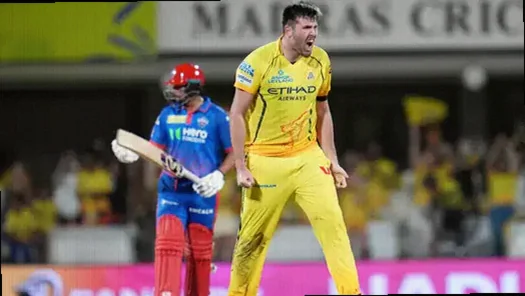
Chennai had the kind of buzz you rarely see at the start of a tense IPL night as Dewald Brevis’ absence loomed over CSK’s early-season plans. On Saturday, April 11, the crowd’s excitement turned into a full-throttle cheer when Ruturaj Gaikwad confirmed Brevis’ inclusion for the heavyweight clash against Delhi Capitals. Yet the skipper didn’t stop there—Gurjapneet Singh was also named in the playing XI, making his IPL debut, and he immediately delivered impact as CSK’s bowlers reshaped the contest at Chepauk.
Key takeaways
- Ruturaj Gaikwad confirmed Dewald Brevis’ return to the CSK XI for the Delhi Capitals match on April 11 in Chennai.
- Gurjapneet Singh was handed a debut IPL role after being bought by CSK ahead of the 2025 season, replacing Matt Henry.
- Gurjapneet struck with his very first IPL delivery and followed up with a short-ball barrage that disrupted several batters.
- Jamie Overton also played a major role, taking four wickets in the match and repeatedly troubling batters with bounce and seam movement.
- CSK’s pace-heavy approach worked on the night, with 48 balls delivered by the two pacers producing just 23 runs and two wickets.
- Sanju Samson produced a standout century at home, while CSK’s next assignment is against Kolkata Knight Riders on Tuesday, April 14.
Gurjapneet’s debut burst and CSK’s bounce-led plan
At toss time in Chennai on Saturday, April 11, the stadium attention was fixated on one name—Dewald Brevis. CSK had missed him in their opening three games of IPL 2026, and the confirmation of his place for the crucial meeting against Delhi Capitals sparked an immediate reaction from the stands.
Gaikwad then added another layer to the selection news by confirming that fast bowler Gurjapneet Singh would be part of the playing XI as well. The left-arm pacer, acquired by CSK before the 2025 season, had not appeared in an IPL match before this fixture. In the XI, he came in for Matt Henry, who was ruled out after initially being part of the attack.
While Gurjapneet was still finding his rhythm, the start of his spell offered a statement. He was introduced after the Powerplay in the second half and, on his first ball in the IPL, he managed to claim a wicket. Axar Patel went for a cut after seeing a short and wide line, but Sarfaraz Khan held a remarkable catch to send Chepauk into celebration mode.
With his confidence rising, Gurjapneet attacked again on the second delivery of the over. He bowled a short ball that rose enough to trouble the timing, sailing over David Miller and Sanju Samson for a boundary. Even after that setback, he kept testing the batters’ discipline, using hard-length deliveries that kept the batters under constant pressure.
From the other end, Jamie Overton then intensified the challenge. The combination of CSK’s pace and their ability to extract troublesome movement and bounce created a steady stream of discomfort for the Delhi Capitals batters. The in-form Sameer Rizvi was eventually dismissed after Gurjapneet and the pressure around the batters continued to build.
When Overton returned to the attack after a short interval, he struck with a pacy cross-seam delivery pitched on a good length. The ball zipped through the surface and resulted in Miller being trapped, further underlining how difficult it was to settle at Chepauk that night.
Chepauk’s reputation is strongly linked with spin-friendly conditions, but this match showed a different angle—one where CSK leaned into pace and used length variations to force mistakes. CSK used a four-man pace unit, and that effectively became a five-man rhythm with Shivam Dube adding to the pace options.
Anshul Kamboj and Khaleel Ahmed supported the plan as well, but it was Overton and Gurjapneet who consistently found bounce. That constant element made life difficult for any batter who couldn’t anchor strongly to the back foot.
Even though Gurjapneet did not add any further wickets to his tally during that spell, he kept the batters uneasy and finished with a four-wicket haul as the two pacers combined to dominate the middle overs. Overall, the duo delivered 48 balls in the match, with 25 of those being back-of-a-length or short. Those 25 deliveries produced only 23 runs and accounted for two wickets. From a good length, just 24 runs came off 20 balls.
One detail stood out most: the pair bowled only three balls at a fuller length, sticking rigidly to their chosen approach and shaping the contest around length discipline.
Fleming on Chepauk’s evolving identity, and Samson’s big statement
Before the game, CSK head coach Stephen Fleming had highlighted how a lack of a clear identity at Chepauk had become an issue and how it had contributed to their recent poor run at home. He noted that the game and the ground have changed over the last five or six years, and that CSK have to learn to adjust—especially when the wicket doesn’t behave the same way it once did.
Fleming also stressed that planning needs to evolve, including changing the type of players used, and even adjusting elements of the core group if CSK are to compete on a wicket that can be hard and fast. He added that it is important to shift your game rather than rely on old assumptions.
There was no attempt to treat the situation as an excuse. CSK have been openly displeased at times about the nature of the surfaces at their home ground, but acceptance is now crucial. The franchise appears to have reached a stage where they recognise that Chepauk may not offer the same kind of assistance to spin in the foreseeable future. In that context, the presence of Gurjapneet and Overton feels like a deliberate move toward a revised template for success at home.
On Saturday, the energy at the venue was noticeable—something that hasn’t been seen as often in recent times. The first half also delivered a different kind of excitement, particularly for fans who love a swashbuckling Indian wicketkeeper.
Sanju Samson’s second home appearance in CSK’s yellow kit turned into a success story. After already becoming one of the more popular characters in the dressing room following MS Dhoni, Samson’s standing rose further thanks to a spectacular century—his first hundred of the season. His form had been on the spotlight even before and during India’s T20 World Cup campaign, where he eventually won the Player of the Tournament award.
However, Samson’s CSK journey wasn’t smooth initially. He went through three straight failures as his new spell began, but given his level of form, it always felt like a breakthrough was only a matter of time. After the match, CSK bowling coach Eric Simmons revealed that Samson remained composed throughout and drew comparisons with Dhoni.
Simmons said he has spent many years around MS Dhoni and described him as one of the calmest cricketers he has come across, adding that Samson is not far behind. He emphasised that Samson understands the game from that calm perspective, insisting there was no sign of panic and that there was never any doubt the breakthrough would come. Simmons also pointed out that it comes down to trusting quality, which Samson clearly has in abundance.
CSK’s home record pressure, and what’s next
CSK arrived at this fixture after suffering six consecutive home defeats. It’s hard to imagine anyone being shocked if that number had extended to seven, given the difficult situation both teams were facing and the broader challenge of converting home advantage into results. At one point, Chepauk truly felt like a fortress where CSK built much of their success.
To return to those glory days, CSK need their home games to start delivering again. With the squad undergoing significant changes in recent years, the franchise requires fresh heroes to step up and make victories feel routine once more. The immediate priority now is to carry this momentum forward when they take on Kolkata Knight Riders on Tuesday, April 14.
