
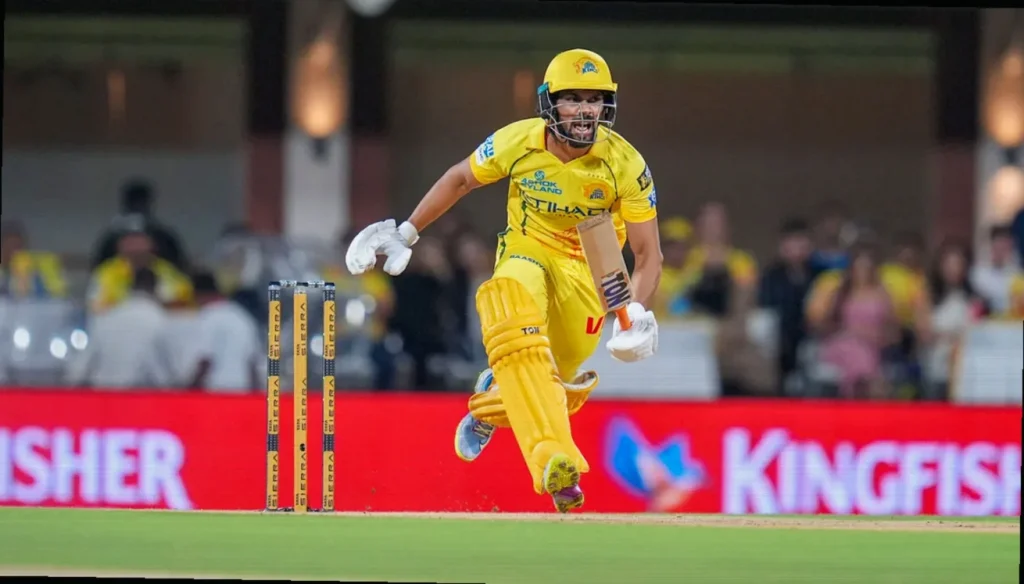
Ruturaj Gaikwad’s IPL 2026 start has been steady but not explosive, with innings of 6, 28, 7 and 15 alongside a strike rate of 103.70. Until Chennai Super Kings (CSK) overcame Delhi Capitals (DC) on Saturday night, his batting looked like a close reflection of the form of the side he captains. Former India batter Wasim Jaffer and Aaron Finch both believe the opener’s approach needs an adjustment—less caution, more intent—so he can influence games more quickly at the top of the order.
Key takeaways
- Gaikwad has opened IPL 2026 with scores of 6, 28, 7 and 15, compiling a strike rate of 103.70.
- Jaffer says Gaikwad should be prepared to “take a lot more risk” if the scoring rate is required.
- Finch argues the issue is largely a “mindset” problem rather than a lack of skill.
- Both former players want Gaikwad to think about maximum impact on the match, and not just accumulating runs.
- Gaikwad’s injury disruption in IPL 2025 and limited T20 action ahead of the IPL is part of the backdrop to his recent rhythm.
What Jaffer and Finch said about Gaikwad’s approach
Wasim Jaffer, speaking on ESPNcricinfo’s TimeOut show, framed Gaikwad’s role as an opener as a chance to set the tone early rather than simply grind. He suggested that an opener doesn’t need to aim specifically for totals like 80 or 100 immediately, but must deliver the kind of opening that batters want—fast enough to control momentum. Jaffer also noted that Gaikwad is not currently playing at a 200-plus strike rate, and if the team asks him to accelerate, he must take more chances. In Jaffer’s view, Gaikwad clearly has the ability, with IPL hundreds to his name, yet he “holds himself” back rather than pushing the scoring pace when the situation demands it.
Aaron Finch added that the problem can’t be reduced to technique alone. He likened the scenario to pairing a batter who can be aggressive with someone at the other end who can strike quickly. Finch said that if Gaikwad were getting the right kind of support, his batting could allow the partnership to set up the middle order—either by scoring a string of 60s and 70s, or by managing strike so a more attacking partner can take on the bowling. However, Finch believes Gaikwad is currently doing neither: he isn’t giving the side a strong, fast start, and the scores are not big enough to create a decisive impact in games.
Finch’s overall point was echoed by Jaffer’s emphasis on mental flexibility. He explained that Gaikwad’s long-term habits have been built around “bulk runs”—the idea of “get runs, runs, runs”—and that shifting toward a T20 mindset is essential. For Jaffer, the key is changing the question a batter asks while batting: instead of focusing only on accumulation, the opener should constantly ask what the biggest effect on the match can be, and how quickly he can create it. He contrasted this with younger players who grew up in the T20 era, who have learned to take risks with a simpler mindset—“whatever happens, happens; I’m just going to take them on.” Jaffer suggested Gaikwad, and others with a more traditional emphasis on big scores, need a mindset shift to play with that same willingness to attack.
Injury disruption and CSK context
Gaikwad’s recent cycle has included setbacks that may explain why he hasn’t found his usual rhythm. He missed most of IPL 2025 because of an injury, which meant MS Dhoni returned as captain after the leadership handover. In the Syed Mushtaq Ali (T20) Trophy, Gaikwad featured in just one game for Maharashtra. Soon after, he was selected for India’s ODI squad to face South Africa at home, where he made 105 in the second ODI, even though the match ended in a losing cause for his team. After that, he played List A and first-class cricket for Maharashtra, but he had not been involved in T20 cricket for a stretch prior to the start of the IPL.
Despite being part of CSK since IPL 2020, Gaikwad’s scoring profile has not always matched the pace expected from a top-order batter in the modern T20 game. He has produced major totals for the franchise, topping 400 runs in three seasons and also registering two centuries. Still, his season strike rate has not gone beyond 150 in any season except 2025—though that year he played only five matches, which limited his ability to build a sustained high-tempo run of performances.
Jaffer later returned to the theme of “tunnel vision,” saying Gaikwad’s batting currently resembles a mindset focused on scoring big. He drew a comparison with Virat Kohli, pointing out that Kohli has changed his game over time. Jaffer suggested Ruturaj can make a similar adjustment, but he must place “impact” ahead of the mere bulk of runs. The message from both former batters is clear: Gaikwad has the talent to take control early, and now he needs to apply it with more risk and sharper intent.
