
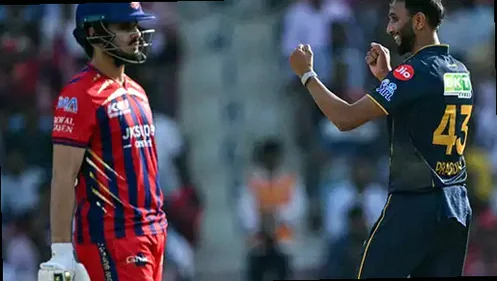
Prasidh Krishna has already collected the Purple Cap in IPL 2025 and is carrying that momentum into IPL 2026 as well. What stands out, though, is where his impact is concentrated: instead of relying on the early overs the way many frontline quicks do, he has built his biggest returns during the middle phase. That pattern was on full display in Lucknow on Sunday, helping Gujarat Titans register their second win of the season.
Quick facts
- Prasidh Krishna won the Purple Cap in IPL 2025 and is leading the wicket race in IPL 2026
- In the match in Lucknow on Sunday, GT secured their second win of the season
- LSG were 60/2 after six overs, with Aiden Markram in fluent form
- Prasidh struck in the seventh over to shift the game
- LSG scored only 50/3 in the middle-overs (5.55 RPO), including 29 dot balls (53.7%)
- Prasidh has 15 middle-overs wickets since IPL 2025; next best among seamers in that phase is Hardik Pandya with 10
- In IPL 2026, GT have used him heavily in Overs 7–15, targeting key batters across orders
- GT’s back-of-a-length or shorter plan yielded 5/44 off 46 such balls
- LSG, meanwhile, conceded 57 runs off good-length deliveries (ER 10.36) in their first three games
After six overs, LSG looked comfortable at 60/2, with Markram timing the ball well. The shift came when Prasidh entered in the seventh over and immediately attacked the hard lengths that suit his strengths in T20 cricket. Markram managed two boundaries in that spell, but the third attempt ended with a dismissal—caught after a mistimed pull.
Prasidh’s next over brought another breakthrough when Ayush Badoni was sent back. With Rashid Khan operating from the other end with tight accuracy, the hosts’ progress stalled quickly. In the middle phase, LSG managed just 50 runs for the loss of three wickets—an output of 5.55 runs per over—while dot balls piled up at 29 (53.7%). Even a late push lower down the order wasn’t enough to steer them to a defendable total.
Since IPL 2025, Prasidh has taken 15 wickets specifically in the middle-overs. Among seamers during that same window, the next-highest tally in this phase belongs to Hardik Pandya, who has 10. Looking across the two editions, among the 11 bowlers who have bowled at least 15 overs in the middle phase, Prasidh is top for average and strike rate. Only Jasprit Bumrah has a better economy rate (5.05), along with stronger dot-ball and boundary suppression figures—Prasidh’s marks in this area stand at 45.9% dots and 8.33% boundaries.
GT’s middle-overs blueprint
Another key part of the story is how GT have structured his overs. The franchise has used Prasidh as a middle-phase enforcer in a similar spirit to how they deployed Lockie Ferguson during their title-winning 2022 campaign. That season, Ferguson bowled half his overs in the middle phase and finished with only three wickets, but his control gave Rashid the platform to do the damage from the opposite end.
Prasidh’s role, however, has been more wicket-taking and less purely restrictive. His dismissals in Overs 7–15 for GT have included Shreyas Iyer, Nicholas Pooran, Marcus Stoinis, Shashank Singh, Riyan Parag, and Ayush Badoni—alongside middle-order batters. He has also removed batters higher up the order who were set at the time, such as Markram (twice), Sanju Samson, Rishabh Pant, Vaibhav Sooryavanshi, Ishan Kishan, Karun Nair, Tilak Varma, and Patthum Nissanka.
The match plan on Sunday was also consistent with how he operated last year. In this game, all four of his wickets arrived via hard-length deliveries. That approach fed into the larger GT attack strategy: across the innings, the team collectively produced 5/44 from 46 balls pitched at the back-of-a-length or shorter area.
LSG’s counterpart, meanwhile, leaned on good-length bowling as well. Across their first three games, they delivered 33 balls at good length which initially helped them, especially with the new ball, but the same line proved expensive on Friday—costing 57 runs at an economy rate of 10.36. They also pitched 22 shorter deliveries, which is less than half of the 46 such balls GT offered.
That difference mattered in the middle of the chase: one of LSG’s shorter offerings played into an extended 84-run stand between Shubman Gill and Jos Buttler. By the time LSG tried to test the opposition’s middle-order again, it was already too late, exposing an unstable period in Gujarat’s batting depth.
All stats correct until Match 19: LSG vs GT end
