
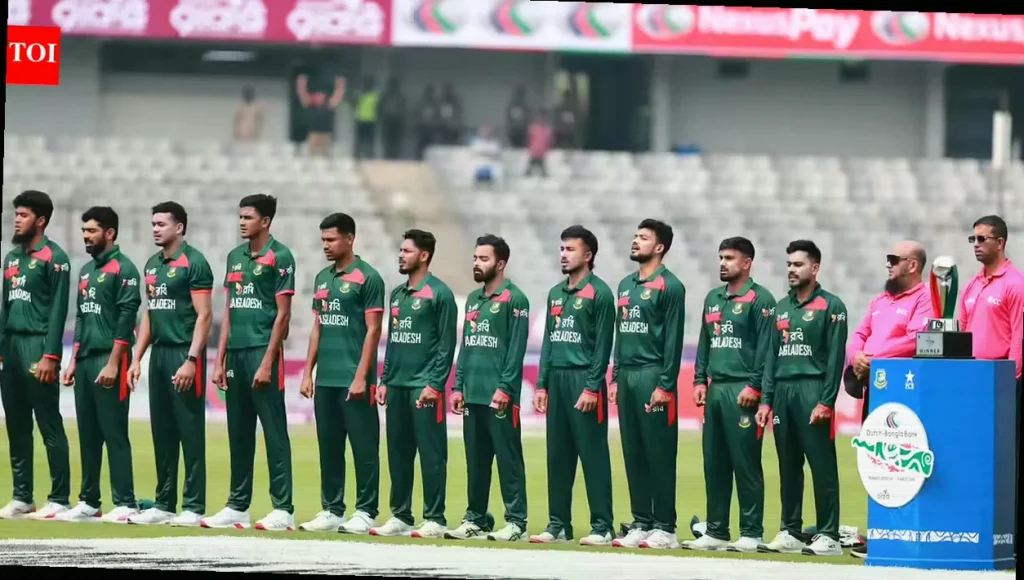
The Bangladesh Cricket Board (BCB) appears to be standing at a delicate junction: it has been laying out plans meant to project steadiness for the game in the country, yet it is also confronting a rising tide of governance uncertainty. The picture has been sharpened by decisions announced after the fourth meeting of the Board of Directors in Dhaka on Saturday, where the board tried to balance long-range cricket development with the need to address an unfolding administrative situation in the present.
Leadership continuity and a renewed coaching push
One of the most significant announcements from the meeting was the board’s decision to keep key leadership roles in place across formats. Mehidy Hasan Miraz has been retained as Bangladesh’s ODI captain until the ICC Cricket World Cup 2027, while Litton Das will continue to lead the T20I side through to the ICC Men’s T20 World Cup 2028. To add depth to the captaincy structure, Najmul Hossain Shanto and Saif Hassan were appointed vice-captains—Shanto for ODIs and Hassan for T20Is respectively—moves that the BCB said are aimed at providing continuity and clarity during a crucial phase for Bangladesh cricket.
The board also moved to strengthen its coaching resources. Former spinner Mohammad Rafique was appointed as a specialist spin-bowling coach and consultant for a one-year term. Rafique, widely regarded as a pioneer in Bangladesh cricket, is expected to focus on developing spin skills not only for the senior group but across pathways as well.
There was also a nod to recent on-field momentum under Mehidy’s leadership, with Bangladesh recording prominent series triumphs against West Indies in 2025 and against Pakistan earlier this year. Alongside team appointments, the BCB approved a new Human Resources policy intended to bring greater transparency and efficiency to internal processes. It further announced the launch of two digital tools—the Player Data App and the Cloud Server App—designed to support performance assessment and enable more data-led decision-making.
Resignations raise fresh questions over the board’s future
Yet the governance side of the story has continued to worsen even as cricket-facing decisions were being made. On Saturday, three directors—Saniyan Taneem, Mehrab Alam, and Faiazur Rahman—submitted their resignations. With their exit, the total number of departures from the current board has risen to six.
The resignations add to concerns that already existed within the organisation. Their move followed the earlier resignation of Yasir Mohammed Faysal Ashique, intensifying talk of internal disagreements. Before that, Amzad Hussain and Ishtiaque Sadeeque had also stepped down, citing personal reasons.
To understand what led to the turbulence, the BCB has set up an investigation committee, which is expected to deliver its findings by April 9. After the report is submitted, the government will determine how the board should proceed. With the uncertainty growing, there is also speculation that the board could be dissolved, and that an ad hoc committee—potentially led by a former Bangladesh captain—may be kept ready as a contingency plan.
Alongside these internal developments, the BCB has been trying to reset another important relationship: its ties with the Board of Control for Cricket in India (BCCI). The relationship between the two boards had deteriorated after Bangladesh withdrew from the T20 World Cup, with security concerns cited at the time.
Tensions sharpened further when Mustafizur Rahman’s participation in the IPL became a flashpoint. That controversy eventually contributed to Bangladesh being replaced by Scotland in the tournament. The fallout did not remain confined to the global event, as it also affected bilateral cricket plans. Bangladesh’s women’s tour of India was cancelled, and uncertainty continued to hover over India’s planned white-ball tour of Bangladesh in September.
In an attempt to restore normalcy, the BCB has reached out to the BCCI with proposals for renewed engagement and exchange programmes. Nazmul Abedin, the chairman of cricket operations, said he is hopeful that a response will come soon, describing the outreach as part of standard communication between cricket boards.
