
Sunrisers Hyderabad turned a strong batting platform into a crushing bowling statement as they defeated Rajasthan Royals by 57 runs. SRH posted 216/6, then dismantled a Royals line-up that had been rolling after a four-game winning streak, bowling them out for 159. The chase never truly got going; once the early breakthroughs arrived, Rajasthan’s momentum and confidence were stripped away so quickly that the result was essentially settled within the opening three overs.
SRH’s 216/6 and RR’s fast collapse
Rajasthan entered the match believing 217 was within reach, backed by form and a deep batting group. While SRH’s total of 216/6 was substantial, it was not presented as an unreachable figure. However, the innings changed character almost instantly when SRH introduced Praful Hinge with the new ball.
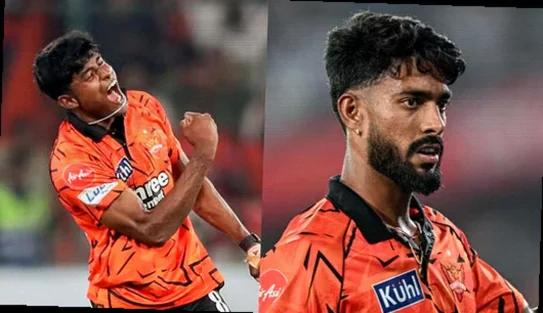
Praful Hinge and Sakib Hussain: the debutant duo that decided it
Hinge delivered a start that set the tone for the entire contest. In his first over, he removed Vaibhav Sooryavanshi, Dhruv Jurel and Lhuan-dre Pretorius, delivering one of the most punishing opening spells by a debutant in the tournament. He then struck again, dismissing Riyan Parag later in the innings to finish with figures of 4/34. By the time he was done, the top order had been wiped out, the chase had barely progressed, and the middle phase was forced into survival mode rather than chasing.
Sakib Hussain ensured the damage did not leave any room for recovery. He struck early by dismissing Yashasvi Jaiswal, then returned later to remove Donovan Ferreira, Jofra Archer and Ravi Bishnoi. His final bowling figures read 4/24. If Hinge’s burst broke the chase, Sakib’s spell slammed the door shut and prevented any meaningful rebuild. Across both phases, the two newcomers combined for eight wickets and completely dismantled Rajasthan’s innings.
How “match worth” was calculated — and why the value stood out
The most eye-catching aspect of the night was not only what the bowlers did, but what they returned in value terms. In this match, the combined investment by SRH in Praful Hinge and Sakib Hussain was ₹6 lakh, while their combined “match worth” translated into ₹2.57 crore for the franchise.
Why Praful finished with the higher overall return
Both bowlers had the same auction price and each cost SRH ₹3 lakh for this game under the season-state logic. Both also took four wickets, yet Praful Hinge produced the higher overall monetary return. The reason lies in how wickets are weighted in a context-based impact model: not all dismissals carry the same leverage depending on when they happen and how they affect the batting structure.
- Praful’s wickets arrived right at the top, when Rajasthan’s chase was still structurally intact.
- He did not merely remove batters from a collapsing innings; he broke the innings’ framework.
- By taking out three batters in his opening over and then removing the captain soon after, he forced RR out of an attacking rhythm and into damage control before they could settle.
- Sakib’s wickets were also highly valuable, but they played a slightly different role: tightening the pressure so the innings never recovered or even threatened a brief scare.
The model behind the numbers
The player’s match worth is not determined solely by wickets or economy. It is derived from an impact score that prices a performer’s actual effect in the specific match context. Bowling impact is influenced by factors such as the quality of wickets, the phase of the innings, how much pressure the bowler creates, dot-ball control, and the cost of runs conceded. Batting and fielding contributions are included where relevant. That total impact score is then converted into a monetary value relative to the player’s auction price and the effective amount invested for the match.
- Praful Hinge and Sakib Hussain were both ₹30 lakh buys.
- Since this was SRH’s fifth league match, the effective match-day investment for each was ₹3 lakh.
- Praful’s impact produced match worth of ₹1.49 crore, translating into SRH profit of ₹1.46 crore on him.
- Sakib’s impact produced match worth of ₹1.14 crore, translating into SRH profit of ₹1.11 crore on him.
- Together, SRH spent ₹6 lakh and got back ₹2.63 crore in match worth, for a total profit of ₹2.57 crore.
What ₹2.57 crore profit means, and why this night mattered
That combined profit is significant on its own, but it becomes even more striking when expressed through familiar purchasing comparisons. The return SRH made from these two bowlers in a single match was enough to buy roughly 573 PS5 Slim consoles, 158 Royal Enfield Hunter 350 bikes, or 215 Galaxy S25 Ultras.
Those comparisons are not the core point. The real story is what they reveal about roster efficiency. SRH extracted premium match value from the lowest end of the auction spectrum. In pure efficiency terms, it was the kind of game franchises hope for: a small cost, a massive swing in outcomes, and control over the result.
A match that can reshape a season
In IPL, big totals and headline names often dominate discussion, but seasons can also be redirected by low-cost players who seize a game with such authority that expensive pieces become secondary. That is what SRH accomplished here. They needed a result, and they needed it against an opponent building serious momentum. SRH’s batting provided the base, but it was the debutants who turned a competitive chase into a rout.
For one match, SRH spent ₹6 lakh on the pair. In return, they claimed a 57-run victory, with eight wickets taken between them, and generated a profit of ₹2.57 crore. In a tournament where margins can swing quickly and small edges often decide outcomes, it was not just a good performance—it was a clear auction-value statement.
