
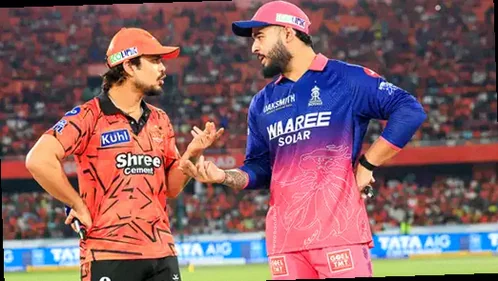
Since 2024, Sunrisers Hyderabad’s batting blueprint has revolved around one idea: overwhelm during the Powerplay, then keep expanding until the chase becomes a formality. Their success has rarely been accidental. In most of their 200-plus totals from this period, the openers have provided brisk momentum early, forcing opponents to defend too much, too soon.
Quick facts
- SRH have scored 200-plus in 15 innings since 2024.
- In those 15 innings, Travis Head has 650 runs at a strike rate of 187.86.
- In those 15 innings, Abhishek Sharma has a strike rate of 227.24.
- On average, SRH have been 77/1 at the end of the Powerplay in these 200-plus games.
- This season, SRH crossed 200 for only the second time without a meaningful contribution from their openers.
- At the Chinnaswamy earlier, SRH made 201 after managing 18 off 17 between Head and Abhishek.
- Against an unbeaten RR side, SRH posted 216 after getting 18 off 19 from Head and Abhishek.
- The Powerplay totals in the 216 chase were 49/3 and 51/1 (as cited for SRH’s standards).
Abhishek Sharma is typically the spark that turns good starts into match-breaking ones, while Travis Head operates as the partner who keeps the pressure steady—only “second fiddle” in relative terms. When SRH have reached the 200-mark, Head and Abhishek have often driven the scoring rhythm, with the openers building a base and then stretching the innings beyond ordinary limits.
That pattern makes the latest performance stand out. For just the second time this season—and seldom in this stretch—SRH managed to breach 200 without a proper impact from the top two. Even though their openers were not the main engine, the franchise still found enough momentum elsewhere to push the total into a commanding zone.
How SRH still found 200-plus
Earlier at the Chinnaswamy, Head and Abhishek combined for just 18 runs off 17 deliveries, yet SRH still got to 201. The same theme repeated against an unbeaten Rajasthan Royals side: again, it was 18 off 19 between the openers, but SRH ended up at 216. Those numbers underline how their batting has evolved into something more than a two-man Powerplay machine.
To be clear, the Powerplay itself was not overwhelming by SRH’s own yardstick. The totals referenced for their Powerplay output were 49 for 3 and 51 for 1—respectable, but not the kind of dominant start that usually accompanies their biggest scores. In 2024 and 2025, SRH reached 200 with a Powerplay under 65 only once more, which is part of why this innings felt different.
Rajasthan, though, appeared to attack a specific weakness they believed they could expose. Their right-arm seamers—Jofra Archer, Tushar Deshpande, and Sandeep Sharma—targeted Ishan Kishan’s body, a channel that had previously troubled him, with three dismissals coming in 19 balls last season. This time, Kishan was ready. When the plan was aimed at the leg-side line, he turned it into scoring territory, cracking 27 off 12 while being targeted there.
From there, Heinrich Klaasen made the kind of impact that has become his signature in T20 cricket. He read the spin matchup and then disrupted it decisively, with Ravi Bishnoi—then the tournament’s leading wicket-taker—being struck for 21 off 10. One over taken away, and Rajasthan’s middle-overs control started to unravel.
That shift mattered because SRH then piled on 78 runs across five overs spanning 9 to 13. By the time they reached 216, the innings still carried an edge of discomfort: SRH’s bowling group, described as light on experience, was being asked to handle the season’s most explosive Powerplay unit in Rajasthan.
Rajasthan’s Powerplay threat and the plan that backfired
Rajasthan entered the contest with an intimidating early rhythm. Across their first six overs in those referenced innings, they averaged 14 runs per over and lost only one wicket across four innings. In three of those matches, the contest had effectively been decided inside the Powerplay—largely because both openers were able to set the pace and then keep it.
That is where the game turned. In this match, both Rajasthan openers were dismissed inside the second over, dragging the side into a phase it has largely tried to avoid this season. Dhruv Jurel and Riyan Parag have not been the quickest starters against spin, and Shimron Hetmyer’s recent T20 returns have pushed him higher in the order; in this case he was sent in at No. 5, a role he had grappled with last season.
Donovon Ferreira carried the pressure as the innings moved forward, with Ravindra Jadeja misfiring at No. 7 and only Jofra Archer left to follow. Once the early buffer from the top order vanished, Rajasthan struggled to bridge the gap with the middle overs, especially against an SRH side that could still convert its momentum into a defendable total.
SRH’s bowling challenge, however, remains a reminder that T20 games can flip quickly. Rajasthan’s ability to accelerate from the start has been a major weapon all season, and this is the kind of off day a team would much rather take early than later—before the tournament enters the phase where small slips and sudden reversals tend to decide entire seasons.
