
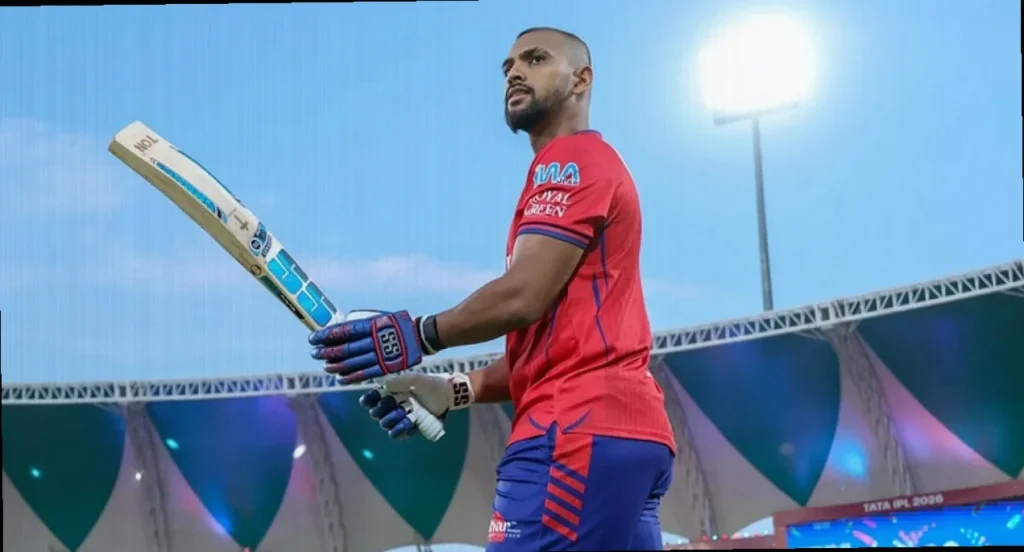
Nicholas Pooran wasn’t ready to walk out of the nets at Chinnaswamy. He had just taken apart a run of five straight deliveries, sending each one racing beyond the ground with a clean swing, crisp timing and a follow-through that looked almost effortless. About half an hour into his hitting session, with the rhythm clearly set, the ground staff moved in to dismantle the nets—only to pause when instructions arrived that Lucknow Super Giants were not shutting training down yet, and Pooran would continue batting past the planned cut-off of 8.30pm.
Once the message landed, the staff fell into line behind the nets and simply watched as the next balls disappeared over the boundary. The scene felt repetitive in the best possible way, as if they were seeing the same outcome again and again—contact, lift, and the ball vanishing into the night. Even with their own work delayed, it was hard not to watch, because Pooran appeared to be working inside his own bubble, swinging with intent at almost anything that came his way.
You could understand the reluctance to leave. This season, the sensation of bat on ball—and the sheer joy that comes from watching sixes fly—has not arrived as regularly as it has in the past. Yet when he was in motion, the evidence was unmistakable: he struck through yorkers, attacked length with the kind of confidence that makes bowling plans feel pointless, and dispatched full deliveries with a dismissive flick that suggested he was always one step ahead. For close to thirty minutes, the ball kept finding new corners of the ground.
When he finally called it a day, a few members of the staff crossed over to offer thanks for the entertainment. Pooran returned the gesture with a grin, then gave his willow a quick tap in the middle, as if to mark the moment he’d rediscovered the sweet spot.
But training sessions don’t always translate immediately into match production. Across four IPL 2026 innings, Pooran has managed 41 runs at a strike rate of 85, the lowest among batters who have faced at least 30 deliveries. The concern deepens against pace: his average stands at 5 with a strike rate of 63 versus fast bowling.
The latest outing against Gujarat Titans captured that struggle in miniature. Dismissed by Prasidh Krishna, Pooran skied a slower bouncer softly toward mid-off. In Ahmedabad, he made 19 off 21 balls, with 12 of those deliveries going untouched. His strike rate was only lifted by two consecutive sixes off Rashid Khan, but the rest of the innings never truly got going.
Of course, this isn’t the same Pooran who arrived with a reputation for taking games apart. He was a defining force in the previous season, scoring 527 runs at a strike rate just shy of 197 and breaking attacks with ferocity and freedom, often operating at No. 3. He is also the same player who surprised many by stepping away from T20 internationals at the peak of his form. Even so, since 2024, only Abhishek Sharma has hit more sixes than Pooran.
Since IPL 2025, though, there has been a visible dip in his output across multiple T20 competitions, including MLC, CPL, SA20 and ILT20. The numbers show him settling in the 130s and below more often than he would like. For perspective, between June 2024 and the end of IPL 2025, his strike rate sat at 164.
In a way, Pooran’s downturn echoes Lucknow’s batting problems more broadly, something their director of cricket Tom Moody has acknowledged. Still, within the franchise, there is a strong belief that a reversal is close. The camp’s view is that the class is already there—it’s only a matter of timing and rhythm.
Moody was clear about that mindset. “Obviously, Nicky is fully aware of the slow start he has had,” he said. “We’ve got absolutely 100% confidence in what he brings to the table. As I say, class is permanent.”
He added that venue conditions can sometimes unlock the right instincts. “I’m sure that the opportunity at a place where batting can be something that top-order players can enjoy—the size of the ground, the surface—could well be the tonic that Nicky Pooran needs. Everyone knows he is a world-class player. He can have a little lean patch, but look out for the counterpunch.”
So far in this IPL, Pooran has been dismissed while setting up pace in three of his four innings, and it has sharpened attention on specific details of his technique. Against Delhi Capitals, Lungi Ngidi removed him with a slower ball that dipped. Kolkata Knight Riders also made life difficult with hard lengths, similar to the way Prasidh Krishna troubled him earlier.
Former India batting coach Sanjay Bangar offered a technical explanation that focuses on movement up front. He suggested that Pooran’s front-foot action may be slightly overdone, narrowing his options against pace and pushing him into repeatable patterns.
“He is just planting his front foot down the pitch and only wanting to play from there,” Bangar said on ESPNcricinfo Time Out. “If that movement of his front foot can be a little bit shorter, maybe that will allow him to transfer his weight on the back foot as well. In that process, if he comes inside the line of the ball, it’s much better because by doing that, he can also play behind square. At the moment, a big stride down the pitch anticipating the fuller ball and only wanting to play off the front foot and then looking to play the pull shot irrespective of pace or line—that’s something he can look at.”
Sometimes, familiar surroundings are exactly what a player needs. Pooran averages 74 and strikes at 218 at the Chinnaswamy, and it is easy to see why LSG would want this return to Bengaluru to awaken the best version of his batting. If he can translate the same confidence from the nets into the middle overs and powerplay moments, this could become the platform he uses to drive his season back into top gear.
