
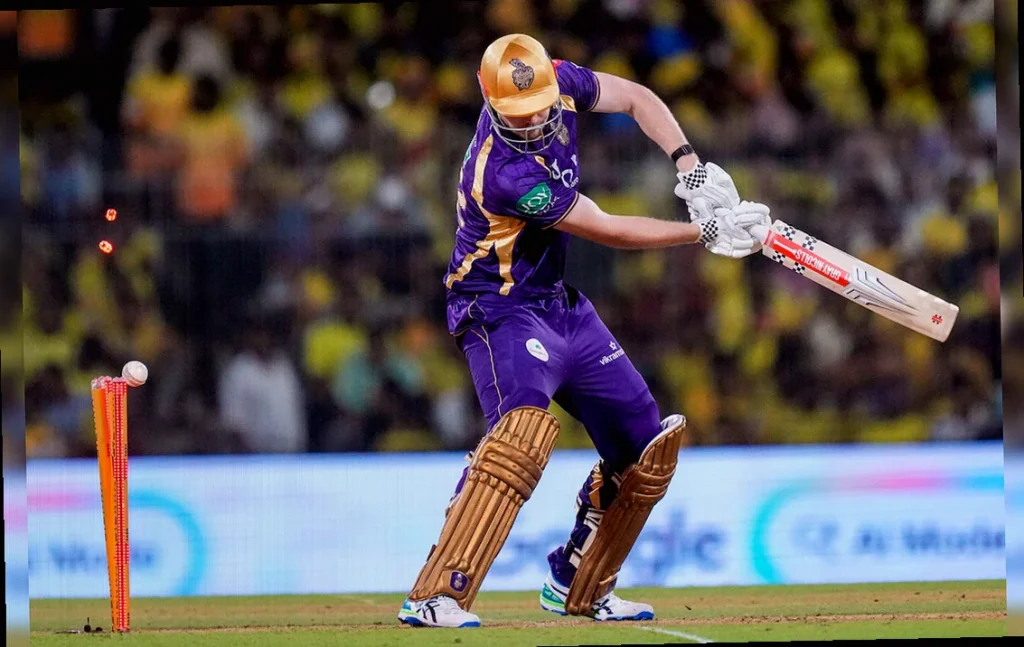
After the opening stretch of the IPL season, Kolkata Knight Riders are standing on just one point from their first five outings. That solitary return came from a no-result washout against Punjab Kings, while the other four fixtures have ended in defeats.
The situation is especially uncomfortable given KKR’s approach at the IPL 2026 auction. The franchise entered the bidding with the biggest available budget, going in with a purse of more than ₹60 crore, and then backed that commitment with several marquee acquisitions, including Cameron Green for ₹25.20 crore, along with Finn Allen and Tim Seifert.
Quick facts
- KKR have collected 1 point after five matches due to a washed-out game vs Punjab Kings.
- KKR lost the other four matches.
- At the IPL 2026 auction, KKR had the maximum purse of over ₹60 crore.
- High-profile signings included Cameron Green (₹25.20 crore), Finn Allen, and Tim Seifert.
- Green has bowled in only two of five matches and taken just one wicket.
- Green’s batting scores so far: 18, 2, 4, 32* and 0.
Green was signed with the expectation that he would add balance to KKR’s setup, contributing in both disciplines. So far, though, his impact has been underwhelming—particularly with the ball, where he has delivered in only two games and has managed a single wicket across those appearances.
With the bat, his returns have also been inconsistent. In the five matches played, he has registered scores of 18, 2, 4, 32* and 0, failing to establish the kind of rhythm KKR would have hoped for from a player bought at a premium.
Sehwag pushes for a change
Former India batter Virender Sehwag believes KKR’s management should stop hesitating if the team’s best interests require a call. He argued that if a player has not delivered despite the investment, then it is better to acknowledge the misfit and adjust rather than persist.
In his view, the decision becomes complicated mainly because of the price tag. Sehwag suggested that if you pay ₹25–27 crore for a player and they become a “liability” on the field—whether through lack of bowling returns or insufficient batting output—then the franchise should be prepared to make a tough selection call.
He also addressed the fear of public criticism. Even if the benching decision leads to questions about why the money was spent, Sehwag maintained there is “no shame” in accepting that the purchase did not work as intended. He pointed out that Green’s presence has not yet improved the overall combination, with neither his batting nor bowling offering the lift KKR expected.
Sehwag then floated a specific alternative: give Tim Seifert a chance higher up the order while dropping Green. His reasoning was simple—Seifert can be deployed immediately in a role where KKR need productivity, and the shift can be made without losing momentum in the batting card.
To strengthen the suggestion, Sehwag referenced Seifert’s recent success for New Zealand, saying those aggressive opening displays showed what the team might unlock with the right top-order pairing.
He proposed a batting reshuffle as well: bring both openers in together, then slot Ajinkya Rahane at number three. After that, he suggested moving Powell to four, and pushing Raghavanshi further down the order. The idea behind the structure, as Sehwag explained, is contingency—if Rahane departs early, Raghavanshi can be the next option, while if another wicket falls sooner, either Powell or Rinku can come in to keep the batting flow going.
