
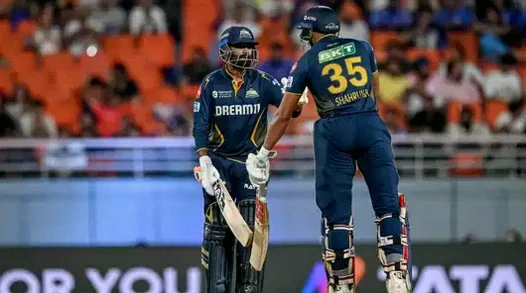
Ahmedabad is beginning to feel like the IPL’s version of the Impact Player era has taken root: totals are climbing, batting looks deeper than before, and the chasing side rarely feels that a modest number will be enough. In this setting, 210 has started to resemble what 170 used to represent at other venues—an elevated baseline rather than a standout. That’s why Rajasthan Royals’ total of 210 felt, for a stretch, like something Gujarat Titans could chase with comfort. With the match moving into the second innings, Titans were at 84 needed from 12 overs and holding on to eight wickets—an arrangement that usually signals control. Yet the script turned quickly, as a collapse arrived in a way that began to resemble a recurring theme: five wickets lost across three overs, followed by a lower middle order that could not recalibrate when the game demanded it.
The warning signs were already visible earlier in the season. In their opening match against Punjab Kings, Titans started with momentum—sitting at 119 for 2 in the 14th over—only to finish the innings at 162 for 6 from the 20 overs. The final five overs brought just 34 runs, and notably there were no sixes struck during that phase. It was the kind of finish that exposes how much a team’s planning depends on the top end delivering when the swing phase arrives.
To understand why this matters, it helps to revisit what Titans managed in IPL 2025. While many franchises tried to spread risk across the batting order, Gujarat operated with a deliberately top-heavy approach. Shubman Gill, Sai Sudharsan, and Jos Buttler each crossed 500 runs, and all did it with strike rates above 150. Even more telling was that at least one of them was getting time in the death overs (16 to 20) in 12 of their 15 matches, giving the innings a reliable engine right where most teams are forced into improvisation. That repeatable production is what allowed their middle order—often more volatile—to remain within acceptable boundaries.
The numbers add weight to that paradox. In IPL 2025, Titans’ batters ranked strongest across positions #4 to #8, posting a strike rate of 162.71, and they were also among the fastest to build momentum early. Their first five-ball strike rate of 150.43 was well ahead of the next best side by 15 points. But the same period also came with a sharp trade-off: their balls-per-dismissal ratio was among the lowest in the league, at 13.1. In plain terms, the innings were built on high-risk hitting—made possible by the buffer created at the top of the order. When the early group performed, the later part of the innings could absorb uneven returns.
Within that framework, the impact of dismissals was blunted because the top three did the heavy lifting. Gill and Sudharsan were especially influential in the death overs alongside Buttler. Around them, players such as Shahrukh Khan, Rahul Tewatia, Washington Sundar, and Rashid Khan were asked to play roles that carried plenty of variance—lower balls per dismissal, inconsistent outputs, but still usable because the team’s structure rarely needed those batters to rescue the innings early. The system depended on timing and on the top end creating a platform that could withstand a few setbacks.
Now, the same blueprint is looking less dependable. Gill, Sudharsan, and Buttler all arrived for this season carrying less T20 momentum than the form they showed in 2025, which makes a direct repeat of the old template difficult to imagine. After just two games, that risk has already started to show. With the middle order receiving earlier entry points, the batting side has faced longer stretches against spin than these Indian batters would normally prefer. That mismatch showed when Ravi Bishnoi used his angles effectively, getting two wickets against the two southpaws with googlies that disrupted their rhythm.
Personnel changes have not fully solved the imbalance either. Sherfane Rutherford has departed—one of the more effective enforcers in this phase since the SA20 last December—and that loss removes an element of insurance during the critical middle-to-death transition. Glenn Phillips is not presented as an immediate like-for-like replacement for that specific role, and neither are the bench options, with Tom Banton and Jason Holder offering alternatives but not a ready-made fix for the structural gap. Titans’ model has always been a calculated gamble: prioritise stability at the top, keep wickets in hand, and accept volatility underneath. But when the top weakens even slightly, the volatility stops being a controlled feature and starts acting like the fault line.
