
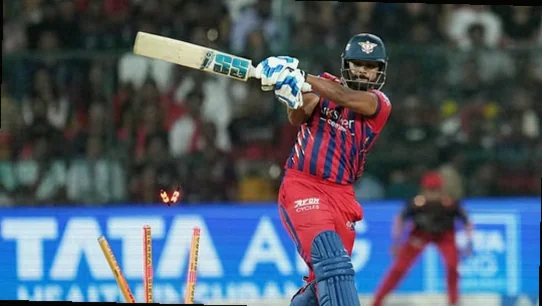
Lucknow Super Giants’ loss to Royal Challengers Bengaluru on Wednesday carried more than just a second defeat of the season—it also sharpened the financial unease surrounding one of their major decisions for IPL 2026. Nicholas Pooran, kept on a ₹21 crore retention deal as one of LSG’s most destructive T20 batsmen, lasted only seven balls and scored 1 before the innings collapsed. LSG posted 146, and RCB chased the total in 15.1 overs, adding another heavy entry to a ledger that is starting to read poorly.
Key takeaways
- LSG were bowled out for 146 against RCB, with Pooran contributing just 1 off seven deliveries.
- RCB completed the chase in 15.1 overs, turning LSG’s batting troubles into a decisive result.
- Pooran’s match in this game is valued at ₹0 in a match-worth framework, against a per-game cost of ₹1.5 crore.
- Across five matches, Pooran’s total match value is estimated at ₹31.13 lakh versus ₹7.5 crore in exposure, leaving a running deficit of ₹7.19 crore.
- In five appearances, Pooran has delivered value in only two matches, with three outings producing ₹0.
Pooran’s early exit, and why it stung LSG more than usual
Pooran’s dismissal—caught for 1 after dragging Josh Hazlewood back onto the stumps—would have been disappointing in any context. But for LSG, this was the sort of night where they needed far more from a player carrying elite retention value. It was not a typical high-scoring Chinnaswamy-style chase where one failure can blur into the background. The track played slower, the seamers found enough purchase, and the middle overs required steady judgment and clean execution.
Pooran did not provide that control. In the match-worth framework referenced in the analysis, the innings produced a match worth of ₹0, turning the outing into another full-cost, zero-return performance. The financial impact is what makes Wednesday’s dismissal feel larger than the scoreboard.
Retention value turning into a season-long gap
The broader issue is becoming hard to ignore. Over five matches this season, Nicholas Pooran has returned a combined match worth of only ₹31.13 lakh in the model. Against that, the cost exposure is ₹7.50 crore, leaving LSG with a running deficit of ₹7.19 crore. For a retention fee of ₹21 crore, this is not simply underperformance—it is the kind of gap that starts to become a defining storyline of the campaign.
The pattern of returns makes the situation even more uncomfortable. Pooran has delivered value in just two of his five appearances. One match returned ₹20.04 lakh, while another brought ₹11.09 lakh. The remaining three have produced ₹0—meaning Wednesday’s innings against RCB lands in the growing group of zero-return games. Taken together, it is no longer only about one poor stretch or one unusual failure; it looks like a trend building over multiple matches.
This is where the conversation shifts from vague labels like “out of form” or “rusty” into a more precise comparison: premium money being paid, and almost nothing coming back so far. The numbers suggest LSG are carrying a premium bet that has not delivered the expected output.
Why RCB’s chase made the loss feel harsher
The match context mattered. LSG were not simply overpowered by an unplayable surface, but the conditions clearly demanded better decision-making and sharper execution than what players typically need on a standard Chinnaswamy night. RCB’s seam bowling made those demands count, and Hazlewood’s control forced Pooran into an early problem.
That is the expectation attached to expensive middle-order retentions. Franchises do not spend ₹21 crore on a top-order or middle-order game-changer for routine chases or flat decks. They pay for awkward nights, for rescue opportunities, and for innings that can reverse momentum when the match tightens.
That is why Pooran’s 1 off 7 takes on extra weight. LSG needed a stabiliser with bite—someone who could either withstand pressure or respond aggressively. Instead, they received an innings that hurt them twice: first during the chase, and then in the investment ledger. In the model, Pooran’s per-match cost sits at ₹1.5 crore, so every zero-return game lands with full force. After three such matches in five, the red ink begins to resemble a major concern rather than an early-season wobble.
The core problem isn’t one bad game—it’s what the retention was meant to buy
The bigger concern for LSG is not that Pooran has had one poor outing. It is that he was retained as one of the engines of the side, and right now he is not close to justifying that role. This does not mean his season is beyond repair. Few players in the league can swing a campaign in a short window the way Pooran can, and his reputation rests on proven impact rather than inflated hype.
But exactly because that track record is real, the current returns feel even more uncomfortable. A proven match-winner is not merely supposed to start quietly; he should be generating one of the tournament’s sharper investment gaps. At the moment, that is not happening.
Through five matches, LSG have effectively carried a ₹7.19 crore running loss on one of their biggest bets. That is a tough position to be in this early, particularly while the side is still working to settle its batting order and protect its middle overs.
The match-worth model: how the numbers are calculated
The balance sheet is built using a match-worth model designed to estimate how much value a player contributes in a game, then compare it against what that appearance costs the franchise. The starting point is the player’s full-season price. Pooran’s ₹21 crore retention is converted into ₹2100 lakh.
That total is then divided across an expected appearance denominator, producing a notional per-match cost. For Pooran, the rolling match cost is ₹150 lakh. From there, the model evaluates his on-field actions in the match. Batting contribution is a key component, and bowling and fielding are also factored in where relevant for batters. There are also controlled adjustments such as a manual rating, captaincy effect, and a synergy element when applicable. These factors are combined to create a normalised impact score for the match.
The impact score is then translated into a match worth in lakhs. This figure represents the model’s estimate of the value generated in that specific game. The final comparison is straightforward: the match worth is weighed against the per-match cost. If the worth is below the cost, the game is treated as a loss for that match. If it is above, the player has produced surplus value.
In Pooran’s case versus RCB, the match worth is recorded as ₹0 lakh, while the per-match cost is ₹150 lakh. That means the game adds another ₹150 lakh to LSG’s running loss on him. Read in that way, the balance sheet becomes direct: what the player cost for the match, what he returned, and how wide the gap was.
