
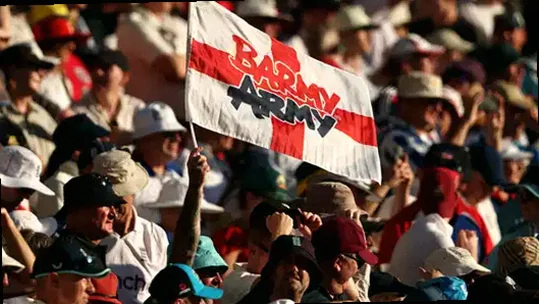
When the England men’s football team travels overseas, locals often brace for rowdy scenes and street-level trouble. Cricket, though, brings a different kind of spectacle. During England tours, many supporters are drawn less by conflict and more by the colour, camaraderie and collective energy of the Barmy Army—an atmosphere that can be heard, seen and felt in stadiums from one continent to another. The contrast becomes even more intriguing because a noticeable number of those same cricket faithful are also passionate fans of England’s football set. Yet, for all the noise and the devotion, the organisation insists its culture is built around inclusion, personal safety and fitting in with host communities rather than provoking trouble.
Adam Canning, who spent time as a Barmy Army member before taking charge as the group’s commercial and operations director eight years ago, framed the mission in straightforward terms. “It’s quite hard to explain, but we’re a community built on inclusivity, safety, fun, enjoyment, and integrating with the communities we travel to,” he said. Canning pointed to the idea that the group’s values were meant to survive growth, not get diluted by it. “We will continue to have an amazing time and continue to support the team through thick and thin. We’ve tried to maintain those values throughout our growth. There are no negative connotations to our behaviour. It’s really well self-policed.”
That self-policing, he added, is not left to chance. Members are meant to protect the reputation they take pride in, and if there is any early sign that something could go wrong—or if one individual might endanger the group’s tone—intervention is handled internally by the supporters themselves. “People who are part of the Barmy Army are really proud of that reputation and will do everything they can to make sure they maintain that reputation worldwide,” Canning said. “So if there ever is even a slight inkling that something might be about to happen or there’s one individual who might compromise the group, it’s managed in-house by the members themselves. That’s something we’re really proud of.”
With political divisions increasingly sharp across the United Kingdom, the question naturally arises: what happens when individuals don’t see eye to eye? Could supporters of Jeremy Corbyn on one side and Nigel Farage on the other simply coexist because they share the same T-shirt? Canning’s answer was that the Barmy Army is designed to sit above those kinds of divides. “The Barmy Army operates outside of politics, and outside of football rivalries,” he said. He referenced a well-known song sung by members when something controversial threatens to surface, adding, “There’s a famous song of ours that members sing if anything gets brought up that’s irrelevant and might cause conflict. It goes, ‘We’re only here for the cricket…’”
He argued that cricket—and the way England supporters rally around it—creates a unifying force that other environments can struggle to replicate. “I think we unite people in a way that other things and other sports can’t,” Canning said. “Our members share a passion for cricket, England, travel and fun, and nothing can pierce that. So the answer [to the Corbyn-Farage example] is yes.” In his view, the community can bring together people from sharply different backgrounds, even where their politics and even their football allegiances differ. “You could have a lawyer who’s just sold his business for hundreds of millions of pounds sitting next to a painter and decorator with completely different political views. They support different football teams. They come from very different walks of life. But they’re Barmy Army members. That’s what unites them and that’s where they find their common ground. When you see that materialise and manifest itself on tour it’s pretty special.”
Instead of criticising football crowds, Canning leaned into what he sees as cricket’s distinctive spirit—particularly the ability to enjoy the day even when the result doesn’t go England’s way. “Cricket’s one of those sports where you can have an amazing time and an amazing experience despite the result,” he said. “You’re not influenced necessarily by what’s happening on the pitch. Our culture and values have been born on the fact that it was set up in Australia when England were losing heavily, like they do the majority of the time there.”
The origin story, as it is often told, begins with a moment of inspiration during the 1994/95 Ashes in Australia. Australia were moving toward a first-day stumps score of 329/4 at the Gabba when Dave Peacock—an England supporter who had accepted redundancy from his job to pay for his trip—decided the best response to the jeers from home supporters was to turn the stadium walkways into a performance. Peacock, then 27, led a conga line of six, marching along a concrete passage and chanting, “We came here with our backpacks, you with ball-and-chains!”
With the convict reference landing as an insult, the crowd reacted with anger. Peacock and his companions were targeted with verbal abuse and a range of missiles, beer included. But once the English supporters made it back to their seats, the mood shifted—other fans welcomed them as returning heroes. The conga line went again, this time with more songs aimed at Australia. Australia won the match, but the English supporters walked away with the party. The same spirit carried into the second Test in Melbourne, where Peacock moved through the aisles of the MCG holding up an AUS$20 note and promising it to any Australian who could help him and his mates make the crowd laugh.
Peacock later wrote that he never lost that AUS$20, recalling the moment in a LinkedIn post in January of the previous year. By the time the series reached the fourth Test in Adelaide, the group had developed into something more organised, with Peacock joined by Paul Burnham and Gareth Evans, who had helped establish what was then referred to as “Mike Atherton’s Barmy Army.” England went into that match 2-0 down, but they won. The supporters’ place in England’s cricket culture became even more secure when Alec Stewart invited Peacock onto the players’ balcony to celebrate the visitors’ only success of the series.
Not everyone welcomed the spectacle. Ian Wooldridge—an influential figure in cricket journalism—raised the issue in the Daily Mail, questioning whether “there was no Australian law under which you get them ejected for breaching the peace of a crowd of 50,000.” Peacock checked with the ACB, and was told no such law existed. “The Barmy Army was never planned,” Peacock wrote. “I was just very lucky; right place, right time. It’s as simple as that.”
What began as a simple idea—to sell branded T-shirts to finance travel and watching England play—has since transformed into a far larger operation. The modern version of the concept is estimated to generate around US$8.5 million in revenue each year, maintains a database of roughly 60,000 members, and boasts about 2.1 million followers on social media. It also employs 20 full-time staff.
Canning described how the business has been built out to support both travel logistics and marketing. “We run a marketing division; we’ve got a digital marketing element to our business,” he said. “We’ve got a full travel operations team, a finance function, a sales function and a couple of other businesses that we run,” he added. Among those are Joe Root’s academy and another travel venture designed for a slightly different audience—supporters who may not want to travel with the Barmy Army as a group. There is also what he called a teamware business.
In explaining the term, Canning referenced the idea of “teamware” as collaborative software tools intended to help virtual or remote teams operate effectively. He said this slow-burning expansion was necessary to keep both the brand and the business alive. “This slow-burning expansion was something that needed to happen in order to keep the brand and the business alive,” he said. “It was a lifestyle business in the 90s and the early 2000s, and the guys who founded it and ran it did a great job in building an amazing brand, an amazing following, an amazing community and something that was really special in the world of cricket.”
He continued by describing how the digital era enabled further growth. “And then, five or 10 years ago, through the growth of our digital following, we were able to build a much bigger audience, a much bigger membership and a travel business,” Canning said. “The opportunity to take the Barmy Army into travel was a natural next step to make sure that we continue to deliver amazing experiences for our members. It’s still a community and a members-first organisation. But in order to grow and make sure that we could sustain our following we had to invest and grow different potential revenue streams.”
A visible milestone in that evolution came when the organisation’s long-serving trumpeter, Billy Cooper, stopped playing. His last Test appearance was at the Wanderers in January 2020. After that, the search for a replacement was handled openly. “We advertised,” Canning said. “If you’re a trumpeter and you like cricket, let us know… We got hundreds of applications.” The chosen musician was Simon Finch, trained at London’s Guildhall School of Music and Drama. Finch has performed at Glastonbury and shared a stage with Beyonce and Eric Clapton, and when he isn’t working around cricket, he can be found in the orchestra pit of a West End musical.
From conga-line beginnings to West End musicians, Canning’s own planning work has taken on a meticulous, almost logistical character. He was interviewed in Cape Town as he prepared, in detailed fashion, for an expected arrival of 10,000 Barmy Army members for England’s tour of South Africa in December and January. He was scheduled to fly to Johannesburg on Wednesday to repeat the planning process there. Still, he stressed that the story has not been one of seamless expansion.
The Covid-19 pandemic, he said, “nearly led to us going out of business.” With travel and live sport effectively on hold, the organisation had to find a way to remain connected. “We just managed to keep our heads above water. We weren’t able to travel or watch live sport,” Canning said. “But we knew how important shared experiences were for our community. We wanted to keep engaged with people and give them some sort of fun content. So we started Barmy Army TV [a YouTube channel].”
He also highlighted the diversity of the fan base, pointing to the presence of juniors and a female share that he put at 35% of membership. When supporters travel overseas, he said there is a significant contingent of women joining the trips specifically for a sense of belonging and safety. “It’s not just what some people around the world envisage, which is a misrepresentation of 50-year-old men who love drinking beer,” Canning said. “There are some, clearly, but there are also families, couples, and solo travellers.”
Finally, Canning addressed a practical issue for overseas tours: what the Barmy Army gets up to when beer is harder to come by, as in Pakistan, Bangladesh and Ahmedabad where alcohol restrictions apply. “Sometimes you have to negotiate behind closed doors to get a crate of beer into a hotel in an unofficial room or somewhere in a basement,” he said. “But people who travel the world understand that different cultures have different expectations on behaviour. And they are respectful and will abide by the rules and regulations and ingratiate themselves with the locals.”
In other words, even when the party has to adapt to local rules, the organisation’s guiding idea remains the same: no matter the destination, members are expected to keep the tone friendly, the experience shared, and the attention on cricket rather than trouble.
