
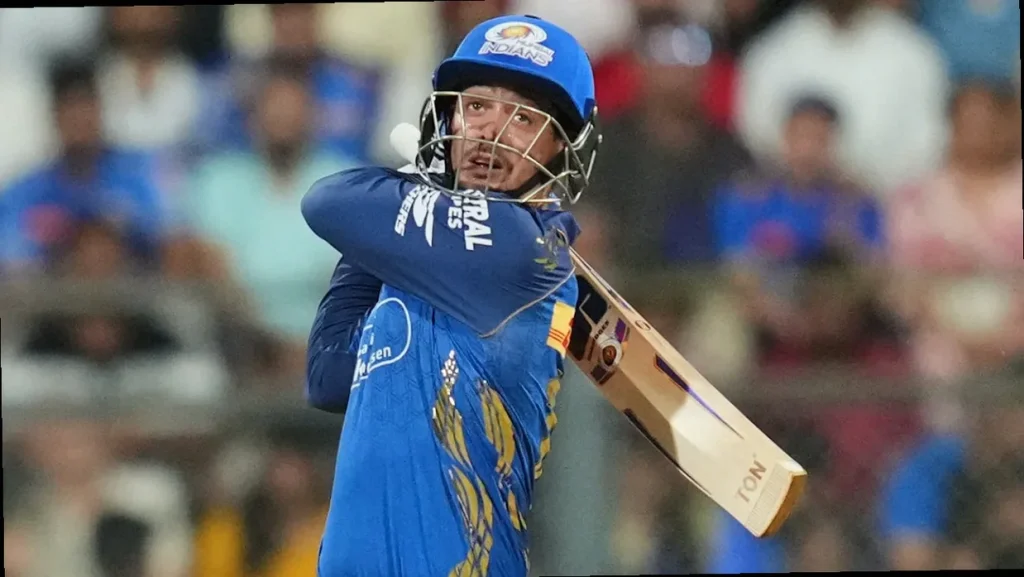
Quinton de Kock looked like the same player Mumbai Indians backed during their title streak—yet the story behind his return is anything but ordinary. Brought back for IPL 2026 after Rohit Sharma was forced to miss the match with an injury, de Kock stepped in at the top and produced a defining innings against Punjab Kings (PBKS) on Thursday night, making it feel as if time had stood still.
De Kock’s return sparks a classic MI start
Rohit’s unavailability meant de Kock came in for his first appearance of the season. He opened with South African teammate Ryan Rickelton, who had been preferred ahead of him in that opening stretch. The pair’s intent was clear from the outset, and de Kock quickly took control of the innings.
De Kock struck a brilliant 112 not out off 60 balls—the second century of the IPL season—finishing with eight boundaries and seven maximums. His approach drew praise even from those who have seen him operate in different roles and formats over the years.
Finch highlights the mindset: “content” rather than “prove”
Australia batter Aaron Finch suggested that what made de Kock’s knock stand out was not just the boundary count, but the mental freedom behind it. Finch framed de Kock’s mindset as calm and settled, rather than driven by any need to audition for a future spot.
- Finch said de Kock understands he is likely to be in a support role behind Rickelton when Rohit is available.
- He described de Kock as relaxed when he gets an opportunity, comparing his composure to a player whose heart rate and focus remain steady.
- Finch argued that the innings showed a man at peace with where his career stands—able to back his skill without getting overwhelmed by what might come next.
In that context, de Kock’s century wasn’t presented as a desperate bid to force his way back into the XI, but as a confident execution of his craft when the timing aligned.
Career twists: from retirement from ODIs to a new MI chapter
De Kock, now 33, has had a complicated recent timeline. He reversed an earlier decision to retire from ODI cricket in September 2025. He had already quit Test cricket, and although he had not officially retired from T20Is, he had not been selected by South Africa for a period after the 2024 T20 World Cup.
That changed in November 2021, when de Kock returned to South Africa’s T20I squad and Rickelton had to make way. Earlier this year, de Kock was also part of the T20 World Cup campaign, despite being well below his best during the tournament.
MI’s selection call and the match details vs PBKS
MI head coach Mahela Jayawardene defended the team’s earlier preference for Rickelton over de Kock after the PBKS match. When questioned about why Rickelton started and why de Kock wasn’t included earlier, Jayawardene pointed to the narrow margins involved in team selection and the importance of competition within the group.
He also referenced Rickelton’s earlier impact and explained how decisions shift when the moment is right. Jayawardene’s message was clear: de Kock did not need to rush the process—he waited, then delivered when called upon.
- Jayawardene said the coaching staff asked about Rickelton’s selection from the first game, and that there was a specific reason behind it.
- He noted that competition inside the squad is a positive, as long as players acknowledge the situation and put their hands up when opportunities arrive.
- Jayawardene added that when the time came, de Kock was played and he “patiently waited” before executing a standout innings.
- He emphasised the need for everyone to be firing early in the season, with hunger and intent in the middle.
For context, Rickelton has only reached double figures once since his earlier innings against KKR.
How MI’s innings unfolded after de Kock’s century
Despite de Kock’s 112—scored at a rate of 186.66 in the MI innings—Mumbai Indians did not cross the 200-run mark. Naman Dhir added a 50 from No. 4 at a strike rate of 161.29, while Hardik Pandya contributed 12. Those were the only other scores in double figures for MI.
MI’s finishing overs were the difference-maker: in the final four overs of their innings, they managed only 35 runs. De Kock faced ten of those balls and scored just 17 runs, meaning the momentum was not sustained—even though he was crucial in taking the innings to the point where MI had a platform to build from.
- De Kock scored exactly half the balls in the innings—his 112 came off 60 deliveries.
- MI’s total momentum slipped in the last four overs, where they scored 35 runs.
- During those final overs, de Kock faced ten balls and made 17 runs.
- De Kock’s century still fell short of pushing MI beyond 200.
Chawla explains the turning points
Piyush Chawla offered a clear breakdown of why the innings didn’t fully convert despite de Kock’s brilliance. He pointed to early wickets—Rickelton and Suryakumar Yadav—then explained how the presence of an experienced batter can affect intent immediately after the new ball.
- Chawla said wickets fell early for MI, including those of Rickelton and Suryakumar Yadav.
- He noted that for the other opener, it is difficult to attack straight away because the batter feels the need to bat deep to build a bigger total.
- He praised de Kock for preventing the run rate from dropping, saying he was always “there” and taking his chances when the ball came his way.
- Chawla highlighted that de Kock’s big shots applied pressure on the bowlers repeatedly, making his impact central to the innings.
Even with the late slowdown, de Kock’s 112 not out remained the defining storyline of the night—less a story of survival and more a reminder of how seamlessly he can produce when the opportunity finally arrives.
