
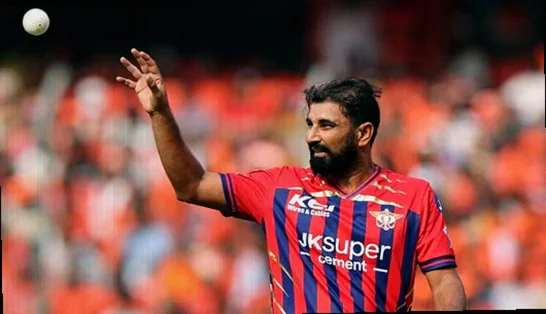
Sunrisers Hyderabad didn’t simply face a sharp start from Lucknow Super Giants—they encountered a familiar decision that was already set in motion months earlier. Mohammed Shami, traded from SRH to LSG ahead of IPL 2026 and returning to Hyderabad in the process, delivered the kind of opening burst SRH had expected to purchase when they secured him for ₹10 crore ahead of the 2025 season. However, the impact came in LSG colours, and it arrived on SRH’s home turf.
Key takeaways
- Shami finished with figures of 2 for 9 in his four overs at the Rajiv Gandhi International Stadium, maintaining an economy of 2.25.
- He accounted for Abhishek Sharma and Travis Head, with SRH slipping to 8 for 2 before their innings spiralled further.
- SRH managed only 22 runs in the powerplay, a major drop for a team that typically looks to attack early.
- After 9 overs, SRH were 31 for 4, largely shaped by wickets falling inside the first four overs.
- Shami’s spell proved more restrictive than any other LSG bowler who completed an over at the same stage, underlining his control.
The trade subplot sharpened the blow
This contest carried extra weight because it wasn’t just another fixture on the calendar. Ahead of IPL 2026, SRH agreed to send Shami to LSG in a deal that kept his fee at ₹10 crore — meaning SRH essentially moved on from an expensive senior pace option following a disappointing run, while LSG backed him as still a worthwhile investment.
That context matters because Shami’s single IPL season with SRH had been underwhelming relative to the cost. In IPL 2025, he appeared in nine matches and managed only six wickets. His bowling average sat at 56.16 and his economy at 11.23—numbers that pointed to a lack of frequent breakthroughs and insufficient control over scoring phases. The season also included a particularly brutal outing, when he returned figures of 0 for 75 against Punjab Kings, which was the second priciest spell in IPL history. For SRH, moving on purely from performance logic was difficult to argue against.
Why Shami’s spell hurt SRH beyond the wickets
What made the Hyderabad return sting wasn’t limited to the two dismissals. The timing of those wickets disrupted SRH’s innings structure almost immediately. Abhishek Sharma was dismissed at 0.6 overs, Travis Head fell at 2.1 overs, and Ishan Kishan was sent back by 3.3 overs. With three top-order departures inside the first four overs, SRH’s middle overs were forced into a survival mindset rather than an attacking one.
By the time Liam Livingstone was dismissed at 7.1 overs, the innings had already lost momentum. At the point Shami completed his spell, no other LSG bowler who had finished an over was as close to his level of control. Digvesh Singh Rathi had 1 for 10 in two overs, Prince Yadav had 1 for 1 in one over, Avesh Khan returned 0 for 4 in one over, and Manimaran Siddharth produced 0 for 7 in one. In effect, Shami didn’t only take wickets early—he squeezed the scoring rate so tightly that each new dismissal began to feel like it could be followed by another.
There was also an added layer of irony to the method. In the previous season, SRH had seen a version of Shami who leaked runs and rarely managed to clamp down on an innings. Yet on the same franchise’s home ground, LSG received the opposite—an experienced fast bowler who used the new ball to remove two left-handed batters, restricted the release of attacking shots, and kept the pressure on long enough to drag the opposition into a deep hole before the chase even had time to settle.
That contrast is what turns the trade into a haunting storyline for SRH. They released a bowler who had not delivered for them in 2025, and on this evidence, LSG may have obtained precisely the version of Shami SRH believed they were recruiting in the first place.
