
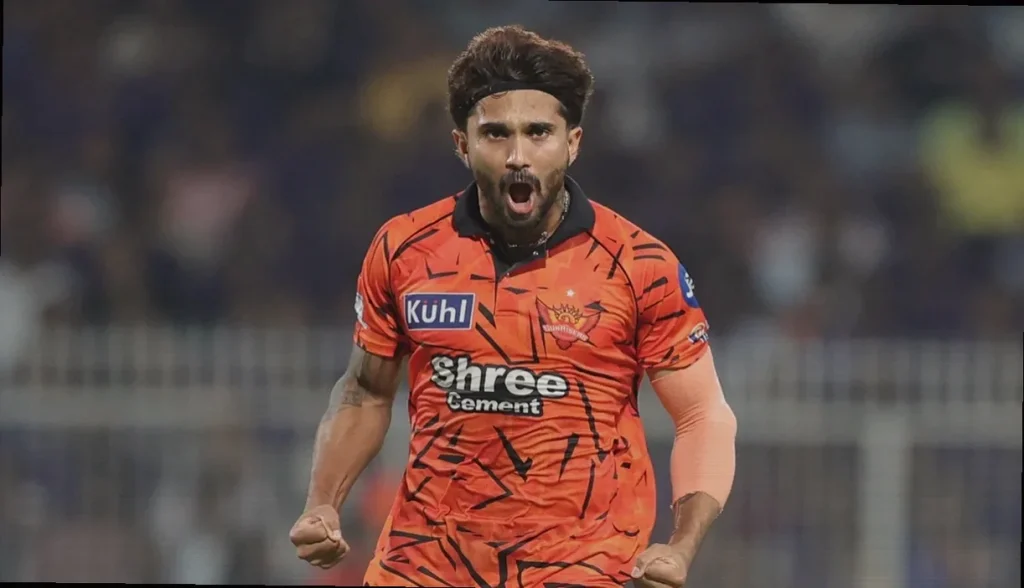
Nitish Kumar Reddy might not have thought much about it at the time, but some of his recent jump in pace during IPL 2026 has its roots in something as modern as doomscrolling. A string of fast-bowling clips and biomechanics content that kept appearing on his Instagram feed pushed him to look deeper into what actually creates speed, and that curiosity eventually turned into a structured coaching intervention.
In February, Reddy reached out to Steffan Jones, a former county cricketer who now works as a fast-bowling and high-performance coach. The idea began after the algorithm surfaced a series of videos focused on pace development and the science behind fast bowling. Intrigued by the clarity of the material, Reddy contacted Jones through direct messages, with the request routed via his manager, to explore the possibility of one-on-one sessions. Those sessions have now started producing visible, measurable improvements.
Last week, a speed gun recorded one of Reddy’s deliveries at 139 kph—an obvious step up from the mid-120s he was working with until fairly recently. Across his last five matches this season, he has bowled nine overs, already surpassing the total number of overs he delivered throughout the entirety of IPL 2025. While the exact figures vary from delivery to delivery, he has repeatedly touched the mid-130s, and the turning point is linked to a week-long camp with Jones held just before the IPL.
Jones says he learned about Reddy largely through social media, noting that he shares coaching knowledge online and that messages arrive from players seeking help when their schedules allow. After he received a note from Reddy’s side requesting cooperation, timing became the first challenge because the IPL was already underway. Even so, Jones was able to make arrangements because he was traveling to South Africa for work connected to his academy in Stellenbosch, where a week-long visit could fit.
Jones admits he knew little about Reddy at the start and had not watched him bowl closely. That gap prompted initial homework, including reaching out to people who could provide context, such as Zubin Bharucha, the high-performance director at Rajasthan Royals, as well as Rahul Dravid, the former RR head coach. With that groundwork in place, they agreed on a week-long programme at the Dravid Centre of Sports Excellence in Bengaluru.
Jones built the plan around the demands of contemporary cricket, where there is rarely a true off-season break. Compressing what might normally take a month into a single week meant he had to manage workload carefully and ensure the sessions aligned with when Reddy needed to peak. Over seven days, Jones designed 10 separate sessions, with each day planned around specific training and recovery needs.
For Reddy, the timing mattered. He said he understood it was a major season and felt he needed the work done before the IPL. He pointed to a frustration from the previous year: his athleticism was not translating into the bowling output he wanted—especially speed. That mismatch, he felt, was something he had to correct, so he chose to invest in himself and put the training under expert direction.
Part of Jones’s preparation involved studying Reddy’s footage in different formats. He reviewed videos shared by the allrounder as well as clips available through YouTube and social media. One particularly influential clip came from Australia, when Matthew Hayden mentioned during commentary that Reddy required more pace. Jones believes that message struck a chord.
Jones says his reputation in the game includes developing speed, having done so with Ishant Sharma as well. With that background, he focused on Reddy’s technique and knew that once they arrived together, the most important next step would be to test him physically and see how his body was responding in practice. Only after those checks could they move into skill-building with confidence.
Before the technical work started, Jones ran a series of athletic assessments to understand what was happening under the hood. They included jumps designed to measure lower-body power, medicine-ball throws aimed at assessing upper-body strength, and ball-velocity tests using heavy, light, and standard balls to establish a baseline. Video analysis also played a central role, with AI-supported tools, along with a machine system that tracked run-up speed, force, and movement patterns.
From those findings, Jones says the key details emerged. Reddy approached the crease on an angle with his pelvis aligned reasonably well towards the leg-side, but he spent too long on the back-foot contact. Jones also felt Reddy could generate more speed by running in faster and from a slightly further distance, changing the timing and the shape of the approach.
Jones describes Reddy as an outstanding athlete—“one of the best around”—and says the job therefore was not to reinvent him, but to fine-tune the technique and “wake up” certain muscle groups. In his view, speed gains are possible when you understand how the mind and the body coordinate to make muscles fire quicker. His coaching emphasis was on the mechanics of fast bowling: separating hip and shoulder action, driving the pelvis forward, and ensuring the upper body works over it. If a bowler runs in on an angle, Jones believes it can block the energy that should be going towards the batter.
To explain the theory further, Jones points to Jasprit Bumrah. He says the final four strides represent the power zone, which is why Bumrah can bowl at high pace with unusual efficiency—walking halfway into the run-up and then accelerating into the delivery stride. Jones estimates that around 20% of ball speed can come from the run-up itself. He and Reddy worked on those run-up and last-stride cues repeatedly, using constraints such as cones, twice a day, with varying intensity levels.
After the week was complete, Reddy’s bowling speed had climbed by roughly 10 kmph. Jones stresses that the exact number is less important than the visible difference, but he believes the short-term gains are real. He also notes that a week can create quick improvements that may not be fully stable yet, while a longer block—like a month—allows the process to become more ingrained. Their goal, he says, is to slow-cook the changes so they stick.
Jones also makes it clear that while speed was the primary headline, the work could not be isolated to one narrow element. They trained the full range of motion, including wrist position, seam alignment, swing development, accuracy, repeatable spell consistency, and gym-based power work. The philosophy, he argues, is closer to an “athlete model” seen in sprinting or javelin than to traditional cricket compartmentalisation.
Jones is currently in the USA for a coaching clinic, but he says he still has Reddy’s IPL plan fully mapped. His desk is covered with scheduling sheets that track both Reddy’s workload and Sunrisers Hyderabad’s timetable. The plan is detailed down to rest days, training windows, specific drill sequences, and even the number of repetitions—because speed gains only matter if they can be maintained through matches.
Jones also believes his ideas align naturally with the franchise’s coaching direction, after having worked briefly with Varun Aaron, SRH’s bowling coach. He describes it as a “natural sync,” which should help continuity in Reddy’s development. He says Reddy is following the drills even on rest days, focusing first on drills before skills and isolating what is wrong so it can be corrected properly. Jones adds that he is direct in feedback—telling Reddy when a slower ball costs runs, while also highlighting what he is doing well. Jones believes Reddy now looks different, and that he has the potential to become a top allrounder across formats, especially if he can keep bowling in the 140 kph range consistently.
For Jones, the impact of this partnership is not just limited to one player’s pace. He views individual coaching as the bigger shift happening in modern sport. He says he genuinely believes this approach is the future of cricket: players using their own coaches, while franchises continue to run with a head coach and a small supporting group. In that model, each player would carry their specialist coach with them around the world.
He questions who would control workloads for a bowler who plays for multiple franchises and who would be responsible for managing personal needs. Jones believes cricket has been behind other sports in this area, but thinks the game could change, comparing the direction to how baseball or the NFL operates.
For now, Jones’s focus is ensuring Reddy’s early speed gains become long-lasting improvements. He says he is keen to continue the relationship and believes Reddy is equally invested. Jones plans to travel to Hyderabad for the match against KKR on May 3, where he will meet Reddy and also reconnect with Varun Aaron. The aim, he says, is to agree on how the collaboration should work moving forward—so Reddy can be pushed consistently into the 140s and developed into one of the world’s leading allrounders.
