
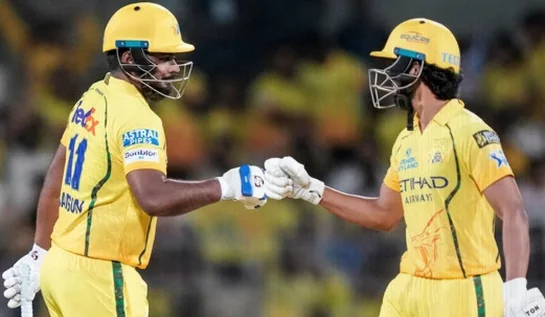
Chennai Super Kings sit seventh in IPL 2026 after 27 matches, with just two wins from their first six outings. Their most recent setback came against Sunrisers Hyderabad, a defeat that intensified focus on a batting line-up which looked close to finishing the job. CSK were only 84 runs short of victory with seven wickets still in hand off 60 balls, yet they ended up losing by 10 runs. It was a chase that should have been controlled—but the momentum slipped at the wrong time.
Behind the on-field disappointment is a more specific concern: the batting core of CSK is not delivering in both cricketing impact and financial value. Two players expected to anchor the top order—Sanju Samson and Ruturaj Gaikwad—are not merely experiencing rough patches. In this season’s “rolling worth” framework, their contributions are also driving the biggest losses for the franchise’s batting economics.
After six matches, Samson’s season ledger shows match worth of ₹2.51 crore and a rolling loss of ₹5.19 crore. Gaikwad’s figures stand at ₹78.70 lakh in total match worth, alongside a rolling loss of ₹6.92 crore. Combined, the duo has produced ₹3.30 crore in total worth while accounting for a combined rolling loss of ₹12.12 crore.
That scale becomes sharper when compared to the team’s overall position in the same model. Following match 27, CSK’s total rolling balance is -₹4.52 crore. In other words, Samson and Gaikwad alone are responsible for a deficit worth 2.68 times the overall team rolling loss. The only reason CSK’s broader squad numbers are not dramatically worse is that several lower-cost or lower-expectation contributors are generating better returns elsewhere.
Samson and Gaikwad are eating premium capital without enough return
CSK invested heavily ahead of IPL 2026, spending ₹81.60 crore on retained players. Gaikwad was central to that group, while Samson joined the franchise via a trade from Rajasthan Royals. Both are paid ₹18 crore, meaning together they account for ₹36 crore—around 44.1% of the total retained-auction spend that shaped the current squad.
When such a large share of premium money sits in the top order, the expectation is simple: consistent control, not scattered cameos. Instead, the returns have been thin and uneven.
Gaikwad’s season is the clearer warning. Over six matches, his best single-match worth is ₹38.82 lakh, while his total match worth is ₹78.70 lakh. In the model’s normalised impact measure, his average is 7.98—an output that falls short of what a batting “pillar” should produce. The pattern is of small, unstable gains from a player priced and placed to steer innings stability.
Samson’s profile looks different, but the problem is not automatically solved. He has produced at least one genuine match-winning surge: against Delhi Capitals, he struck 115 not out off 56 balls and helped CSK post 212/2, while Gaikwad contributed 15 off 18 in the same game. Samson’s model shows he generated ₹1.61 crore and a profit in that match.
However, that standout innings also hides a broader trend. In the remaining games, Samson’s impacts in the model are listed as -0.00, 0.39, 0, 62.54, and 4.86. That means there have been two high-return appearances and four low ones. For a premium asset, that still leaves the player spending too much time “underwater” in value terms.
CSK’s batting-side imbalance is heavily concentrated in those two names
The cleanest way to frame the issue is to separate team-wide batting damage from the specific burden of premium top-order failure. CSK’s batting-side total loss in this model is ₹11.95 crore. Samson and Gaikwad alone account for ₹11.69 crore of that figure—covering the batting contribution only. That implies 97.8% of CSK’s batting-side balance-sheet damage is tied to these two players.
That does not mean the entire team has failed in isolation. The real story is that two expected pillars are dragging down both batting output and batting economics, while the rest of the unit tries to offset the leak. Even so, the cost of the deficit remains concentrated.
Several supporting players have delivered meaningful positives. Jamie Overton (₹3.96 crore), Ayush Mhatre (₹3.82 crore), Sarfaraz Khan (₹3.82 crore), and Anshul Kamboj (₹2.94 crore) have all registered major value gains. The contrast is particularly clear with Ayush and Sarfaraz: neither arrived with the same level of top-order expectation as Samson or Gaikwad, yet both have produced stronger season scores and more favourable balance-sheet results.
That shifts the conversation away from “lack of effort.” The problem is that support pieces are being asked to overcompensate for two names who were supposed to set the batting floor themselves.
Expected pillars have turned into episodes, not foundations
Samson and Gaikwad were meant to shape CSK’s batting identity. Their role was to set the tempo in the early phase of each innings, absorb pressure when wickets fell, and keep risk manageable for the middle order. That has not happened consistently enough.
Gaikwad’s record is the harsher indictment because it lacks even one major corrective performance. Samson’s numbers can look more deceptive because a century can reshape perception quickly. Still, in value terms, one innings cannot restore a season when four other matches are burning cash and surrendering control.
This is why the Sunrisers Hyderabad defeat matters beyond the single result. CSK were deep enough into the chase to own the narrative. Yet the innings fractured at the point where established batters are expected to steady the game.
For a side already seventh after six matches, this is no longer random noise. It is a trend, and it is blunt. CSK’s secondary pieces are keeping the books alive, but the expensive batting pillars are not holding their end. The cost is not only lost money in a performance model—it is also a loss of stability across the season.
How the player “worth” calculation works
The model behind these figures uses a rolling monetary approach, rather than a simple runs-only or wickets-only ranking.
At the base level, each player’s match contribution is built from a normalised monetary impact score. That normalised impact is the sum of batting score, bowling score, fielding score, captaincy bonus, manual rating bonus, and synergy bonus. The model then records a match value in lakhs for that performance, before subtracting a dynamic cost allocation to arrive at each player’s rolling profit or loss.
The rolling per-match cost (in lakh) is calculated as: (price in crore × 100) / rolling cost denominator.
The denominator is linked to a rolling estimate of total appearances. It uses prior appearances, the current appearance, and expected future matches. In plain terms, the model spreads a player’s auction or retention price across a season-usage curve rather than charging the full amount blindly match by match.
After that, the profit/loss layer is calculated as: rolling profit/loss = match worth – rolling per-match cost. This is why a player can score runs and still end up negative—an innings must clear the cost threshold implied by the player’s price and projected usage.
Normalised impact reflects how strong the actual cricket contribution was within the model. Match worth in lakh converts that contribution into monetary value. Rolling per-match cost reflects what an outing effectively costs at that player’s price tier. Rolling P/L shows whether performance beat its price burden.
So Samson and Gaikwad are not being assessed against ordinary players. They are being judged against premium cost, premium role, and premium expectation. On that scale, both are underwater—and Gaikwad in particular is dragging the books further down.
