
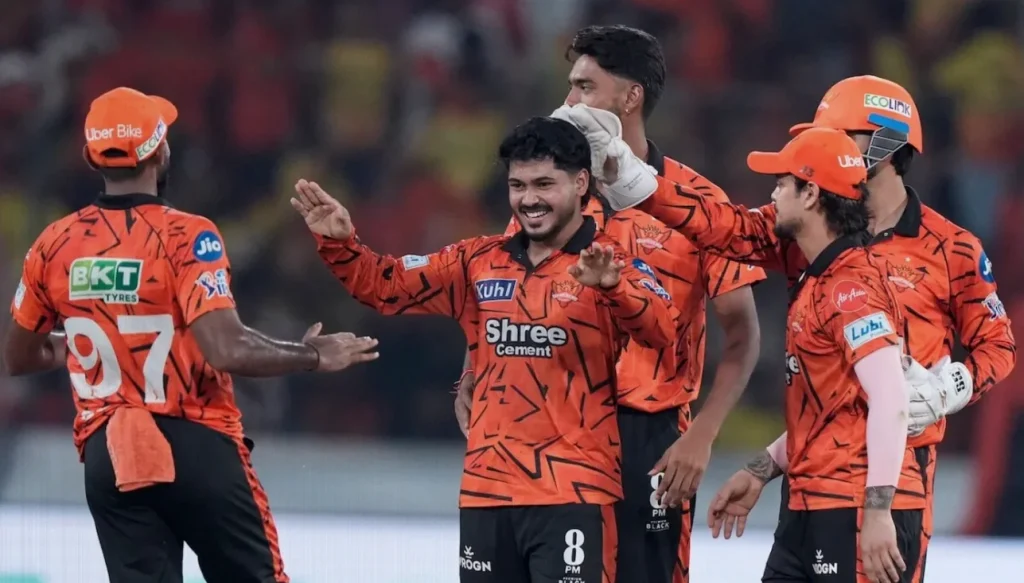
Eshan Malinga and Nitish Kumar Reddy grabbed the spotlight as Sunrisers Hyderabad held their nerve against Chennai Super Kings, finishing the IPL 2026 match on Saturday night with CSK falling just ten runs short. Yet it was the work of two other SRH bowlers—Shivang Kumar and Sakib Hussain—that quietly tilted the game at key moments, turning what looked like a straightforward chase into a tougher task for the defending side.
Shivang stepped in right after the powerplay and immediately tightened the screws, conceding only seven runs in that spell, then adding eight more in his next over and three in his final one, the 12th of the innings. He ended with figures of 1 for 18, taking the crucial wicket of Dewald Brevis—the sort of breakthrough that can completely change the tempo of a chase.
Ambati Rayudu praised Shivang’s mindset, highlighting the courage to bowl in the middle overs and force batters into mistakes. Speaking after the contest, Rayudu said it was “smart bowling” from the youngster—especially early on—pointing out that SRH have been calling for bowlers to be brave in the middle overs, to “toss it up there” and use that pressure to lure errors. Rayudu also felt Shivang’s spell was central to bringing the chase back in SRH’s favour, adding that CSK were in control after starting strongly with 76 for 3 after six overs while chasing 195, and they likely would have finished the job comfortably without that shift.
Rayudu’s assessment of the wicket was backed by Aaron Finch, who explained how Brevis was made to reach for the ball. Finch said the delivery was wide enough to stretch the right-hander, and that Brevis was on the back foot—so instead of timing cleanly, he was forced into the kind of position where he needs to get the bat away quickly. Finch noted that the batter had been “none of three” balls, which only heightened the urgency, and Shivang’s plan ensured Brevis couldn’t settle.
Finch went on to underline that it was not just about pace, but about understanding when and how to deploy variation. “Smart bowling” and knowing “when to use it and how to use that variation of pace” were the keys, and he singled Shivang out for executing that idea effectively.
SRH’s impact with the ball did not begin and end with Shivang, either. In their previous outing, two debutants—Sakib Hussain and Praful Hinge—were the bowling highlights for SRH, with both grabbing four-wicket hauls on their IPL introductions. Hinge, who was later named Player of the Match, produced a standout moment by taking three wickets in the first over of Rajasthan Royals’ chase, setting the tone immediately for his side.
Against CSK, though, Hinge had a harder stretch early, giving away 53 runs from his first three overs. Still, he recovered impressively as the chase evolved, conceding only seven runs in the final over using an around-the-wicket plan, and also taking the wicket of Jamie Overton to keep SRH’s pressure intact.
Sakib, meanwhile, had no such early wobble. His powerplay figures went for 13 runs, and he then conceded seven and six in his middle-overs spells. The most telling part came late: he allowed just six runs in the 17th over of the innings, while also removing Shivam Dube in that final over. Dube—who had been sitting at 21 off 15 balls and looked set to steer CSK across the line—could not finish the job after that dismissal.
Finch described Dube’s exit as a decisive moment, pointing out how it appeared the batter was shaping into the kind of closing role usually assigned to a true finisher at the back end—before getting out at the wrong time. He added that it was a strong sign of an inexperienced bowler learning exactly what was required in that phase, and he also spoke about the contrast between the two bowlers’ effects: Hinge’s great game followed by a tougher spell, then Sakib’s ability to suddenly shift gears and execute with precision using pace-off.
Finch explained the strategic advantage of that approach, noting that Dube tends to want the ball full, fast and delivered at a consistent pace, which makes it easier to clear the infield when the plan is repeated. By continually varying the delivery, Sakib disrupted that rhythm. Finch summed it up as “brilliant” execution—changing it up just when it mattered most.
Rayudu also pointed to another detail in Sakib’s bowling: the ball’s movement toward the right-handers. He said Sakib has a “unique action” that is not easy for batters to read early, and with support from the tail-end, the deliveries he bowled were the ones shaping away from the right-hander—or sometimes coming in just enough to catch a batter’s expectations off guard. Rayudu highlighted that Dube generally anticipates a wide yorker because that is often the length used against him, so Dube was surprised when the ball was bowled straight. Rayudu called it “the ignorance of youth,” but insisted it worked perfectly for SRH on the night.
