
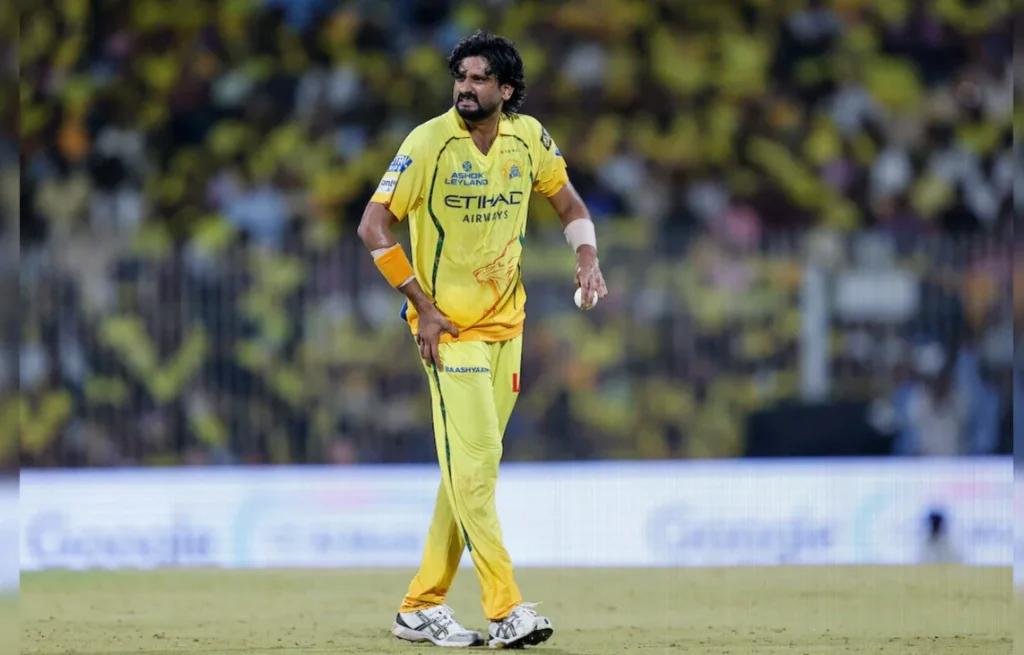
A season defined by injuries has dealt a heavier blow to Chennai Super Kings, with the troubles beginning earlier with MS Dhoni and Khaleel Ahmed, and now escalating through an additional setback involving Ayush Mhatre. The growing list of names in the medical room is starting to feel like it changes the team’s identity match by match, and each defeat only adds pressure to an already stretched squad. As IPL 2026 gets underway, CSK’s depth is being tested in a way that is leaving little room for error.
Why Khaleel Ahmed’s absence matters
The most inconvenient timing has come with the injury to their leading Indian pace option, Khaleel Ahmed. On paper, his output for the season looks modest, with two wickets across five matches. However, what he offers CSK goes well beyond those numbers. At the start of the campaign, Khaleel was used as CSK’s first-choice Indian quick, trusted to run in during the early phases and also capable of handling the pressure of the death overs.
As a left-arm seamer, he adds a kind of variation that is not replicated elsewhere in the bowling unit. That change of angle and rhythm has helped CSK maintain shape, particularly during the powerplay where tightening the game can allow the captain to build pressure from the other end. It is a role that often goes unnoticed in highlight reels, but it can decide how the middle overs unfold.
When Khaleel is not available, CSK have struggled to regain the same balance against SRH. In that contest, SRH surged to 75/2, and while Anshul Kamboj produced a strong wicket haul with three scalps, the side still could not recreate the control that Khaleel typically provides.
- CSK went into the season with Khaleel Ahmed as their main Indian fast-bowling option.
- He was deployed for the new ball and used again in the final overs, giving CSK both early control and late-threat.
- His left-arm pace brought a variation the rest of the attack struggled to match.
- That balance was especially important in the powerplay, where he helped keep things tight and let the skipper pressure the other end.
- Without him, CSK found it harder to manage SRH, who moved to 75/2, despite Anshul Kamboj taking three wickets.
The injury and the reshuffle
Khaleel’s setback is described as a grade 2 quadriceps tear, an issue that rules him out for the remainder of the season. The impact is visible, and it has forced CSK into a reshuffle that the squad has not fully settled into yet.
Gurjapneet Singh has been moved into a larger role sooner than expected. Mukesh Choudhary—still in the process of returning to full rhythm—has been asked to deliver consistently. Akash Madhwal has also joined the setup, but stepping into a different environment midway through a tournament is rarely straightforward.
There is a key difference between having names available in the squad and having bowlers you can trust when the match is at its most tense—especially when batters are hunting specific matchups and the margins for error shrink.
Pathirana’s missing role
That is where the absence of Pathirana hurts even more. Over the last couple of seasons, he has been CSK’s go-to option at the death, valued for his ability to land yorkers and for the unusual action that made him difficult to pick up, particularly in the final overs when results are often determined in a short window.
Without him, CSK have lacked a specialist who can finish innings with authority. To make matters tougher, the team has also moved on from him—an early sign that the balance of power within the franchise is shifting away from the old playbook and more toward a leadership style associated with Ruturaj Gaikwad.
Spin reliance and the pace gap
Beyond the death overs, CSK also do not currently have a clearly defined finisher with the ball. In the middle overs, they have leaned heavily on spin to maintain control and keep games from slipping away completely.
The spin group includes Rahul Chahar, Noor Ahmad, and Akeal Hosein. They have delivered in bursts, but with the exception of Noor, none of them is a guaranteed performer every time the opposition sets a target or presses for a breakthrough in key overs. As soon as conditions flatten out, the limitations of having fewer pace options becomes more obvious.
For Ruturaj Gaikwad, the loss of Khaleel Ahmed has reduced the flexibility to experiment with plans and adjust quickly to matchups. Opponents have started to take advantage of what they perceive as a weaker pace attack, pushing CSK into uncomfortable situations more often than they would like.
CSK’s campaign had started with a couple of early wins, but they have since slipped back into defeat. With each loss, the central question grows louder: whether the side can adapt quickly enough to injuries, and still find a combination that works—even when key roles are missing.
