
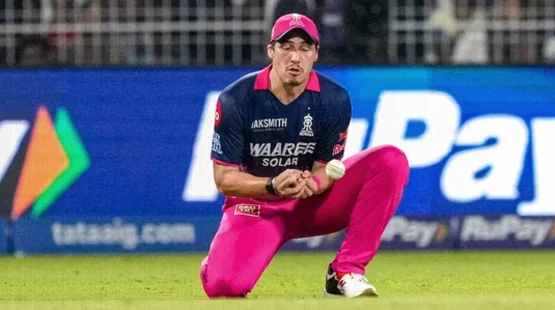
Kolkata Knight Riders’ maiden win of IPL 2026 swung on a lone fielding slip by Rajasthan Royals in Match 28. While chasing 156, KKR were struggling at 73/5 in the 11th over when Rinku Singh, on 8, was dropped at 10.6. Rajasthan had already disrupted the chase and removed much of KKR’s core batting group, but that missed chance gave Rinku the platform to steer the innings. He stayed put, finished unbeaten on 53, and helped KKR register a four-wicket victory—turning one let-off into a near ₹96 lakh swing in value.
Key takeaways
- KKR chased 156 successfully after Rajasthan missed a catch at 10.6 in the 11th over.
- At 73/5, Rinku Singh was dropped when he was on 8, changing the momentum of the chase.
- Rinku made 53* and scored 45 of the 88 runs KKR added after that missed opportunity.
- Rajasthan had reduced KKR to 70/5 by the 11th over, with multiple key batters already dismissed.
- Using an impact-based approach, the dropped chance is estimated to have cost Rajasthan about ₹95.9 lakh.
How the chase was fractured—and how it changed
Rajasthan had done plenty right before the turning point. Defending 155, they cut KKR down to 70 for 5 by the 11th over, with Tim Seifert, Ajinkya Rahane, Cameron Green, Angkrish Raghuvanshi and Rovman Powell already back in the pavilion. With so much of the batting unit dismantled, KKR’s task required stability, smart strike rotation and someone willing to bat deep—something they were not yet getting.
The pressure point arrived on the final delivery of that 11th over. Rinku Singh was batting on 8 at 10.6, when the chance was not taken. From that moment, the innings took a different shape. Instead of the chase tightening further with another wicket, Rinku carried on, added 45 more runs, and remained unbeaten. He effectively became the batter who controlled proceedings from there until the target was reached.
Rinku’s control after the drop—and the impact estimate
What made the miss so damaging was not merely that Rinku survived—it was how much value he produced after being given a second chance. KKR went on to score 88 runs after the missed opportunity, and Rinku accounted for 45 of them on his way to 53*. In other words, he contributed a little over half of KKR’s runs after Rajasthan failed to complete the catch, meaning the chase did not run on a “survive at one end” plan. It flowed through him.
That dominance also showed in the way he paced the innings. After being dropped, Rinku struck seven boundaries, including five fours and two sixes. In that stretch, he faced 25 balls. The knock was not limited to late hitting; he absorbed pressure through the middle stages and then released the innings once the chase came back under KKR’s control.
That is why the Royals will look back hardest at the wicket that could have come next. With KKR already at 73 for 5, another dismissal would not only have increased the ask—it would have forced KKR to lean on a much thinner batting group much earlier. Instead, Rajasthan handed the phase’s ideal customer an extra life, keeping Rinku at the crease when they needed the chase to wobble.
The impact-based framing makes the swing even more stark. Rinku’s total batting impact in the innings was 76.37, and 68.28 of that came after the dropped chance. Nearly 89.4% of his batting impact therefore arrived after Rajasthan failed to hold the catch. Put simply, almost the entirety of his innings value was created in the aftermath of that moment.
Rajasthan may revisit other details—boundary balls, fielding setups, or execution under pressure—but once this chance is isolated, it becomes the dominant reference point. At 10.6, the match was still alive for RR. After Rinku was reprieved, KKR’s most valuable batter at that stage remained in control.
Why the miss is estimated at nearly ₹96 lakh
The monetary estimation is built around a conservative approach: it counts only the batting value Rinku generated after the dropped catch, avoiding hypothetical “what if” endings. This values only the contribution Rajasthan kept alive by failing to complete the catch.
On that basis, the cost is estimated at ₹95.9 lakh. The method counts the batting impact points earned after the chance—Rinku was dropped on 8 at 10.6, and from that point to the end of the innings he produced 68.28 batting impact points. In this match’s calculation, each impact point is valued at roughly ₹1.4046 lakh. Multiplying 68.28 by ₹1.4046 lakh yields a post-drop batting value of about ₹95.9 lakh, which becomes the monetary cost assigned to the missed catch.
By the end of the chase, KKR had their first victory of the season. Rajasthan, in contrast, were left with a defeat that can be traced back to a single let-off in the 11th over—one batter on 8, and one moment that effectively carried a price tag close to ₹96 lakh.
