
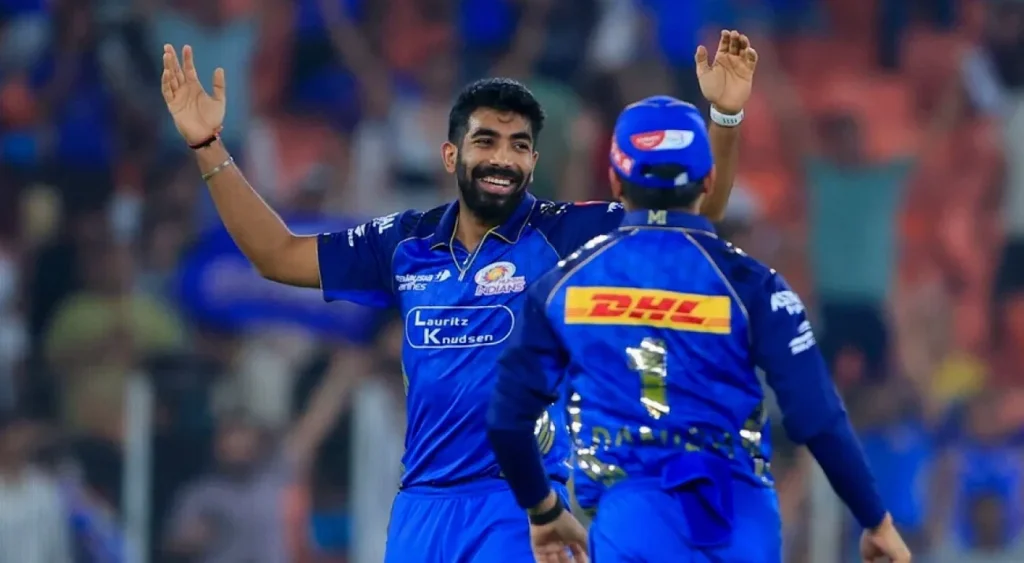
Before their crushing win over Gujarat Titans on Monday in IPL 2026, Mumbai Indians had already played five matches. In those earlier outings, their opening spells featured Deepak Chahar three times and Trent Boult twice. Even with that variety up front, MI managed only one win, and Jasprit Bumrah had not taken a wicket in his first-ball phases.
How the bowling plan changed
- Across MI’s first five IPL 2026 matches, Deepak Chahar opened the bowling three times.
- Trent Boult opened the bowling twice.
- Bumrah had no wickets in his opening overs during those five games.
- When Chahar opened, Bumrah typically bowled the second over, while in the other cases he bowled the fifth or fourth over.
- Against Gujarat Titans, Bumrah delivered the first over and took the first wicket.
In the three instances when Chahar started the attack, Bumrah was used in the second over. On the other occasions, he was brought on for the fifth and fourth overs respectively. On paper, sending down the second over sounds like “opening,” but T20 cricket has evolved—each early over plays differently, and teams now treat them with more specific intent.
That shift became clear against Gujarat Titans. Bumrah’s first over produced the breakthrough—B Sai Sudharsan was dismissed off his very first delivery, giving MI an early edge that they were not getting in the same way earlier in the season.
The impact of that early strike was not lost on Faf du Plessis. He joked that it felt as if Bumrah’s first-over wickets might become a repeated theme for the rest of the fixtures.
Du Plessis and Abhinav Mukund on the early strike
Abhinav Mukund, speaking on ESPNcricinfo’s TimeOut, framed it as a tactical “affordability” issue. He argued that if Bumrah is not bowling the powerplay opener, a team can still manage with multiple pace options. However, the bigger change is that Bumrah is now getting the first over when conditions don’t necessarily demand it—unlike earlier patterns where he was often introduced when the batting side was already settled.
Mukund pointed out that MI had previously tried Boult and Chahar in that opening role. But for the first time since 2022, Bumrah was allowed to start proceedings with the new ball in a situation where teams were not typically cruising—no “ready-made” platforms of 40 for no loss, 50 for no loss, or 60 for no loss. He also noted that this season, in most matches, whenever Bumrah came on to bowl, it had often been in circumstances where the batting side was not in a position to score freely from the outset—except against Delhi Capitals.
On this specific match, Mukund highlighted the sequence: the over began at 0 for 0, Bumrah arrived, then struck immediately. While he stopped short of calling it the definite turning point, he suggested that taking an early wicket matters most against a Gujarat Titans side that can be less effective in the middle overs when spin takes hold. He connected that to MI’s decision-making: the match “adds up” when you consider the way the contest was shaped for Gujarat’s strengths and weaknesses.
Du Plessis also linked the early wicket to a lift in the team’s defensive momentum. He said that the conversation in the dressing room often becomes the same—everyone urging each other on—yet the first over can quickly sap energy if it goes for 13 or 14 and the wind is knocked out of the plan. In his view, body language drops immediately after that kind of start.
That’s why he valued what happened when Bumrah bowled the opening over. Du Plessis described Bumrah as the standout white-ball bowler of the current generation, and said the first-over strike “kicks belief” through the group—reinforcing the sense that the day can be a successful one in the field.
For MI, the context carried extra weight. The franchise hasn’t won an IPL title since their fifth triumph in 2020, and handing the ball to Bumrah at the very start felt like a throwback. But Mukund stressed that the game has changed sharply since then, particularly with how impact rules and match conditions alter bowling value.
He noted that with the impact player system, teams are attacking more aggressively, and that—over the last four to five years—the ball tends not to swing after the third over. He connected that evolution to MI’s earlier decline: Bumrah was often introduced later in the powerplay, and teams expected him to take wickets through pure skill. He does that, Mukund said, citing Bumrah’s yorkers and slower balls.
Still, Mukund’s key point was that Bumrah becomes even more dangerous when he’s given a ball that’s genuinely moving—fresh and lively. In that scenario, the first-over wicket is not just a lucky moment; it’s what the conditions allow him to do at his very best.
