
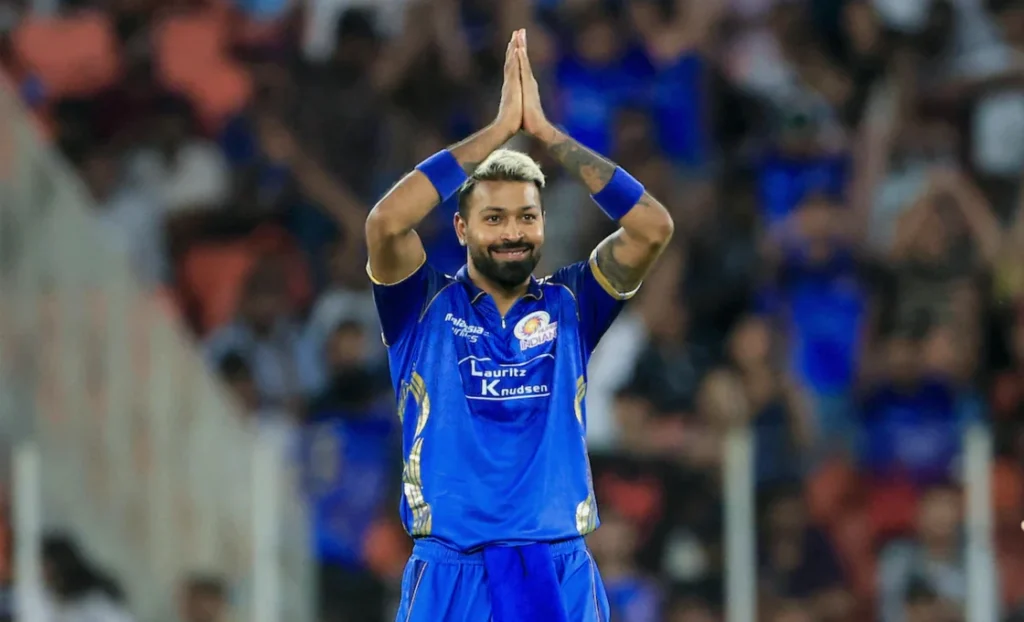
Mumbai Indians finally found some breathing space on Monday, clinching a commanding 99-run win over Gujarat Titans in their IPL 2026 fixture. The victory came after a difficult stretch for MI, who had dropped four of their opening five matches and saw their campaign drift off course early on. The turnaround was powered by Tilak Varma, who produced his first IPL century in Ahmedabad, delivering the kind of innings that can swing a season in a single afternoon. With Varma’s effort setting the tone, Mumbai posted 199/5 from their 20 overs, then went on to restrict Gujarat Titans to just 100, wrapping up the contest with a decisive margin.
Even with the emphatic result, the debate around Hardik Pandya’s leadership has not quietened. Pandya took over the captaincy from Rohit Sharma in 2024, and since then he has been closely watched—both for his on-field decisions and for how his overall impact has measured up. Before returning to Mumbai, Hardik had already built a strong captaincy narrative. He led Gujarat Titans to the IPL title in their debut season in 2022, and then followed it with a runners-up finish in 2023, establishing himself as a skipper capable of delivering at the highest level.
While his record on paper looked impressive, scrutiny intensified after he assumed charge at MI, with questions increasingly centred on how his numbers and performances evolved in the new role. Former India batter Sanjay Manjrekar recently stirred further discussion with a pointed comment, suggesting that Mumbai Indians may have viewed Hardik Pandya through a commercial lens as much as—if not more than—pure cricketing considerations. He also pointed to the role of head coach Ashish Nehra, implying that Nehra’s influence was a major factor behind Hardik’s success with Gujarat Titans.
Manjrekar said that the decision to bring Hardik into Mumbai was “very interesting,” adding that franchises sometimes make choices that end up becoming headline-worthy and putting a spotlight on their brand value. He suggested that such moves can be driven by the wider business picture, including the valuations and expectations surrounding high-profile signings, rather than being purely cricket-led. He argued that Hardik’s earlier success with Gujarat Titans had a strong connection to Ashish Nehra, and raised the idea that if the franchise wanted Hardik specifically, it could arguably have secured Nehra’s services alongside him. “Hardik Pandya had success with the Gujarat Titans, and that had a lot to do with somebody named Ashish Nehra. So maybe if you wanted Hardik Pandya, you could have also got Ashish Nehra with him,” Manjrekar added.
The former batter also reflected on the pressure Hardik faced immediately after joining MI, including the reaction from sections of the crowd when he was named captain. He noted that Hardik arrived at Mumbai in a situation where he was effectively replacing major names, and that the lack of backing from experienced senior players during the early phase made the job harder. Manjrekar said it was tough for Hardik because, upon his arrival, he had to move into a role that came with enormous expectations—especially when players like Jasprit Bumrah, Rohit Sharma, and Suryakumar Yadav were not given the nod in the captain’s immediate set-up. “So, he felt the pressure and the first season when he captained, he did not have support of the senior players. So, this is tough,” he said.
Manjrekar further underlined the emotional challenge of the position, describing how difficult it can be for a captain to settle in when the environment turns hostile from the very start. He highlighted the scene of Hardik walking out for the toss and being booed by local MI supporters, calling it “a tough place to be in.” “Just imagine, a captain going out for toss and getting booed by the local MI supporters, it’s a tough place to be in,” he concluded.
