
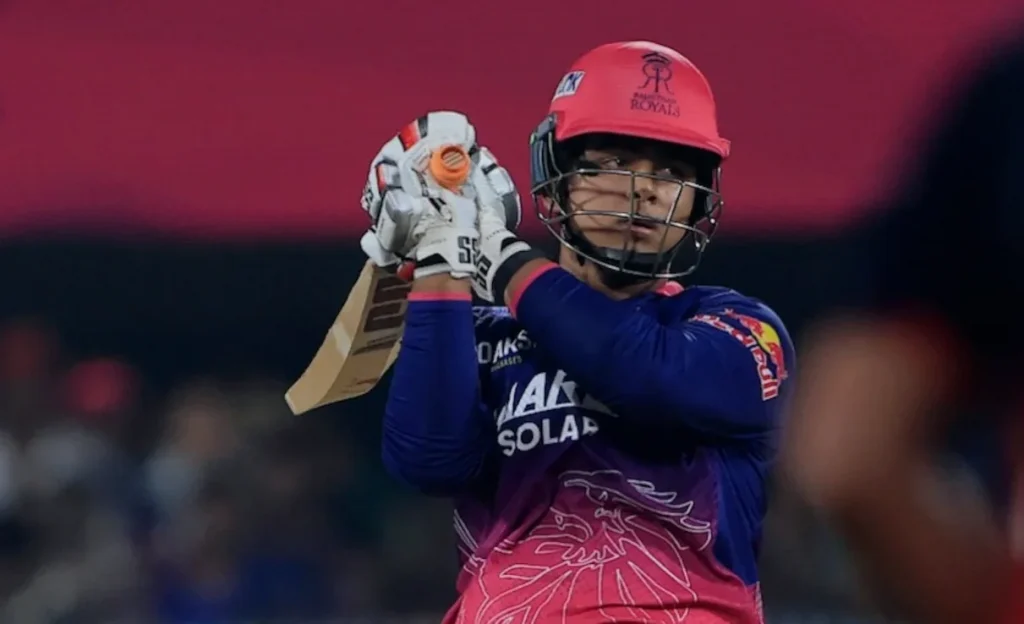
Vaibhav Sooryavanshi’s second season in the Indian Premier League (IPL) appears to be surpassing even the promise he showed in his debut year. Although he is still searching for his first IPL century in 2026, the 15-year-old has already produced two blistering half-centuries off just 15 balls in the tournament’s opening six matches. Those starts have helped him pile up 246 runs so far, with his aggressive tempo turning heads across the league.
Sooryavanshi’s run of form has also included some eye-catching scalps. He has taken apart two of today’s most feared T20 strike bowlers—Jasprit Bumrah and Josh Hazlewood—making their plans look far less settled than usual. Even with such high-level opposition, he has consistently found the boundary and kept the scoreboard moving at pace.
That kind of freedom inevitably invites tactical thinking from experienced campaigners. Former England fast bowler Steven Finn, who recently discussed the challenge on the “For the Love of Cricket” podcast with fellow ex-England pace great Stuart Broad, tried to map out how teams might finally find a way to dismiss Sooryavanshi.
Finn first offered a light-hearted, slightly mischievous suggestion—joking that a bowler might need to “pull” a calf or hamstring before being asked to bowl at Sooryavanshi. The quip was clearly tongue-in-cheek, but it underlined just how difficult it is to contain the teenager once he is set and looking to attack.
From there, Finn moved to a more concrete bowling concept. He pointed out that even watching Sooryavanshi’s net sessions can look daunting, especially with Jofra Archer working hard and throwing different looks at him. Finn noted that in training, deliveries of many types—full and wide, short and straight—were still finding the boundary, suggesting that length and line alone may not be enough to curb his scoring.
In Finn’s view, bowlers may need to do more than “hit the right spot” consistently; they must also be prepared to surprise him. He suggested that maintaining a tight line and then changing the angle or pace at a key moment could create openings for wickets.
Finn also explained how captains could shape field and bowling variations around Sooryavanshi’s free-flowing style. “When someone likes to play as free-flowing as he does, you’d think a few in and around the tight line and the back of the length, or over the top of the stumps, try to protect the leg-side to begin with,” Finn said.
He added that the next step could be a deliberate pattern break. “And then if you could throw in like a full, slow, wide one and make him reach for it out there on the back of three or four tight deliveries, you could catch him off guard,” Finn continued.
Even with that plan, Finn admitted the difficulty of turning theory into results. “At the moment it seems to be pot luck as to whether you get him or not,” he said, highlighting how unpredictable the contest can become once Sooryavanshi takes control.
One moment that best captures the scale of Sooryavanshi’s impact came in Rajasthan Royals’ clash with Mumbai Indians. In that game, the teenager struck Jasprit Bumrah for a huge six right off the first ball—an early statement that his attack-first mindset can translate into instant damage against top-tier pace.
