
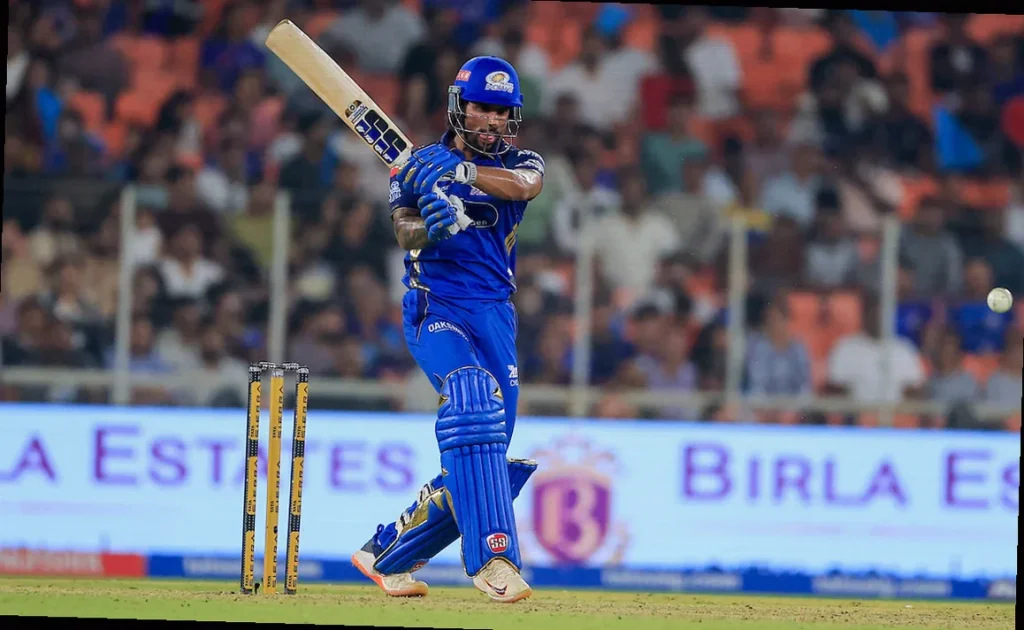
After Mumbai Indians (MI) secured a win over Gujarat Titans (GT), former India batter Cheteshwar Pujara stressed that Tilak Varma will need to adopt a more positive approach versus spin if he is to consistently trouble teams in the IPL. Pujara pointed to Varma’s sweeping and reverse-sweeping options, along with the value of stepping out of the crease to force changes in the bowler’s length. The comments followed a memorable knock from Tilak, who struck a century against GT and helped MI post a competitive total before defending it.
Tilak Varma must be more proactive vs spinners, says Pujara
Pujara highlighted that Varma’s game plan against spin should involve intent rather than merely rotating the strike. He noted that Varma’s century against the Titans was a standout effort, also representing MI’s joint-quickest fifty in IPL history. Tilak matched the record shared with left-handed great Sanath Jayasuriya for reaching the milestone at the same pace. In his innings of 45 balls for 101 not out, Varma faced a difficult opening phase, managing only 19 runs from 22 deliveries as MI slipped into trouble at 44/3.
However, Varma accelerated decisively after that setback. Over the following 23 balls, he added 82 runs, finishing with eight fours and seven sixes while striking at 356. Pujara’s focus was on how Varma can translate such acceleration into a repeatable method—especially when spinners are setting up batters to play for singles and twos.
Speaking on JioHotstar’s “Champions Waali Commentary,” Pujara explained that a batter does not need to abandon caution entirely, but should still force the spinner to rethink. He said the spinner becomes more comfortable when the batter only looks to keep the scoreboard moving without taking calculated risks. In Pujara’s view, stepping out and choosing attacking shot-makers like the sweep or reverse sweep can compel the bowler to adjust his lengths.
“Tilak needs to be a bit more positive against spinners. I am not saying he should just go for the big shots. When you play with intent and try to be positive, the spinner is forced to change his lengths. That puts pressure on him. Tilak can step out of the crease and can use the sweep or reverse sweep. He has many options, but first he must understand his own strength,” Pujara said.
He added that stepping out of the crease was central to his own success when he played, especially when bowlers tried to offer short deliveries. Pujara suggested that Varma should take similar initiative—using back-foot shots like cuts or pulls when the ball comes on the shorter side. He also underlined that Varma’s sweep is a weapon in itself, but the overarching objective remains maintaining pressure on the bowler throughout the spell.
“When I played, stepping out was my strength. If a bowler tried a short ball, I would play the cut or pull on the back foot. I feel Tilak should also step out and play his strokes. That will put the spinner under pressure. His sweep shot is also good, so that is another option. But the key is to keep the spinner under pressure. If you only try to rotate the strike in T20s, the spinner gets on top and doesn’t need to change his length,” he added.
Aditya Tare points to MI’s fighting spirit after early losses
Another JioStar analyst and former cricketer, Aditya Tare, drew attention to MI’s ability to “fight” after a difficult start to the season. He said the win over GT was significant because it represented MI’s second victory of the campaign after four consecutive defeats. Tare also referenced the franchise’s reputation for staging memorable turnarounds, noting that MI have repeatedly responded strongly after poor openings.
“This win against the Gujarat Titans is very important for the Mumbai Indians. They had lost four of their first five matches this season and were at the bottom of the table. But Mumbai Indians have a history of making comebacks after poor starts. Take the example of the 2014 season, they lost their first five matches but still reached the playoffs. Then in 2015, they were in a similar position. They made an incredible comeback in the second half of the season and went on to win the trophy for the second time, beating Chennai Super Kings in the final. This team knows how to fight back. They will definitely take inspiration from those past seasons,” Tare signed off.
Match report: MI post 199/5 after Tilak’s surge; GT bowled out for 100
Turning to the game itself, Gujarat Titans won the toss and chose to field first. MI had a shaky start and slumped to 44/3 during the powerplay, but they rebuilt through a critical partnership between Naman Dhir and Tilak Varma. Dhir contributed a half-century, scoring 45 off 32 balls with six fours and a six, while Varma provided the base that allowed MI to regroup and set up a later acceleration.
Once the innings began to open up, Tilak proved the difference. After struggling to hit at a run-a-ball pace earlier, he exploded into a dominant spell and finished with a 45-ball hundred not out—101*—including eight fours and seven sixes. His finishing burst carried MI to 199/5 in their 20 overs.
For GT, pacer Kagiso Rabada was the most effective bowler, taking 3/33. Mohammed Siraj supported well with 1/25 and continued his run of tight bowling during the tournament.
During GT’s chase, the Titans never really appeared to pose a serious threat. They were dismissed for 100 in 15.5 overs. Ashwani led the demolition with career-best figures of 4/24. Spinners Allah Ghazanfar and Mitchell Santner then added pressure with two-wicket spells, tightening the chase and leaving GT with little room to recover.
Jasprit Bumrah also contributed at the death, finishing with figures of 1/15 from three overs as MI completed the win over GT.
