
Twelve years ago, Mumbai Indians endured an ugly start—losing their first five games and sitting in the lower half of the standings—before finding their rhythm and qualifying for the playoffs. A similar pattern played out last season as well: four defeats in the opening five fixtures eventually gave way to a late surge. Their most dramatic turnaround, though, belongs to 2015, when they dropped five of their first six matches before going on to win the title.
From slow starts to surprise surges
This season, the script began uncomfortably familiar. Mumbai have already lost four of their first five matches, and while the early results have been troubling, the situation has not carried the same “same old story” feel. The defeats haven’t simply been dismissed as the franchise’s usual slow-starter reputation—because there were signs of the right ingredients, yet they never quite came together. Even Hardik Pandya’s leadership has been under the spotlight as Mumbai searched for answers across departments.
That narrative began to shift after Monday’s match in Ahmedabad, where Mumbai Indians produced a 99-run rout of the Gujarat Titans. For the first time this campaign, the side looked like the IPL powerhouse they are widely associated with.
Hardik’s captaincy spark and Bumrah’s early breakthrough
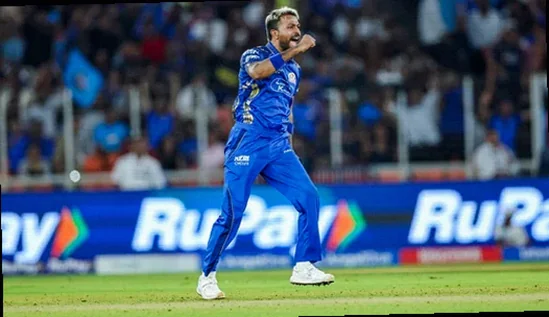
Hardik’s mood was unmistakably upbeat—euphoric, animated, and visibly relieved—because the captaincy had delivered a clear change in approach. Rather than forcing the hunt for early wickets through himself, he entrusted the new ball to Jasprit Bumrah, and the India fast bowler responded immediately.
Bumrah’s first breakthrough of the season arrived with the very first delivery of Gujarat’s chase. He dismissed Sai Sudharsan, ending a seven-match wicket drought in IPL action for the pacer, and the impact of that moment was felt instantly—Mumbai looked calmer, more confident, and more in control.
Bowling changes that disrupted Gujarat’s rhythm
Mumbai didn’t rely on one decision; they made several tough calls that paid off on the day. Their adjustment to the bowling plan helped tighten the middle overs and deny Gujarat the kind of momentum that can flip a chase.
- They reworked the bowling combination and used both spinners, AM Ghazanfar and Mitchell Santner, to squeeze the run rate in the middle overs.
- They brought Ashwani Kumar into the XI to provide extra support for Bumrah.
- Ashwani rewarded that selection with a four-wicket haul, which included the dismissal of Shubman Gill.
- Those wickets triggered a collapse deeper in the batting order, leaving Gujarat with too much to do.
That near-flawless bowling display—delivered at Motera—pulled Mumbai back into contention in the most tangible way. The victory moved them from the bottom of the table to seventh place, reviving talk of a potential playoff push.
“Is this that game?” — Hardik’s response
The tone of the day was summed up in a quick moment during the presentation. The presenter asked, “Is this that game?” Hardik replied, “Yes.”
Still, the question remains open: it might not be the full turnaround yet—at least not entirely—but the direction is unmistakably better than what Mumbai had shown earlier.
Bowling revival lifts the ceiling, but batting still needs work
Beating Gujarat with authority confirmed Mumbai have addressed their bowling problems. Yet the batting conversation is not finished. Even in a match like this, the broader issues in their batting structure are difficult to ignore.
The powerplay continues to be a concern, with Mumbai losing three wickets within the first six overs. Without Naman Dhir’s stabilising half-century, the chase would have looked far more precarious even after Gujarat were set up for an under-pressure chase.
Key concerns: Suryakumar, and Tilak’s early struggle versus spin
Suryakumar Yadav remains a worry, with his form having dipped over the past year. At the same time, Tilak Varma provided a reminder of what Mumbai can unlock when their innings accelerates—he struck a late surge, scoring 82 runs in the final six overs to reach his maiden IPL century. However, his early battle against spin was less convincing: he managed only 19 runs from his first 22 balls.
What Mumbai could do next
With the win offering hope, Mumbai now need to turn that momentum into repeatable batting plans. The ideas being discussed include:
- Persisting with Naman Dhir as a powerplay option, given how he steadied the innings when wickets fell early.
- Considering Sherfane Rutherford as a counter to spin, since his strike rate in the middle overs this season is 144.2, compared with Tilak Varma’s 84.
- Using Tilak Varma alongside Hardik Pandya as a designated pace-hitter during the death overs—an approach both executed during India’s 2026 T20 World Cup campaign.
- Leveraging Tilak’s slog-overs pace strike rate of 263.8 versus pace, while Hardik’s pace strike rate in slog situations stands at 165.
Mumbai will take the confidence from Monday’s performance, but the message going forward is clear: the bowling revival has arrived, yet the batting still requires fixing if this season’s turnaround is to become something more than a one-off.
