
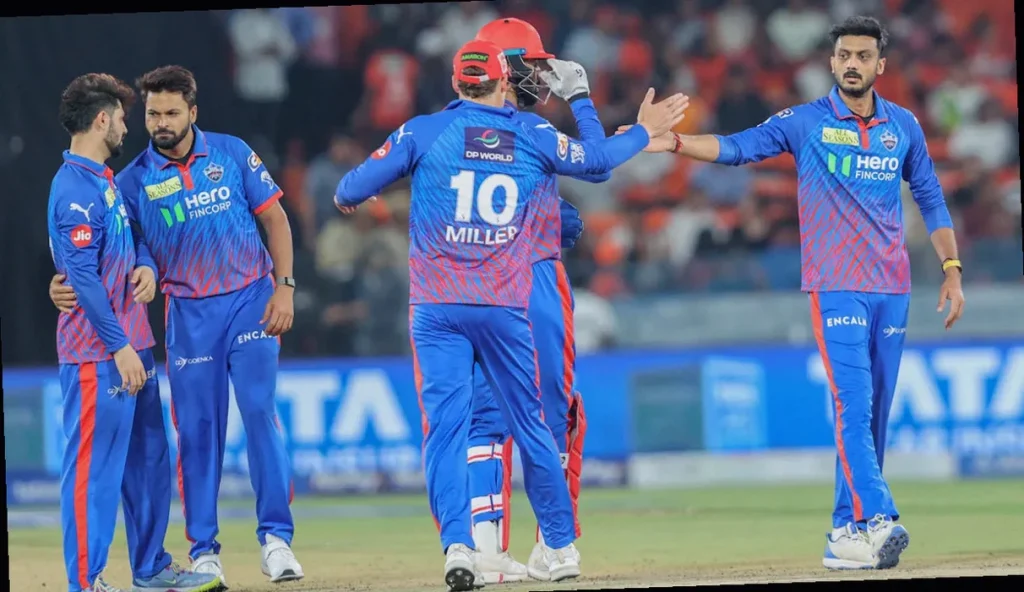
Delhi Capitals’ spin attack, built around captain Axar Patel and wristspinner Kuldeep Yadav, was expected to be their main weapon in the defeat to Sunrisers Hyderabad. However, the bowling numbers told a different story: the pair combined for only four overs in the match, leaving room for DC’s plans to unravel when SRH needed control and wickets.
Why DC’s spin plan drew criticism
Delhi Capitals have long relied on their two-pronged spin strategy, with Axar leading from the front and Kuldeep providing variation through his wrist work. In this particular game, though, the spin duo did not get the workload one would normally associate with their matchup strength. Their combined output was limited to four overs in the loss.
That mismatch was highlighted by Aaron Finch on ESPNcricinfo’s Time Out show. Finch pointed out the contrast between what DC had available and what they ultimately delivered. He also questioned why the rest of the bowling unit did not compensate by using more overs from a specialist spinner.
- Axar Patel’s figures: 2 overs, 0 maidens, 23 runs, 1 wicket (2-0-23-1)
- Kuldeep Yadav’s figures: 2 overs, 0 maidens, 30 runs, 0 wickets (2-0-30-0)
- Finch noted that together they bowled only four overs, despite being Delhi’s leading Indian spin options
- Nitish Rana, described by Finch as a part-time offspinner, also bowled four overs
Nitish Rana’s role and the bowling direction for SRH
Rana, who had missed DC’s previous two matches, was tasked with opening the bowling for Sunrisers Hyderabad. It was his 27th time in 122 IPL matches to bowl, and the second occasion in which he completed his full quota.
DC’s intent, as Finch and the match discussion suggested, was clear: they wanted a bowler who could slow the ball down, take pace off, and turn it away from SRH left-handers Abhishek Sharma and Travis Head. The plan leaned heavily on Delhi’s premium spinners—because their turning deliveries typically create discomfort for left-handed batters.
But the game’s shape forced Axar to respond quickly. With Abhishek Sharma carrying his bat through the innings—finishing unbeaten on 135—Axar had to keep adjusting his approach as left-hand threats kept coming at him.
Finch’s reaction to Axar’s decision-making under pressure
Finch acknowledged that DC faced a difficult challenge, yet he was blunt about what he felt was a captain’s responsibility. In his view, a retained player and senior figure—particularly one with a proven international record—should trust his execution when pressure rises.
Finch referenced Axar’s stature and the expectation that comes with being a core bowler in the Indian setup. He argued that the issue wasn’t merely execution in a single spell, but the apparent lack of trust to defend against left-handers once they arrived at the crease.
He also commented on Axar’s attitude, saying that the choice not to lean more heavily on him against left-hand batting made the situation look more about mindset than about match circumstances.
Axar’s record versus Abhishek and the defensive mindset Finch praised
Finch said Axar had reasons to feel confident because he had already done damage to Abhishek Sharma in IPL matchups. Before the game on Tuesday, Axar had dismissed the SRH opener twice in eight balls, conceding only six runs in those encounters.
Finch further expanded on why he believed Axar’s skill set was tailor-made for the problem posed by Abhishek. He described Axar as someone with a strong defensive mindset, not the type to simply float a ball into the slot when the match tightens. Instead, Finch said Axar defends himself with smarter bowling—altering angles, using his height, and keeping the attack both compact and purposeful.
- Finch said Axar is not likely to “float” a delivery when under pressure
- He praised Axar’s ability to defend with changes in angles
- Finch highlighted Axar’s use of his height as part of his defensive craft
- He argued that even when Axar intends to bowl defensively, it can still be attacking against Abhishek Sharma
- Finch suggested that if a bowler lands a couple of decent balls, something tends to happen in that matchup
Axar’s post-match message and Finch’s follow-up
After the game, Axar addressed the DC bowling performance and pointed to execution and planning. His view was that they did not execute what they had planned, and that if execution is missing, there is only so much a side can do.
Finch responded by challenging the framing. He suggested that if a captain is critiquing mis-execution, he also has to acknowledge that he had the chance to stand up at the moment too. Finch said he had no problem with a bowler mis-executing in a match or across a short stretch—what matters most, in his opinion, is whether preparation, planning, and thought process are right.
He added that perfection in T20 is impossible: no one can deliver 24 flawless balls, and decision-making won’t always land at the right time.
Du Plessis on the overs Axar and the bowling changes
Faf du Plessis also weighed in, focusing on the strategic turning point of the innings. He said DC wouldn’t have been faced with such a “bold” stand—implying a costly partnership or momentum swing—if Axar had bowled the over in question differently, especially if it had gone for 20.
Du Plessis questioned the bowling order and timing. In his view, once left-handers were set at the crease and Axar had completed his two overs, the side should have brought in the next bowler with clearer impact rather than giving away overs in a way that felt untimely.
He argued that Axar had already done key work—getting a left-hander out and also dismissing Head—so the bigger issue became what followed after Axar’s spell and why DC did not go to their impact options immediately.
- Du Plessis said Axar’s outcome of a high-scoring over (described as going for 20) contributed to the pressure of the stand
- He questioned why the bowling decision appeared to place Rana ahead of himself (“ahead of Rana”) after the left-handers situation
- Du Plessis noted that Axar did get the left-handed batter out and also removed Head
- He said DC then did not use another impact player who came on to bowl, such as a fast bowler who was available
Du Plessis on Kuldeep and why he still backed Axar
Du Plessis said he could understand why Kuldeep might not have been preferred in that moment. He referenced Kuldeep’s figures of going for 30 in two overs and suggested that the captain may have felt Kuldeep wasn’t bowling the right length on the night.
Still, du Plessis maintained that Axar should have remained the primary option. He pointed to Axar’s ability to operate across left-handers from around the wicket, his capacity to bowl into the heel, and the “tricks” he brings to spin bowling.
- Du Plessis said Kuldeep’s workload could be understood because he went for 30 in two overs
- He suggested the captain may have felt Kuldeep wasn’t finding the right length
- Du Plessis acknowledged that a fingerspinner can sometimes control length more consistently
- He said he would still go back to Axar as the key bowling choice
- He cited Axar’s left-hander variations from around the wicket and his ability to bowl into the heel
- Du Plessis concluded that Axar’s skill set and changeups make him the standout option
With Abhishek Sharma’s 135 not out anchoring the chase and Delhi’s spin workload skewed away from its usual stars, the match became a case study in how quickly T20 plans can shift—and how captaincy choices, in du Plessis and Finch’s view, ultimately shaped the outcome.
