
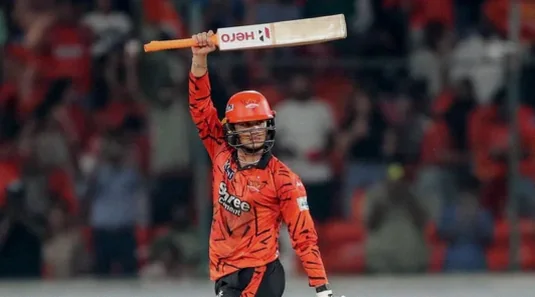
Abhishek Sharma’s unbeaten 135 against the Delhi Capitals was more than a classic IPL century—it created a major swing in value for Sunrisers Hyderabad, one of the most eye-catching overnight gains by a top-order batter in the current season. The knock converted a sizeable franchise investment into an almost immediate near-doubling of match-day worth.
Key takeaways
- Abhishek Sharma finished with 135* off 68 balls versus Delhi Capitals.
- His season-to-date valuation entering the game was estimated at ₹14 crore, with a projected ₹1 crore per league match.
- The innings was assessed at ₹1.95 crore match worth, leaving SRH with a surplus of ₹95.16 lakh from that night.
- His strike rate reached 198.53, including 10 fours and 10 sixes.
- About 55.79% of SRH’s 242/2 was credited to his batting, with boundary scoring accounting for 100 of his 135 runs.
- Batting-only surplus was estimated at ₹37.01 lakh, while the complete match surplus rose to ₹95.16 lakh after factoring overall impact.
A century that arrived with control—and escalated in waves
Abhishek’s innings is supported by sharp batting metrics. He struck 135 runs from 68 deliveries, maintaining a strike rate of 198.53. His boundary production came in a big way: he struck 10 fours and 10 sixes, and 100 of his 135 were scored in boundaries. That meant 74.07% of his total came through the bat’s biggest scoring routes.
The momentum didn’t sit in one gear for long—it moved through distinct bursts. In the Powerplay, he struck 34 off 15 at 226.67. In the middle phase across overs 7 to 11, he added 26 off 15. Then came the decisive surge: from overs 12 to 16, he hammered 55 off 21 at a strike rate of 261.90, pushing the innings from merely large to genuinely chase-altering.
His scoring distribution also made the damage difficult to contain. Against Nitish Rana, he scored 43 off 15. Against T Natarajan, he produced 24 off 15. He took 23 off 11 from Mukesh Kumar and added 22 off 17 versus Lungi Ngidi. Even when the ball was brought into tighter roles, he still found runs—12 off 5 from Kuldeep Yadav and 11 off 5 from Axar Patel. Delhi’s bowling attack, as the innings unfolded, never found a workable plan to reduce the threat.
How the ₹1.95 crore match value was built
The starting point was a player valued at ₹14 crore, spread across 14 league games—translating to a baseline cost of ₹1 crore per match. From there, the estimate for a given game is formed by translating match influence into rupee value. For Abhishek, the bulk of that figure came from the batting itself, while the framework also allowed for additional contribution in the field.
In this model, the performance converted into a batting score of 42 and a fielding score of 6. Because the innings combined scale, control, and match impact, it triggered a strong manual rating lift, taking the final normalised monetary impact to 116. That total then mapped to the ₹1.95 crore “match worth” for the night.
Once the base cost of ₹1 crore is deducted, the remaining surplus is ₹95.16 lakh. In practical franchise terms, SRH effectively deployed ₹1 crore for one league fixture and recovered nearly ₹2 crore in assessed value by the end of play—an outcome that stands out even in a season where totals are often chased down at speed.
The innings’ value logic: why expensive stars need heavier returns
The same investment logic can be illustrated like a market move: putting ₹1 lakh into a stock at the opening bell and watching it reach nearly ₹2 lakh by the close. Here, the principal is ₹1 crore and the closing value is ₹1.95 crore.
That is why the innings stands out beyond the raw milestone. It wasn’t simply a century—it created a near-doubling of match-day value on a high starting base. Generally, lower-cost players can post big percentage gains from a single standout showing because their entry price is modest. Higher-priced players operate under a different equation: their cost line is higher, so the performance has to be more substantial, cleaner, and more decisive to produce the same kind of surplus. Abhishek’s knock cleared that bar with ease.
From batting control to financial impact
The final value number wasn’t built from empty volume. It came from dominance across phases of the innings. Abhishek shaped the opening, accelerated through the middle overs, and pushed SRH into a scoring zone that changed the chase’s entire shape. His boundary tally provided the pace behind the total, while his share of the innings gave SRH the substance needed to control the match. Just as importantly, his ability to score against both pace and spin denied Delhi any stable tactical shelter.
That control is reflected in the financial breakdown. Abhishek’s batting-only surplus was estimated at ₹37.01 lakh. After the complete match impact was folded in, his full match surplus rose to ₹95.16 lakh. The gap between those two figures captures the breadth of the night’s effect—batting dominance at the centre, supported by the innings’ overall match influence.
For Sunrisers Hyderabad, the takeaway is straightforward. Abhishek Sharma came into the game as a ₹14 crore asset with a ₹1 crore game cost, and he exited the fixture with an estimated return of ₹1.95 crore. That is the kind of elite value franchises pay for—not only runs or highlights, but nights when the investment nearly doubles before the match is even done.
