
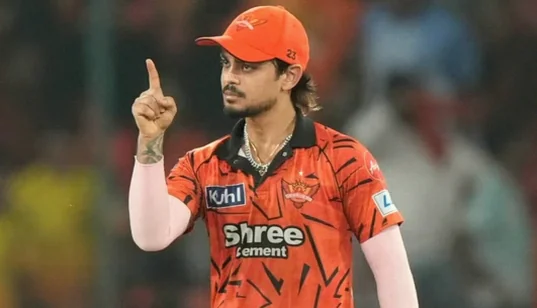
Ishan Kishan arrived at Sunrisers Hyderabad as the stop-gap solution to a leadership question, especially after Pat Cummins’ unavailability forced a change. What was expected to be short-term cover has, with a little over a month of IPL 2026 already played, started to look like something more substantial. Kishan has not just steadied the group—he has given SRH a clearer rhythm and a captaincy framework that is beginning to deliver consistent results.
Kishan’s captaincy: from stand-in to a settled plan
The strongest argument for Kishan’s impact is not built on mood or sentiment. It is rooted in how SRH have moved under his guidance. In the seven matches he has led so far, the franchise has won four. While that points to effectiveness, the bigger takeaway is the way his leadership has evolved as the tournament progressed.
In the opening stretch, SRH’s approach looked energetic but at times lacked control. Kishan, too, appeared to be adapting to the burden of directing a high-intensity T20 outfit. However, the pattern has improved sharply over recent weeks, and the captaincy now reads as more structured and decisive.
- SRH beat Rajasthan Royals by 57 runs.
- SRH edged Chennai Super Kings by 10 runs in a tense, low-margin defence.
- SRH then overpowered Delhi Capitals by 47 runs.
Those results have come in different ways: one through early dominance, another through managing pressure late in the innings, and the third through an all-round, comprehensive performance. That mix suggests Kishan is not merely riding form—he is learning to handle varied match situations with greater authority.
Clarity over drama: how Kishan’s thinking is changing
One of the most telling aspects of Kishan’s captaincy may not be something that jumps out like a dramatic fielding switch or a surprise bowling call. It could be a decision to step away from wicketkeeping for a period, allowing him to communicate more effectively with his bowlers.
That choice reveals how he is prioritising the job itself. He appears to have understood that captaincy requires clean access to the attack—quicker conversations, sharper in-the-moment adjustments, and better clarity for the bowling unit. Rather than trying to manage everything simultaneously, he has simplified his role to improve team coordination. It is not a headline-making move, but it reflects self-awareness and a captain focusing on team growth instead of protecting personal visibility.
SRH’s win over Rajasthan Royals gave this direction immediate credibility. While Kishan’s contribution with the bat mattered, the structural shift looked even more important. The side appeared more connected, plans were easier to execute, and the bowling group did not seem as reactive—there was a stronger sense of alignment throughout the spell sequences.
That is often the line between surface-level captaincy and genuine leadership. The best calls are not always loud. Sometimes they are about cutting out noise so the team can operate with intent.
Back the youngsters: SRH’s bowling trust under Kishan
Where Kishan’s captaincy begins to look genuinely useful—beyond any temporary phase—is in how he is handling the bowling unit. SRH’s defence against Chennai Super Kings offered the clearest proof. Chasing 194 is never easy for any side, and defending a total like that requires calm sequencing and belief in execution.
SRH were not simply trying to cling on after the game became lopsided. They had to maintain shape while the opposition remained in the contest. Kishan backed a young bowling group to do the job, and they delivered.
In the IPL, young fast bowlers and emerging options are often managed conservatively—captains delay their overs, reduce their exposure, or hide them when pressure rises. Kishan’s approach seems different. He has trusted them with responsibility and allowed them to carry out plans during meaningful phases of the innings.
- This trust increases accountability because the bowlers are given real roles rather than comfort zones.
- It expands SRH’s tactical options in tight matches—if the captain believes there are more than two reliable spells to lean on, opponents find it harder to map out a simple strategy.
- Under Kishan, SRH have started to look harder to pin down in the death and during key middle-over moments.
The same theme continued in the Delhi Capitals win, where the discussion after the match focused not only on calmness but also on how Kishan used his bowlers against particular batters and at different stages of the game. Instead of generic leadership clichés, the conversation moved toward actual tactical choices and game-flow understanding.
Kishan is not being labelled a revolutionary captain. Instead, he is being praised for a practical grasp of matchups, bowling roles, and how an innings should evolve—an essential skill in T20 cricket where momentum shifts quickly.
SRH’s identity stays intact—and the Cummins question changes shape
A captain’s first real test is whether the team still resembles itself under stress. Under Kishan, SRH’s totals have ranged from shaky starts to explosive finishes, yet the franchise has largely maintained its aggressive batting identity. Even after setbacks, they have not retreated into caution for survival. They have continued to attack from the front foot.
A temporary captain can sometimes end up shrinking the game—simplifying batting plans and focusing on staying in the contest. Kishan has not captained in that manner. The last three wins underline that point: SRH scored 215 against Rajasthan, defended 194 versus Chennai, and then posted 242 against Delhi. Those are not figures from a team that has surrendered its method.
That said, perfection has not arrived yet. The earlier defeats showed SRH can become untidy when matches turn awkward. Kishan is still evolving as a tactician, and there will be situations where he must prove he can steer SRH through messy overs even when the first plan breaks down. Still, the direction is clear: he has grown more settled, and SRH’s performances are reflecting that stability.
Why Cummins’ return doesn’t automatically require a captaincy switch
This is the central dilemma. Pat Cummins remains one of SRH’s most important players, with class, experience, and authority that are difficult to dispute. But captaincy is not only about stature. It also depends on continuity, availability, and whether a system is already working.
SRH now have a structure under Kishan that is beginning to take shape. The batting group continues to play with freedom, the bowlers appear to trust the captain’s decisions, and the team has found multiple routes to victory. Changing the armband immediately on Cummins’ return could interrupt a pattern that is only starting to harden into something meaningful.
There is also the practical factor. Cummins is returning from injury concerns. Even if he is fit enough to play, SRH do not have to place every layer of responsibility back on him right away. They can still benefit from his tactical guidance, bowling quality, and experience without making him the primary decision-maker on day one.
In fact, that may be the most effective balance: Cummins as the senior voice and Kishan as the active captain—one providing stature, the other ensuring continuity.
The verdict: Kishan has earned the role on merit
Ishan Kishan has not simply filled space at SRH. He has started to justify the captaincy through performance and decision-making. Across the season, he has made practical adjustments, trusted young bowlers at crucial moments, and kept SRH’s attacking identity from being diluted. Most importantly, he is beginning to look like a captain the team can follow—not just someone who is temporarily accommodated.
That is why SRH do not need to rush the armband back the instant Pat Cummins returns. For now, the evidence points in one direction: Kishan is no longer keeping the seat warm. He has built a strong enough captaincy case for SRH to let him continue.
