
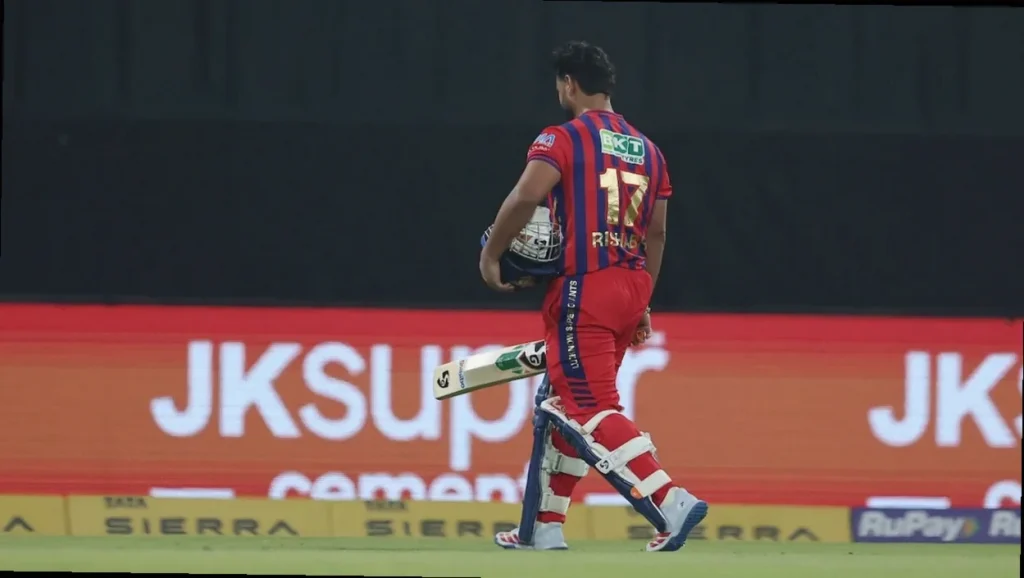
Rishabh Pant appeared to be finding his rhythm in the IPL 2026 edition, but his second-half momentum has stalled again. After making 43 off 23 balls in the last game as Lucknow Super Giants (LSG) chased a target of 255 against Punjab Kings (PBKS) and ended up 54 runs short, Pant struggled to get going on Wednesday, falling for a three-ball duck in another LSG defeat—this time against Rajasthan Royals (RR). It was LSG’s fifth loss in seven matches this season.
Quick facts
- Pant made 43 off 23 balls in LSG’s previous match vs PBKS, as the chase of 255 ended 54 runs short.
- Against RR on Wednesday, Pant was dismissed for a three-ball duck as LSG lost again.
- The defeat was LSG’s fifth loss in seven matches this season.
- Dale Steyn said Pant is playing “more than one game in his head right now,” trying to balance his own approach with what captains have been doing.
Dale Steyn linked the downturn to Pant’s mental juggling. He suggested Pant is attempting to play his natural style while also trying to match the aggressive, role-specific demands being pushed by leaders around him—names like Shreyas Iyer and Rajat Patidar were brought into the discussion. The result, Steyn implied, has been a batting identity that is not locking in at the top level when pressure rises.
Pant’s start to the campaign had offered some encouragement. In LSG’s second match of the season, he struck 68 not out from 50 balls in a win over Sunrisers Hyderabad (SRH), in a low-scoring game. Even so, beyond that innings and the 43 against PBKS, his production has been limited, with a highest score of 18 and a total of 147 runs across seven innings at a strike rate of 132.43.
LSG coach pinpoints the No. 3 pressure
Justin Langer, LSG’s head coach, was blunt about how the role at No. 3 can shape a batter’s decisions. After the loss to RR, he said Pant wants to play with freedom and that his instincts are visible across formats. Langer also noted that Pant may be feeling the squeeze that affects everyone when results are not coming through.
Langer added that Pant batted aggressively against Punjab because LSG were chasing 250-plus, and he felt that was the kind of cricket Pant wants to play. However, he stressed that the frustration is shared, because the innings did not land the way it was intended to on the day.
On ESPNcricinfo’s TimeOut show following the match, discussion quickly shifted from form to method. The emerging consensus was that Pant appeared unclear about the clearest way to approach his innings in this phase of the tournament.
Faf du Plessis framed it with an example of how elite batters manage tempo on difficult surfaces. He pointed to a hypothetical scenario: if Virat Kohli were in a similar situation, he argued Kohli’s default would be to avoid dot balls, attack along the ground, and build toward a fast accumulation—using gaps, staying high intensity, and reducing risk in a controlled way. Du Plessis said this “modern” template becomes especially important when the scoreboard is demanding runs late, such as when the target is around 160.
Du Plessis then connected the dots to the captains setting the tone in other line-ups. He highlighted how Iyer and Patidar have lifted standards—Shreyas Iyer with 208 runs in five innings at a strike rate of 182.45, and Rajat Patidar with 230 in six innings at 212.96. In that context, he suggested Pant has found it harder to match the pace of those expectations.
From a leadership standpoint, du Plessis argued that modern teams are pushing for aggression and for captains to demonstrate that mindset in real time. He cited Patidar as a leading example of how an RCB batting unit is playing, and Iyer as the style-setter for PBKS batting as well. The captain’s role, du Plessis said, is to shape the tone—so Pant may be thinking he must do the same.
But du Plessis believed what was required on the night was steadiness rather than forcing the issue. He said the wicket was tough and the situation called for calmly “scratching” through the contest—finding a way to reach the end without losing shape too early.
Saba Karim: template still not fully found
Saba Karim, speaking on the same programme, suggested Pant has not fully worked out his white-ball template despite being involved in domestic cricket and the IPL since 2015-16. Karim’s key point was clarity: a modern T20 batter has to create their own system for decision-making, shot selection, and tempo management.
Karim compared that to the apparent confidence of others. He said even if Rajat Patidar were to bat on a similar track, Patidar would likely have clarity about when to go big and how to trust his execution. Karim argued Pant’s issue is that he has yet to establish that clear template for white-ball cricket—not just in T20, but also in ODIs. He also observed that Pant’s preparation for Tests appears to have more transparency in how he thinks and prepares, implying that his thought process becomes more defined over longer formats.
The broader debate, then, is why Pant’s instincts are not translating into consistent returns. By raw numbers, he has proven he can deliver in the IPL—his 2017 season brought 366 runs at a strike rate of 165.61, while 2018 saw 684 runs at 173.60. Although he has never surpassed those peak totals in a single IPL season, he has crossed 400 runs in a season on three other occasions.
For LSG, the urgency is immediate. The side need Pant to show up quickly with the kind of impact that changes matches—because last season, his final tally of 269 runs in 14 innings at a strike rate of 133.17 is roughly where he sits at the moment. With form wavering and the season demanding results, LSG will be searching for a sharper Pant—one who can convert opportunity into runs before the tournament drifts further away.
