
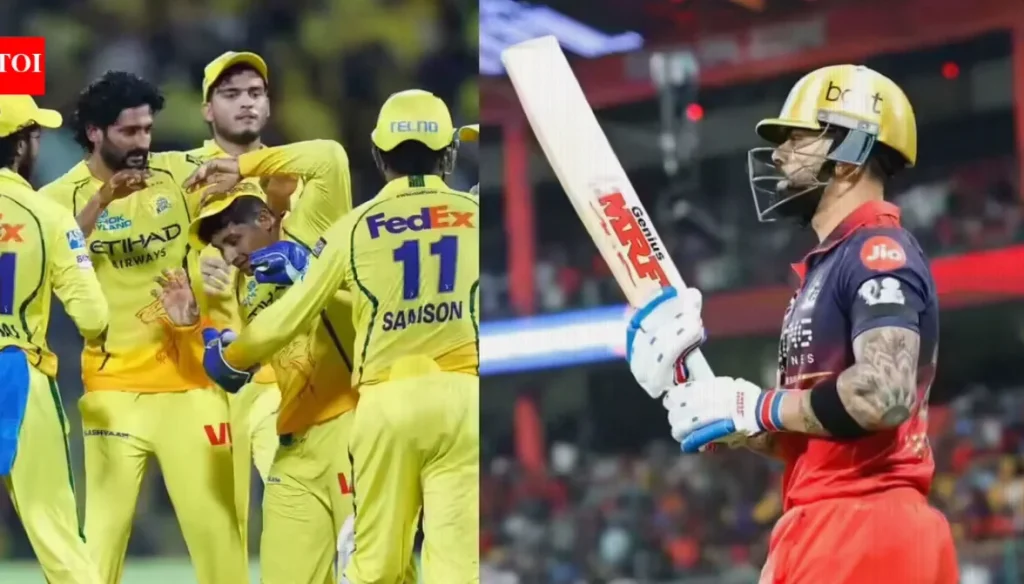
When Royal Challengers Bengaluru and Chennai Super Kings square off, it’s rarely confined to cricket alone. Few IPL match-ups bring the same level of emotion, because this rivalry is fuelled as much by identity and fan culture as by team sheets and tactics. The stadium noise, the social media digs, and the constant chatter around the fixture all add up to something bigger than a standard league encounter.
The excitement usually starts well before the first ball. Tickets tend to disappear quickly, online platforms fill up with playful jabs, and even everyday conversations in local circles often circle back to the clash. Expressions like “Ticket irka or Ticket beku” capture how deeply the rivalry has embedded itself into the way supporters talk and plan around match days.
One reason the atmosphere feels so distinctive is the travelling support. CSK supporters, in particular, are known for turning up in significant numbers even when the venue is Bengaluru, creating a rare blend of voices rather than a one-sided home roar. That mix leads to constant back-and-forth between stands, which only heightens the pressure on players and keeps the spectacle moving throughout the contest.
At moments, passion can also spill into sharper exchanges, but the overall effect is a more intense viewing experience. For brands, broadcasters, and other stakeholders, the fixture’s pull is widely recognised, often pushing it into the “marquee” bracket. In the end, the rivalry continues to thrive on feeling as much as on performance—so even if the on-field story becomes one-sided, the energy in the stands can still make the contest feel alive.
And when RCB and CSK meet, it’s not simply about match outcomes. It becomes a stage for pride, for belonging, and for the thrill of being part of something that fans across generations treat as personal.
RCB’s fast-bowling blueprint: the Chinnaswamy rethink
For RCB, their resurgence at M. Chinnaswamy has not been driven by batting alone. Instead, it has been built around a deliberate and repeatable plan in the bowling. For years, teams at this venue often needed to rely on variations and a more cautious rhythm to avoid getting punished by the small dimensions. Historically, that approach helped them survive the batter-friendly conditions.
However, RCB have leaned in a different direction. Their strategy has featured tall, seam-oriented pacers known for extracting bounce even when the surface is flatter than expected. Names in that mould include Josh Hazlewood, Lungi Ngidi, and Jacob Duffy—fast bowling that makes strokeplay harder than batters anticipate.
The effectiveness of the method comes from consistency. By repeatedly landing hard lengths, bowlers force batters to keep adjusting, which prevents them from settling into a comfortable tempo. Even at a ground famous for big hitting, this style has helped RCB manage key phases and exert control during spells.
Another advantage is how manageable the plan is under pressure. Compared with deliveries that demand extreme precision—such as slower balls or very specific yorker lengths—hard-length bowling is generally less risky and therefore easier to execute again and again.
That blueprint will be tested when RCB take on CSK. The CSK batting group brings experience and adaptability, with the ability to respond to different bowling styles rather than being pushed into one predictable pattern.
If RCB’s pace attack can deliver with the same discipline once more, it could influence how teams think about bowling at Chinnaswamy. More than that, it may offer a sustainable way to defend totals at a venue that has often been described as difficult for bowlers.
Squads
Chennai Super Kings squad
- Sanju Samson (w)
- Ruturaj Gaikwad (c)
- Ayush Mhatre
- Sarfaraz Khan
- Shivam Dube
- Kartik Sharma
- Prashant Veer
- Noor Ahmad
- Anshul Kamboj
- Matt Henry
- Khaleel Ahmed
- Jamie Overton
- Rahul Chahar
- Matthew Short
- Ramkrishna Ghosh
- Gurjapneet Singh
- Akeal Hosein
- MS Dhoni
- Shreyas Gopal
- Spencer Johnson
- Mukesh Choudhary
- Urvil Patel
- Aman Khan
- Dewald Brevis
- Zakary Foulkes
Royal Challengers Bengaluru squad
- Philip Salt
- Virat Kohli
- Devdutt Padikkal
- Rajat Patidar (c)
- Jitesh Sharma (w)
- Tim David
- Romario Shepherd
- Krunal Pandya
- Bhuvneshwar Kumar
- Abhinandan Singh
- Jacob Duffy
- Suyash Sharma
- Jacob Bethell
- Rasikh Salam Dar
- Kanishk Chouhan
- Venkatesh Iyer
- Josh Hazlewood
- Mangesh Yadav
- Vihaan Malhotra
- Vicky Ostwal
- Jordan Cox
- Swapnil Singh
- Satvik Deswal
IPL 2026 Match 11: the Chinnaswamy narrative shifts
Welcome to live coverage of IPL 2026 Match 11 between Royal Challengers Bengaluru and Chennai Super Kings. For years, M. Chinnaswamy Stadium felt more like a level playing field for RCB than a true home advantage. The smaller boundaries meant that even minor bowling lapses could be punished quickly, often taking the edge away from the home side.
That storyline began to change in the second half of IPL 2025. During their title-winning stretch, RCB showed they could dominate even away from home. They also managed to crack the Chinnaswamy conditions late in the season, stringing together back-to-back wins on their own turf.
That momentum has carried into IPL 2026. RCB have already started the season with another home victory, reinforcing the sense that their turnaround is not just a one-off.
Crucially, the shift doesn’t appear accidental. It points to a clear strategic evolution—better reading of local conditions, more effective bowling planning, and a squad balance that suits what the ground demands.
Now, with CSK in town, RCB’s “new Chinnaswamy” identity will be tested again. The key question is whether these improvements are sustainable across match-ups and pressure situations, or whether they were simply a purple patch that can fade once the opposition adapts.
