
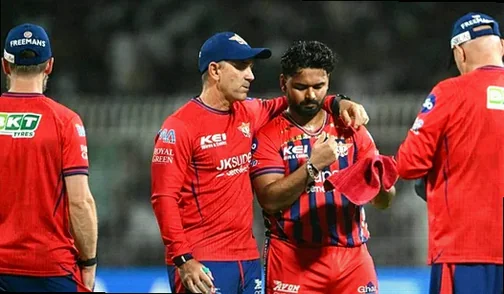
The Indian Premier League (IPL) 2026 has reached the halfway mark, and the pressure is rising as the qualification battle sharpens. Several franchises are trying to turn early lessons into second-half momentum, but some teams are still searching for the right balance through frequent lineup changes. For Lucknow Super Giants, that quest has come with consequences.
Quick facts
- Lucknow Super Giants are led by Rishabh Pant and finished seventh last season.
- LSG began the campaign with a home loss to Delhi Capitals, despite Pant opening the batting.
- LSG are ninth in the points table after seven matches.
- They have suffered four straight defeats heading into the next phase.
- On Wednesday night, April 22, LSG lost to Rajasthan Royals, chasing a target of 159.
- Rajasthan Royals were restricted to 159, but LSG were bowled out for 119.
- Mitchell Marsh top-scored with 55 off 41 balls in the chase.
- LSG’s batting slump: Nicholas Pooran-led middle order has managed 73 runs in seven outings.
- Manoj Tiwary criticised LSG’s lack of batting stability and clarity of game plan.
- Tiwary said the situation has moved beyond “turbulence” into a “crash”, citing the inability to chase even totals around 160.
At the start of the season, Lucknow showed flashes of potential even though they lost their opening game at home to Delhi Capitals. Rishabh Pant, the captain and a middle-order wicketkeeper-batter, made an unexpected move by opening the innings against DC. The decision looked like an attempt to set the tone early, but it did not deliver the desired payoff.
As the tournament has progressed, the constant reshuffling at the top has been linked to a drop in batting consistency. That instability has also taken the edge off the bowling group, which has been spearheaded by Prince Yadav and Mohammad Shami. Even with the ball doing enough work to keep contests close, the team’s inability to build reliable partnerships has repeatedly undone their efforts.
Lucknow, currently sitting ninth after seven matches, now finds itself on a grim run. They have lost four consecutive games, and the latest setback came against a high-flying Rajasthan Royals side led by Riyan Parag. The Royals were kept to 159, but Lucknow’s chase collapsed once again, turning what looked like a manageable target into another disappointing outcome.
Rajasthan Royals were restricted to 159 through a strong bowling display, yet Lucknow were all out for just 119. Mitchell Marsh, starting the chase for LSG, provided the brightest moments with a 55-ball effort of 55, but the rest of the batting failed to carry the momentum forward. The result meant the franchise could not capitalise on a solid start and convert it into a win.
Where the concern is
The defeat highlighted issues that management and the playing XI have struggled to fix as the season goes on. Manoj Tiwary, a former India batter, pointed to the absence of a settled batting order and a lack of an obvious, repeatable plan for how the innings should be constructed. In his view, the frequent tinkering after the opening game has made the team’s thinking difficult to pin down.
Tiwary stressed that when a side keeps changing the approach early, it becomes clear what the team is trying to solve—and that the solution has not taken hold. He argued that if the top overseas players who performed well previously do not seize responsibility and win matches, the franchise ends up in the same cycle of setbacks. His bottom line was blunt: too much shuffling is not the answer, and stability in the playing XI is essential.
His comments carry weight because Lucknow’s best form last year leaned heavily on a consistent opening platform. The Aiden Markram–Mitchell Marsh pair delivered standout returns in 2025 and was widely regarded as one of the most effective opening combinations of the season. Across that campaign, they put together an opening partnership total of more than 570 runs, with Marsh finishing on 627 runs and Markram adding 445.
That continuity appears to have been diluted this season. Rotations involving Ayush Badoni and Pant, along with adjustments to the opening structure that worked so strongly in 2025, have been cited as key reasons the team’s rhythm has not returned. The result has been a batting unit that struggles to find a consistent tempo, even when the ball department offers chances to win.
The cracks were visible again in the loss to Rajasthan Royals on Wednesday night, April 22. Markram, Badoni, and Pant were all dismissed for ducks in the 40-run defeat, underlining how quickly Lucknow’s chase was derailed. With the top order failing to provide a platform, the middle order was left with too much to do under pressure.
Nicholas Pooran, who was retained for ₹21 crore after a standout 2025 season, has also been in a severe slump this year. The middle order has managed only 73 runs in seven outings, leaving the team short of the kind of innings that can rescue totals in the death overs. When the batting struggles like this, even a “modest” target can turn into a trap.
Tiwary added that failing to chase totals around 160—combined with a fourth straight defeat—signals that the situation is becoming extremely difficult to reverse. He said clarity in decision-making is needed, and that the match against Rajasthan Royals was a golden opportunity to return to winning ways. In his view, Lucknow should not have needed to chase only bigger totals to secure points, especially in a season where the margin for error is unforgiving.
He also referenced Himmat Singh’s chance during the chase, noting that after years of opportunity, it still did not turn into the kind of impact innings the team required. Tiwary described the current state as no longer “turbulence”, but a “crash”, adding that there has been no escape from the downward spiral. With the playoffs race tightening, Lucknow’s pathway to the qualifiers now looks increasingly unlikely.
