
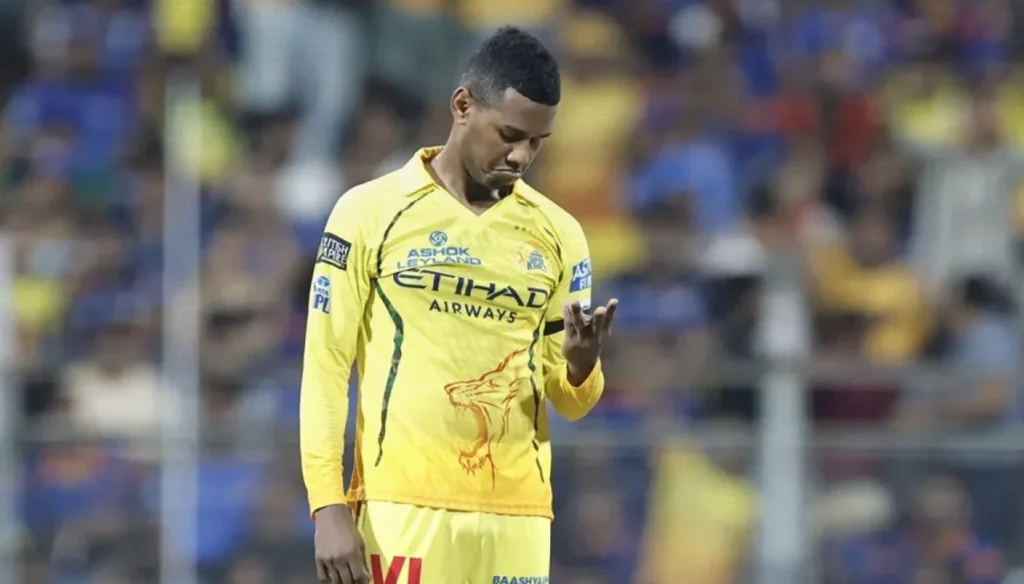
Akeal Hosein ended the night with a haul of four wickets, but the most telling part of his spell came long before the final tally. The story begins with the first wicket he took—and with the five deliveries he bowled before that breakthrough.
It was left-arm fingerspin from Hosein, attacking Quinton de Kock, the aggressive left-handed opener, with a fresh new ball in his hand. The surface was one where Chennai Super Kings (CSK) had earlier managed 207, setting the tone for a contest that demanded accuracy from the very first over.
Hosein was back in CSK’s XI after being left out for the previous game. The reason wasn’t far to find: the earlier selection dilemma hinged on exactly this kind of batter matchup. Matthew Short, who can chip in with bowling, had been ahead of him, with the team valuing his off-spin option. CSK, though, were up against Sunrisers Hyderabad (SRH) and one of the sport’s most damaging left-left opening combinations.
For Hosein, this was the job he has done across T20 leagues worldwide and for West Indies as well—operate in the powerplay, then use the seam-up arm-ball as a weapon. The variation is designed to swing: it can come in on the right-handers (an inswinging angle) and move away from left-handers (an away-swinging line), with the aim of keeping runs under control.
The plan against de Kock was straightforward in theory. Bowl from around the wicket to shape the ball across him, using both angle and movement to keep it away from his most comfortable hitting zone, while still avoiding too much width that would invite free swings.
But that is easier said than done. Hosein’s second ball drifted a touch wide of leg stump, giving de Kock access to his preferred scoring channel—backward square leg. The result was immediate impact, with a swivel-sweep that cleared the ropes for six.
Still, Hosein’s response on either side of that moment was sharp. He returned quickly with the ball landing on a good length, limiting de Kock to punches and stabbing shots that found fielders in the off-side inner ring. Dot balls, then a six, followed by dots again and a single—seven runs from five deliveries. For a spell that started with a miss, the recovery showed composure and control.
With that phase complete, Hosein shifted his focus to the right-hander Danish Malewar, a rookie in only his second IPL appearance. With the batter now different, Hosein had scope to open up his attacking options.
Over the last three decades, spin bowling has steadily grown quicker. Hosein generally bowls in the low-to-mid 90s in kilometres per hour, which would have been considered seriously fast for spinners back in the 1990s. Today, that pace is closer to the norm for many spinners, while the genuinely quicker operators—Varun Chakravarthy being one example—are often in the high 90s and can flirt with the low 100s.
Against that modern speed context, the ball Hosein delivered next looked oddly slower than it actually was. It wasn’t in the territory of Mitchell Santner’s earlier slow spells, when—earlier in the evening—Mumbai Indians (MI) left-arm spinner had dropped to around 78 kph at times. Hosein’s delivery clocked 86 kph, but the way it travelled created the illusion of extra hesitancy.
That’s the rare and beautiful sight batters fear: a ball that is objectively quicker yet still floats above the batter’s eye-line before dropping sharply to beat them. It’s the kind of delivery that drags batters forward while leaving them searching for timing. The key is how the ball spins—high revs, with the seam angled towards slip—finding the balance between sidespin and overspin.
Malewar went for it with a push at the ball, presenting a closed bat face while making contact well in front of his body. It almost looked as if he had rehearsed this exact ball in his warm-up routine. The delivery behaved like a classic left-arm orthodox stock ball: it dipped and then ripped through enough to threaten the outside edge.
Trajectory, revolutions, and length—those three elements came together again in Hosein’s following over. Naman Dhir, looking to step out and hit a ball he judged hittable, ended up swinging through thin air as the ball dipped and broke past him to strike the top of middle stump. At around 90 kph, it was even more deceptive: Dhir may have thought he had time to set a full stride into the shot, but it was simply an illusion.
Hosein now plays for CSK—the franchise he has represented for 12 seasons—and his new-ball wickets against MI, especially the one involving Dhir, carried a flavour that fans associate with Ravindra Jadeja. The two bowlers are not identical in style, but Jadeja’s greatness as a left-arm spinner is rooted in the ability to impart strong rip while keeping pace high and accuracy sharper than most. Hosein has not played Test cricket and has not featured in first-class competition since 2022, yet he shares some of those red-ball traits that translate into T20 control: pace for a spinner, plus precision for wickets.
On commentary, Dale Steyn—who had served as bowling coach at SRH when Hosein was part of their setup—highlighted how difficult it is to take the gloves and keep control against Hosein in the nets. The challenge, Steyn noted, comes from the way Hosein sticks to a length that can trim the top of the ball as it approaches batters. That “bail-trimming” length is widely viewed as a Jadeja specialty.
Jadeja, though, does not typically bowl in the powerplay in T20 cricket, and he is especially cautious when left-handers are at the crease. Hosein, by contrast, lives in those descriptions. Since the start of 2025, he has bowled more deliveries to left-hand batters in T20s than any other left-arm fingerspinner, with 223 of his 430 balls coming during the powerplay.
It’s also no coincidence that Imad Wasim—another frequent user of the arm-ball—sits second and third on those specific lists. What Hosein adds, beyond what Imad offers, is the capacity to turn the ball more sharply off the stock delivery as well, genuinely testing the right-hander’s outside edge.
With pace, exacting length, and the ability to trouble both sides, Hosein looks like an obvious CSK option. Yet team selection is seldom that straightforward, particularly at the point where fingerspin needs to align with overseas availability and matchups.
In that light, it makes sense that CSK chose Short instead of Hosein when Abhishek Sharma and Travis Head were the opposing threats. They may even have felt justified at first: Short conceded just 13 runs across his first two overs, before giving away 25 in his third.
Even so, Hosein’s showing against MI should serve as evidence that CSK need not avoid him when the opponent fields a largely left-handed batting lineup. Just as importantly, he can be used effectively against left-handers across every phase of an innings.
When Hosein returned for his third over, Tilak Varma was beginning to find rhythm after a slow start. In his most recent sequence of eight balls, he had already struck three fours.
On the first delivery, Tilak tried to slap it towards deep point, but the timing was off. As he ran for a single, he voiced frustration. Replays suggested the issue may have been linked to how Hosein released the ball: it was pitched short and angled away from Tilak’s hitting arc, and the seam was scrambled, leaving it with the possibility of either landing on the seam or catching the leather—meaning it could react differently depending on the exact contact point and, by extension, how the pitch received it.
Tilak faced Hosein again on the fifth ball of the same over. Once more, the seam scrambled and Hosein sent it skidding across him with movement through the air and then off the surface. Tilak attempted to hit into the angle, going for a swipe towards the leg side. This time, the ball appeared to skid slightly low, then struck the stumps after clipping the bottom edge.
“I’ve been trying to pick the coaches’ and players’ brains on red soil, black soil, what it does, which deliveries work,” Hosein said during his post-match press conference. “I was pretty happy with how I went about it today, because it can be a bit challenging if you don’t adapt to the conditions quickly. Some deliveries come on a bit slower, some surfaces react differently. It’s about just trying to do your homework as fast as possible.”
Hosein’s preparation showed on the Wankhede Stadium track. The pitch was unusually kind to spin, with spinners taking nine wickets throughout the match—an IPL venue record for Wankhede. Hosein used that to display the full range of what he can do. He swung the arm-ball as a powerplay option against left-handers, then rolled out his stock ball with loop and overspin to trouble right-handers, getting it to dip and bite. Finally, when he faced another left-hander with an older ball, he found a further route to exploit the surface’s quirks, maintaining an exacting length throughout.
Hosein has proven these skills in T20 cricket around the world, but he waited a long time to unveil them properly in the IPL. He played only one match for SRH in 2023, his debut season, and then went unsold at the next two auctions. Now, in his third CSK appearance and his fourth overall in the tournament, he may finally be making his case to stay firmly in the spotlight.
