
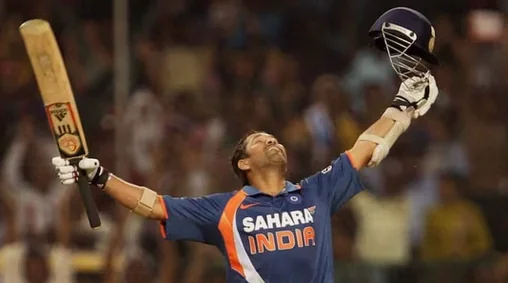
Sachin Tendulkar turns 53 today, and the occasion once again spotlights a record that anniversary writing often dresses up too neatly. The “100 international centuries” milestone is frequently presented as a sparkling, round monument—an achievement wrapped in celebration. The more revealing truth is less decorative and far more practical: it is a story of output sustained across 21 years, seven months and seven days, from his first international hundred in August 1990 to his 100th in March 2012. Up close, that monument is not a single peak at all; it is a quarry. For more than two decades, something was being carved out of the same raw material—day after day, year after year.
The real story is the span itself. Tendulkar did not build the total in one uninterrupted period of peak form and then coast past the finishing line. His first international century came at 17, and his last at 38. Between those two innings were different batting phases, different physical conditions, and different versions of the same player carrying the weight of accumulated runs forward.
The build-up: where the 100 came from
Tendulkar ended with 100 international centuries—51 in Tests and 49 in ODIs. The combined tally is still the international record, and it remains the only time any player has reached the 100 mark in this category.
What makes the number meaningful is not just that it exists, but how it was maintained. The record reflects both range and longevity: the ability to score at the highest level over a long stretch of international cricket, with the two formats rising together instead of one lagging behind the other.
- The first century arrived in a drawn Test against England at Old Trafford on August 9, 1990, when Tendulkar struck 119 not out.
- The 100th century came on March 16, 2012 against Bangladesh at Mirpur, where he made 114.
The contrast between those two innings is not chiefly about “how good” one was compared with the other. The separating force is time—more than two decades of international cricket compressed into one statistical arc. A high-water mark tells you how high a player once climbed; this record tells you how long the climb kept going.
Age spread: the point that refuses to go away
The distribution across age makes the scale difficult to ignore. Five international hundreds came before Tendulkar turned 20. Then he added 25 more between 20 and 24, followed by 35 between 25 and 29—often remembered as his harvesting years. From 30 to 34, he scored 16 more, and after 35 he still produced 19 further centuries.
That last figure is the part many discussions drift past. Nineteen hundreds after an age when most batting careers have already narrowed to a trickle is not a normal pattern. The record did not simply stop when the early peak ended; it kept feeding itself from reserves that arithmetic suggests should have run thin.
To sustain numbers like that, form has to be recovered across long periods. Technique has to be tuned as reaction times slow. Hunger has to survive repetition, even with the unusual pressure of being expected—again and again—to reproduce what has already been produced, in front of crowds who may forget how hard it is every time.
Century timeline: rebuilding across eras
Breaking the century count into segments by time makes the pattern vivid. Tendulkar scored 12 international hundreds from 1990 to 1995. From 1996 to 2000, he added 39—his most volatile batting period. Between 2001 and 2005, he made 22 more, and from 2006 to 2010 he produced 23. He then struck four centuries in his final run between 2011 and 2012.
These are not just totals; they describe a player repeatedly re-establishing the conditions required for production. The record is not fascinating because “100” is a round number. It is fascinating because the tally did not collapse after the prime years folded.
Even though he enjoyed a decade of dominance, his later chapter was substantial enough to keep the count moving. When decline eventually arrived, it did not move in a straight line. The curve bent—and then, at times, bent back again.
ODI milestones reshaped by a role change
One of the most important details in Tendulkar’s ODI story is what is missing. He began his ODI career in 1989, but his first ODI century did not arrive until September 1994—nearly five years later. That uncomfortable gap tends to get omitted in easy tributes because it complicates the idea of greatness that was supposedly inevitable from the first day. It should not be left out; it is exactly the kind of detail that makes the record feel earned rather than preordained.
The shift was tactical, and it is one of the clearest role-change narratives in modern batting history. In 1994, when Tendulkar was moved to open in ODIs, the shape of his white-ball career altered. As an ODI opener, he scored 15,310 runs in 344 innings at an average of 48.29, including 45 centuries. In every other ODI batting position combined, he made 3,116 runs across 119 matches at an average of 33, with four centuries.
Those figures read like two different careers. One was unlocked by a change in role; the other was what existed before the change. The 100 international centuries were not guaranteed from the moment he walked into international whites. There was waiting, adjustment, and a single decision that expanded one format’s contribution beyond what it had delivered so far.
Opposition strength: the record holds up under pressure
A century record of this scale can look impressive from a distance, only to weaken when examined closely against the quality of the opposition. Tendulkar’s total does not dissolve.
He scored 20 international centuries against Australia—the most by any batter against a particular opponent in his era. He added 17 against Sri Lanka, 12 against South Africa, nine each versus England and New Zealand, seven each against Pakistan and West Indies, and six against Bangladesh.
The figure of 20 against Australia does the heaviest work. It suggests the record was built substantially against one of the toughest opponents he faced across his career.
Just as importantly, the spread resists easy dismissal. This was not a case of one opponent, one set of conditions, or one psychological comfort zone inflating the numbers. The record covers Test cricket’s major nations and two formats that demanded different skills during an era when those skills were still evolving.
In Tests, Tendulkar’s 51 centuries remain the all-time benchmark. They were accumulated against every significant Test nation of his generation. In ODIs, the 49 centuries came during years when the format was sharpening—when the value of the opening slot was becoming decisive and when fielding restrictions and pitch surfaces were changing what it took to reach three figures. He stayed ahead of those adjustments for an unusually long period.
When he reached his 100th international century, he stood 29 centuries clear of the next-highest tally at the time—an overt separation that places the achievement in a different category altogether.
Not ornamental: match impact behind the milestones
Centuries are sometimes treated like private milestones—beautiful objects on a shelf, admired but sealed off from the result. Match details offer a correction.
In Tests, India won 20 of the games in which Tendulkar scored a hundred, lost 11, and drew 20. In ODIs, India won 33, lost 14, had one tie, and recorded one no result in his century-making matches. Across all 100 international hundreds, India won 53 times. That makes it hard to dismiss the record as decorative accumulation. In more than half of those matches, Tendulkar’s team finished ahead.
- The Old Trafford century came in a match India needed to save.
- The Mirpur century arrived in a context where the public focus was intense—the chase of the landmark itself had become an entire year-long spectacle.
Those two innings were surrounded by completely different match conditions. The skill of reaching three figures, the mental reset after early balls, the concentration reset after boundaries, and the management required during the last twenty runs were not the same. Yet the milestone still arrived.
Why the record still carries weight
Some records last because nobody comes close. This one lasts for a tougher reason: it blends accumulation with reach over a massive span—200 Tests and 463 ODIs—figures that signal durability even before the century count is considered.
It is not only about touching a ceiling once. It is about staying in the building long enough to keep touching that ceiling again, even as the environment keeps changing.
On his 53rd birthday, the proper way to read Tendulkar’s century record is not as a polished tribute, not as a museum exhibit behind glass. It is a record stretching from a teenage century at Old Trafford in 1990 to a landmark hundred in Mirpur in 2012—through role changes, format shifts, and the slow mathematics of age—without letting the standard drop for long.
He did not produce 100 international centuries through a single long outpouring of brilliance. Instead, he kept taking apart the conditions that might have prevented the next one, and rebuilding the conditions that allowed it to happen. That is why the number still stands alone.
