
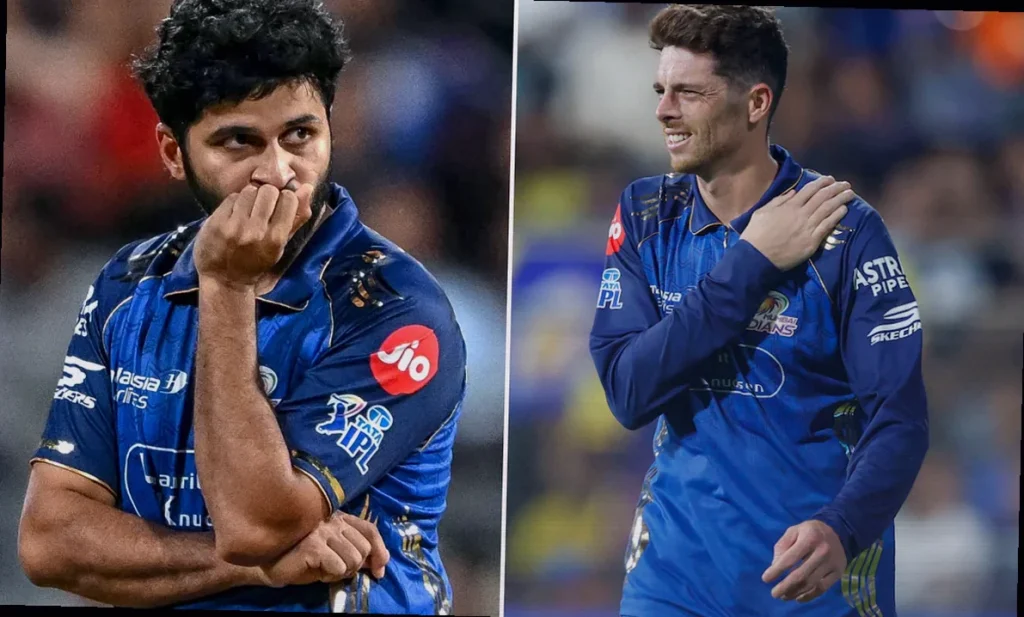
Five-time champions Mumbai Indians (MI) have found themselves at the centre of a fresh IPL 2026 storm after allegations of improper use of the concussion substitute rule during Thursday’s clash against Chennai Super Kings (CSK). The controversy erupted in the middle of the match when MI all-rounder Mitchell Santner was forced to leave the field after appearing to suffer an injury while attempting to complete a catch off Jasprit Bumrah. Santner, who is known for his spin-bowling craft and athletic fielding, climbed to take the chance off CSK batter Kartik Sharma, but immediately after the grab he was seen holding his shoulder and was subsequently taken away.
Almost right after the incident, MI moved quickly to make a formal request to bring in Shardul Thakur as a concussion substitute, and the request was accepted. From that moment, debate intensified—not only about whether the concussion substitution was justified, but also about whether Thakur could be treated as a like-for-like replacement for Santner under the match regulations.
Under IPL playing conditions, a concussion substitute is permitted only if the player has sustained a head or neck injury. Crucially, the degree of the injury must be backed by medical verification and a diagnosis before it is approved by the match referee. In Santner’s situation, the visible discomfort appeared centred on the shoulder, while the substitution request was linked to neurological symptoms rather than a purely shoulder-related issue. Even later in the contest, Santner was spotted using ice on his shoulder while seated in the MI dressing room, adding another layer to the scrutiny around what exactly was driving the decision.
The rules governing concussion substitutions, as set out in the ICC framework, allow such a change in several scenarios: immediately after a concussion is confirmed or suspected; after an assessment conducted on the field and/or away from the field; or at any other point when a concussion is confirmed or suspected, including cases where a player has already undergone evaluation and returned before the incident is treated as a concussion concern again.
In the build-up to the discussion, Santner’s effort at the deep—where he completed a diving catch off Bumrah—had been one of the key moments of the match. But once the substitution became the talking point, attention quickly shifted from the fielding highlight to the process that followed and whether it was applied correctly.
MI coach Mahela Jayawardene defended the decision, saying that both Santner’s neck and shoulder were affected during the catch. He also explained that the MI management sought a concussion substitute after the player was assessed and that the match referee permitted Shardul to replace him. Jayawardene said Santner “hit his head first and neck,” adding that he went for a scan after getting back. He described that once Santner returned, he felt dizziness, lay down, and while ice was used for the shoulder, the player did not feel stable, leading to further medical evaluation.
Jayawardene further underlined that the call to request a concussion substitute was made promptly, stressing that the ultimate permission lay with the match referee and the umpires. He also noted the emotional impact of the situation on Santner, remarking that the New Zealander would be disappointed to see his batting role matched by someone else, but that the decision had to be taken based on what officials allowed at the time. Even so, the switch did not swing the contest in MI’s favour.
Despite Shardul Thakur’s introduction, Mumbai Indians failed to recover momentum and were eventually handed a heavy 103-run defeat. The loss, coming after the heated concussion-substitute dispute, has only amplified the attention on MI as IPL 2026 continues to draw sharp questions about how concussion regulations are interpreted in real match situations.
