
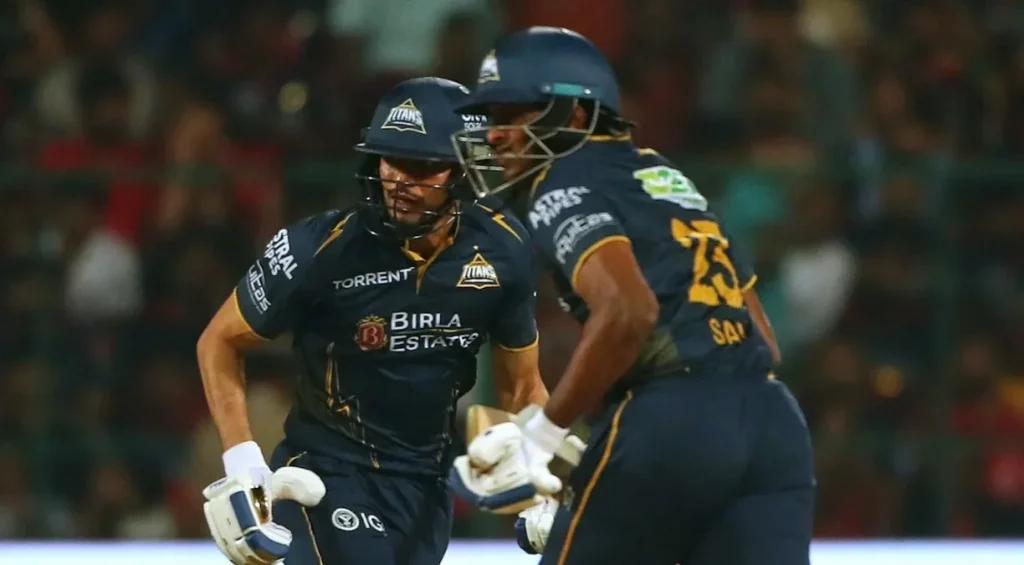
An unforgettable flash of timing defined B Sai Sudharsan’s third IPL hundred. He appeared set on targeting leg-spinner Suyash Sharma with a slog-sweep, and while it looked like he might have misjudged the bowler, Sudharsan’s advantage was in staying with the ball for that extra fraction of time. That late read let him alter his execution—lifting Sharma over wide long-off from the same slog-sweep setup, this time sliding down onto one knee to finish the shot.
Yet that very habit—watching the delivery for longer than most—may not always be a benefit.
It’s easy to sound critical of a young batter still shaping his career, but if the idea is followed through, the conclusion becomes less about him personally and more about the team’s approach. This isn’t a matter of opinion either; it can be seen in the numbers.
Sudharsan’s hundred at IPL 2026 arrived as the slowest of the six centuries scored in the tournament so far. It also came at the smallest and fastest-scoring venue for night matches this season, and, tellingly, it ended in defeat.
However, the issue isn’t simply Sudharsan. It is a Gujarat Titans (GT) issue.
Across their innings, GT never looked like they were putting enough runs on the board to create a defendable total under those circumstances. Even allowing for the argument that a slowdown between overs 16 and 19 cost them 20 runs, the total still didn’t match what the match conditions demanded—not necessarily the exact conditions that existed during their own batting, but those that shaped the Royal Challengers Bengaluru (RCB) chase. In night games, it’s now widely accepted that batting becomes easier as the chase progresses. The only real way to counter that is to overwhelm the chasing side with a mountain of runs. In places like Bengaluru and Mumbai, even a strong bowling unit like GT’s can struggle to compensate for insufficient totals.
GT are still leaning on habits that powered their early success, but the rest of the league has moved forward. By persisting with a conviction that other teams are not capable of exposing their flaws, GT are taking the risk of not pushing hard enough with the bat in situations where attacking cricket is required.
Since the start of the previous IPL, GT have gone after the ball less than any other side in terms of attacking deliveries. They have also posted the highest “control” rate when they do choose to attack. The pattern suggests they are waiting for mistakes rather than trying to score consistently off good deliveries—an area where other teams have clearly taken the lead. Even though GT are the second-quickest team to accelerate once they decide to attack, the bigger problem is that they simply don’t attack often enough.
GT’s answer to changing times has been to ask their batters to work harder and become more precise at risk-free acceleration. But that is not the most efficient use of eight batters in a match that lasts only 20 overs, especially with the impact player rule in play. Their run into last season’s top four, despite making the fewest attacking-shot appearances, was impressive—but there is a limit to what T20 batting can achieve without taking risks.
Since the start of the previous IPL, GT’s most prominent partnerships tell the story. The two highest-control partnerships with the lowest attacking intent have been GT combinations: Sai Sudharsan with Shubman Gill, and Jos Buttler with Gill. Those stands also tend to run long, leaving less time for others to turn average starts into truly match-winning totals.
In most T20 setups, the most destructive batting usually arrives in the lower-middle order. Yet since the start of the previous IPL, GT have left that zone with only 24.57 balls per innings on average. For comparison, Punjab Kings (PBKS) have lost their fourth wicket with 45.83 balls left on average, while RCB have 39.07 balls remaining. Those two sides reached the final last year and currently sit at the top of the table this season.
GT will offer two reasons for their style. First, their bowling has been far stronger than others, meaning their batters don’t always feel forced to take reckless risks while aiming for a par score like 240—because the bowling can still keep them in the contest even if they get close to 120 all out. Second, the runs coming from GT’s Nos. 6 to 8 have been limited: they have scored only 276 runs since the conclusion of the previous IPL, which is just 45% of the total made by the next poorest side on the same measure.
Trying to identify the cause becomes a classic chicken-and-egg dilemma. Do those batters post weaker numbers because they end up facing only around five balls per innings on average? Or is the innings so short that they never really get the opportunity to show what they can do?
In GT’s case, rather than solving the lower-middle-order question, they went the other way. They released Sherfane Rutherford, who had a better strike rate than the openers, even though he had to begin in more difficult match situations and conditions. The obvious thought is: why not add another hitter and let the top order play more freely? At the moment, though, it reads like a self-perpetuating loop—we will not add firepower in the off-season, and then we’ll cite a lack of hitting in the lower middle order as the reason we can’t take enough risks.
Still, GT’s overall efficiency and quality in both departments have been enough to keep them landing in the kind of positions they need—similar to last year, when they looked capable of winning the title if they could have turned three straight games against the tournament’s strongest teams into victories.
At this stage, GT may not have the batting depth required to play a less conservative brand of cricket. Until they build that depth—so they can attack throughout an innings—the team’s batters are working on the idea that the side committing the fewest unforced errors will win.
But the game has moved. The standards of hitting, the depth within batting line-ups, and even the character of pitches have all changed. As a result, costly mistakes are being made at a lower rate than what captain Gill and coach Ashish Nehra want to bank on. They are likely to come to the realisation that this approach—playing low-risk cricket and waiting for the opponent to commit high-cost errors when attempting high-risk shots—will not always produce the same rewards. That is the point when GT will need to construct a stronger XI, one that helps players maximise scoring rates without worrying about getting out quite as often as they currently must.
