
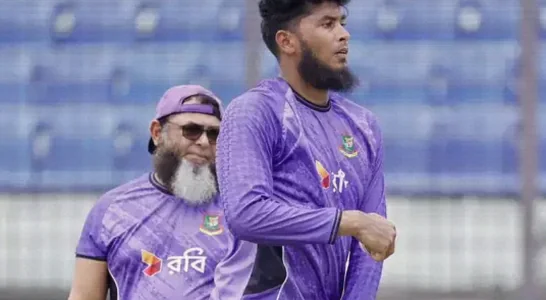
Bangladesh spin bowling coach Mushtaq Ahmed says the team setup is focusing on refining Rishad Hossain’s bowling action so the youngster can produce steady, repeatable overs—not only moments of impact. The former leg-spinner also believes that sitting out the third ODI versus New Zealand may ultimately prove beneficial for Rishad’s growth, arguing that periods away from the XI often build a player’s mental strength.
Rishad has become a talking point after being left out of the third ODI, with questions raised over how frequently he was used in the matches before that. Mushtaq noted that such swings can be part of the learning curve, but he also pointed to clear areas for development in Rishad’s craft, especially in terms of consistency and control.
Earlier, Rishad had established himself as Bangladesh’s leading spinner during the home ODI series against West Indies in October. In that run, he finished with 12 wickets, including a career-best haul of 6 for 35. His performances earned him a spot in franchise cricket as well, and he later turned out for Hobart Hurricanes in the Big Bash League, where he took 15 wickets in 11 matches—jointly the highest wicket tally for a spinner in the tournament.
Since returning to international duties, though, his role has not followed a smooth pattern. In the first ODI against Pakistan, he bowled just two overs, and in the subsequent games he failed to complete his full quota. A comparable trend continued against New Zealand, where he delivered only 15 overs across the first two fixtures before being left out.
Mushtaq stressed that these phases are normal for young players transitioning to top-level cricket, and he underlined the importance of temperament at the highest stage. “I think this (sitting out) is a part of his progress. Sometimes when you sit out, you ask yourself what your mindset is. As a coach, it’s our responsibility to strengthen his mindset,” Mushtaq said. “International cricket is about having the right temperament. It’s a mental battle more than anything else. Skill gets you there, but you have to survive at this level with the mindset.”
He added that his job is to make Rishad mentally tougher as well as technically sharper. “You need a strong mindset to stay at the international level, and as a coach, my duty is to make him mentally tougher,” Mushtaq said. He also clarified that Rishad was not dropped purely due to poor form, pointing instead to the wider balance Bangladesh want across spin options. “He was not dropped basically and he bowled very well in the last ODI. But we want to get stronger in other spinners too, and all spinners should get some games,” he said.
Mushtaq further explained that the team wants players who are not playing to remain upbeat and focused. “This is our duty to make sure that when people are not playing, they stay mentally positive,” he said, while adding that Rishad still needs to develop his googly. In particular, Mushtaq wants improvements in the angle and the side of release against right-hand batters, aiming for more consistent execution. “His googly has to improve a bit more—the angle of the googly, which side you have to bowl to right-handers. Whether it’s close to the stump or wide of the stump. Using the crease with a basic, strong, repeatable action is something I always mention,” he said.
He warned that leg-spin can become costly without the right structure, which is why he wants the youngster to move from producing “good balls” to delivering “good overs.” “That’s very important for a leg-spinner because leg spin can be expensive. So we want to work on his action so he can bowl good overs rather than just good balls,” Mushtaq said.
Mushtaq also discussed Mehidy Hasan, highlighting the need for more variety in his bowling. He stressed that Mehidy is not a “mystery spinner” and is expected to contribute beyond simply slowing the run rate. “He (Mehidy) got wickets in the middle overs. In the last game he took a very vital wicket—Latham. He’s a good player. He can take other batters with him,” Mushtaq said, referencing how Mehidy’s skill can shift momentum.
Mushtaq said Mehidy’s role should include more than containment, and he pointed to Mehidy’s progress as he develops variation. “His role is not only containing runs, and because he’s not a mystery spinner, one thing he can do is develop his variation—which he’s been working on. Credit goes to him obviously,” he added. “But from my point of view as a spin bowling coach, you have to have a variation. You have to change your pace, especially with Western batters,” Mushtaq continued.
He explained that Western batters often have quick hands, so a spinner must adjust speed to create deception. “They have fast hands. So when they have fast hands, you have to vary your pace as a spin bowler. If you vary your pace, you can deceive them. That’s why he got the wicket—Latham—and obviously the last wicket,” he said. Mushtaq then wrapped up his assessment by returning to fundamentals like crease usage and angle. “So he’s been bowling well. Overall, you use the crease—depth of the crease, angle of the crease. Cricket is an angle game,” he said.
He also spoke about tactical aspects of spin bowling, suggesting that matchups can be managed through field placement and strategic planning. “Sometimes you get people out with the field position and tactical moves. If you have those tactical moves, you can stop them scoring runs by understanding their strengths. If you can figure it out during a match, have the strategy, and execute your plan well, you have a better chance to win matches,” Mushtaq added.
On Bangladesh’s overall situation, Mushtaq said the mood in the camp remains upbeat after their ODI series success, while cautioning the side not to become complacent heading into the T20I leg. “Winning the last series is always helpful. It’s a happy dressing room. When you win, a lot of things you don’t even notice. But as coaches, we always want to focus on what can still be improved — there’s always one percent you can get better at,” he said.
Mushtaq noted that the team’s recent ODI wins are positive for confidence and said the squad is also prepared to experiment in the shorter format. “So I think the last three ODI series we won, so it’s good news for Bangladesh cricket,” he said, before adding that T20 is an excellent stage for younger players to express themselves. “Coming into T20, there are a few youngsters, and I think it’s a great platform for them to express themselves,” Mushtaq said. “At the same time, we want to strengthen the bench. You’ll see lots of variation—like in the last game, even Tanvir played while Rishad didn’t.”
He concluded by saying that when Bangladesh go into the World Cup, having bench players with more match experience will help the squad be better prepared. “When we go to the World Cup, the bench strength and the other players will have had a lot of cricket matches under their belt, so they can be ready to play for the national team,” Mushtaq said.
