
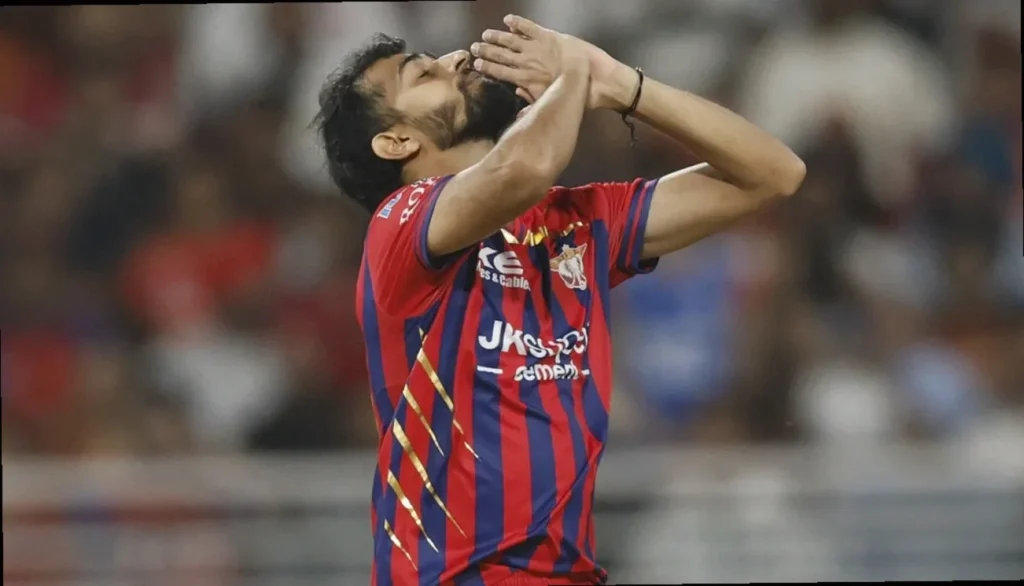
Prince Yadav’s surge in IPL 2026 has been powered by a simple, repeated message from his coach Amit Vashisht: back your yorkers—especially when the match is on the line. The Lucknow Super Giants pacer has since sharpened his death-overs role, refined how he attacks with the new ball, and developed variations that make him harder to read.
From a GT setback to a yorker blueprint
Not long after Lucknow played Gujarat Titans (GT), Prince received a call from Vashisht. The conversation quickly turned into instruction rather than criticism.
“Prince, what is your strength?” Vashisht asked. “Yorkers, sir,” Prince replied.
Vashisht then pointed to a moment from the GT game: Prince had bowled the second-last delivery of his spell slightly short, and Washington Sundar deposited it for six on the leg side. That 14-run over gave GT a much easier route to victory.
The coach pressed further. “Where is it then? Where is the yorker?” Prince answered with a clear mindset for the pressure phase: “It is the death overs, beta. Yorker is yorker. Back your strength and bowl more of it.”
Big improvements in IPL 2026
About a week later, Prince put the plan into action against Punjab Kings (PBKS). In the final over, he nailed his yorkers and conceded only five runs while taking a wicket.
Even though PBKS finished on 254 for 7, Prince’s figures—4-0-25-2—stood out as a controlled, wicket-taking spell. A match later, he earned the Purple Cap for the first time, with his two wickets versus Rajasthan Royals lifting his haul to 13 and keeping his economy at 8.38.
So far in IPL 2026, Prince is averaging 16.76 runs per wicket.
How Lucknow backed him and what changed in his bowling
Prince is in his second IPL season. Lucknow Super Giants picked him up at the IPL 2025 auction with a base price of INR 30 lakh. While he showed promise in his debut campaign, his output was modest—three wickets at an economy rate of 9.85, with an average of 75 from six appearances.
Lucknow retained him for IPL 2026, and the early returns have come through in a pace group that includes India internationals Mohammed Shami, Avesh Khan and Mayank Yadav, along with Mohsin Khan, who is in his fourth IPL season.
Coaches rebuilt his lengths and death-overs execution
Prince’s background is rooted in tennis-ball cricket, but his first taste of IPL cricket exposed what needed to evolve—particularly around length selection and skill execution at higher tempo. Vashisht, who has coached Prince since his early days at the Sporting Club in Najafgarh in Delhi, worked on widening his skill set.
Vashisht, 45, explained that the issue was not effort, but consistency of line and length in key phases. He said Prince often bowled back-of-a-length deliveries in pressure overs, which lowered his wicket-taking chances. Those weren’t even the “uncomfortable” lengths aimed near the armpits; instead, they were a zone batters could handle.
- They focused on bowling fuller, not just landing back-of-length.
- They worked on keeping the ball in the air and creating swing.
- Prince was trained to hit marked spots on the pitch surface.
- He completed practice spells of three or four overs to build repeatable patterns.
- Training included match-simulation scenarios—such as defending 15 runs and bowling to the bowler’s strengths.
- Because Prince’s strength is yorkers, the work specifically targeted sharpening those deliveries.
Vashisht also highlighted that Prince used swing effectively to dismiss Ishan Kishan and Axar Patel.
New-ball bowling became a deliberate project
Improving Prince’s ability to operate with the new ball was a separate task too, one that Delhi head coach Sarandeep Singh—himself a former India offspinner—took on after tracking Prince’s development in domestic cricket and the Delhi Premier League (DPL). Sarandeep felt Prince was still raw and quick, and that an IPL opportunity had shown both his strengths and what he still had to master.
“This season when Prince came to the [Delhi] nets, I told him you should take the new ball,” Sarandeep said. “Last season, he bowled a lot with the older ball. So whenever he got the new ball, he got hit. He couldn’t comprehend the lengths to bowl with the new ball.”
Sarandeep added that the solution was mental planning as much as physical execution. He asked Prince to visualize how he would try to get a batter out by pitching the ball up. Prince responded that his goal was to create chances for the slip cordon by putting the batter under pressure.
- Prince worked on building a strong outswinger.
- He trained intensively at multiple camps for about one-and-a-half months.
- The progress could be seen in the DPL, in domestic T20s, and particularly in the Vijay Hazare Trophy.
Domestic performances that backed the IPL rise
In the Vijay Hazare Trophy 2025-26, Prince finished with 18 wickets to become Delhi’s leading wicket-taker. Sarandeep noted that this came a month after Prince took eight wickets in the Syed Mushtaq Ali Trophy 2025, where he was the second-highest wicket-taker for Delhi.
Sarandeep described Prince as a quick learner, adding that last season the wider cricket world had not fully seen him. This time, he suggested, batters would know more about what Prince’s yorkers can do—so the next step was learning to execute that plan with the new ball and take wickets consistently.
Powerplay patterns, variations, and growing responsibility
Prince has also started to make an early impact in IPL 2026. He has taken five wickets in the powerplay so far, with the distribution showing how his approach is evolving.
- Only one of his powerplay wickets came off a full-length ball—against Kishan.
- Two wickets came via short-ball tactics.
- Forty-eight percent of his deliveries in the first six overs have been short or short-of-good length.
At the same time, his numbers show a shift in how often he attacks in the correct “money” zones. The share of full-length deliveries and yorkers has increased to 17% this IPL, up from 12% last year.
He has also added a slower bouncer to his toolkit, making his balls harder for batters to line up. Vashisht said the focus this season was specifically on building variations like the slower bouncer—something Prince did not have last year.
Vashisht added that Prince’s fast arm speed makes the variations difficult to pick even for the coach. He said he himself struggles to track them from behind during spells and that Prince improved by bowling like a one-man unit in extended single-wicket sessions lasting two to three hours.
Leading the attack accelerated his learning
Another factor in Prince’s improvement has been responsibility. Sarandeep said Prince was given the added task of leading Delhi’s pace unit alongside Ishant Sharma, which helped him develop game-reading instincts and preparation habits for different opponents.
Sarandeep explained that this season Prince was often around Ishant, learning how to read situations and how to set himself up before facing different styles of batting.
He pointed to the Syed Mushtaq Ali Trophy as another learning ground, noting that Delhi played bigger teams such as Karnataka, Mumbai and UP—sides that are strong in white-ball cricket. Sarandeep argued that because Ishant was with Delhi, Prince benefited from that experience in dealing with high-quality batters.
Lucknow’s table position and why Prince’s impact still matters
It is not easy to stand out in a side that is not winning consistently. With two victories and five defeats, Lucknow Super Giants sit ninth in the points table at the halfway point of the tournament.
Even so, Prince is not only Lucknow’s leading wicket-taker; he is also the team’s second-most economical bowler. His performances may not always translate into wins for LSG, but they have clearly not gone unnoticed.
