
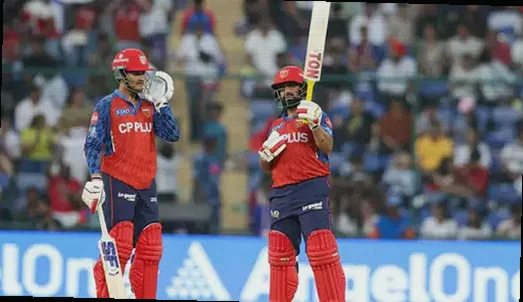
Punjab Kings produced what could be the most stunning chase of the Men’s T20 season, overwhelming Delhi Capitals with the highest successful run chase in men’s T20 history. Chasing 265 for victory, Prabhsimran Singh smashed 76 off 26 balls and Shreyas Iyer remained unbeaten on 61 off 30 as Punjab reached the target with 7 balls left, winning by 6 wickets. The brilliance of KL Rahul and Nitish Rana—who combined for a 220-run stand while batting for Delhi—ultimately proved insufficient, as the finalists from last year extended their own impressive run by finishing the day unbeaten after seven matches.
Key takeaways
- Punjab Kings chased 265 successfully, completing the task in 18.5 overs after Delhi finished on 264/2.
- KL Rahul’s 152* off 67 and Nitish Rana’s 91 off 44 powered a 220-run partnership for Delhi, the second-best for any wicket in IPL history.
- Prabhsimran Singh’s 76 off 26 and Shreyas Iyer’s 61* off 30 starred as Punjab won by 6 wickets with 7 balls remaining.
- Delhi’s total of 264/2 was the highest score of the season, while Rahul’s 152* became the best IPL score by an Indian batter.
- South Africa pacer Lungi Ngidi suffered a severe head injury in the third over and required an ambulance to leave the field.
- After the chase, Delhi host Royal Challengers Bengaluru on April 27, while Punjab will return home for a match against Rajasthan Royals with an extra day’s break.
Delhi’s innings: Rahul’s record-setting surge and a massive total
Punjab Kings looked rattled early, particularly in the field, with Shashank Singh dropping another chance at square leg. That miss came when Rahul was on 12, and it proved costly as he went on to add 140 more runs to his score. Arshdeep Singh struck soon after, dismissing Pathum Nissanka in the same over, but the wicket only brought Nitish Rana to the crease and opened the door for an explosive second-wicket stand.
Rahul took control in a way that felt like a throwback to his more dominant IPL seasons. He struck 35 runs off his first 15 balls for the fourth time in the tournament, with the earlier instances coming during 2018 and 2019 when he played for Punjab. Rana, meanwhile, faced several variations from Marco Jansen and Xavier Bartlett, but he kept pace and allowed Rahul to keep finding gaps.
Rahul reached a fifty in 21 balls, and Delhi moved to 102/1 by the halfway stage. Rana then shifted gears in the 12th over, striking Xavier Bartlett all around the ground. His half-century came with a string of boundaries — 6, 4, 4, 4, 4, 6 — including hits over square leg, fine leg and cover.
Death overs drama: Rahul’s sixth IPL century and Delhi’s 264/2
At 153/1 in 13 overs, Shreyas Iyer had to lean on his best to keep momentum flowing. Arshdeep entered the attack, but Rahul’s intent stayed unchanged. He improvised with a scoop over the bowler’s head for four, followed it with a straight six and then a straight four, before finishing the over with a cut behind point to push his score into the 90s.
Marco Jansen returned and again watched the ball travel as Rahul struck boundaries, reaching his sixth IPL century in the process. The landmark also arrived at the fastest rate—off just 47 deliveries.
After striking 120 runs in the middle overs, Rahul and Rana went after another surge at the death. Rahul smashed three sixes off Vijaykumar Vyshak in a 24-run over to help Delhi push past the 200-mark by 16 overs. A rare quiet over followed from Yuzvendra Chahal, but any hope of removing Rana was shut down after a TV umpire’s decision.
Marcus Stoinis took an outstanding catch at square leg, yet replays suggested the Australian’s foot had touched the boundary line, overturning the dismissal. Rahul added a six and a four in the 19th over to move into the 90s before finally falling to a sharp catch from Shreyas Iyer at mid-off. That wicket ended a 220-run partnership—the second-best for any wicket in IPL history.
Arshdeep finished Delhi’s innings with a nine-run over, leaving the chase set at 264/2, the top team total of the season. Rahul ended unbeaten on 152 off 67, which also stands as the best IPL score by an Indian batter.
Punjab’s chase: early setbacks, Ngidi’s injury, and the turning point in the middle overs
Punjab’s response began with intent. Priyansh Arya struck the first ball of the chase for a six and added nine more in the opening over from Auqib Nabi. Mukesh Kumar was then hit for 21 in the second over.
In the third over, Lungi Ngidi attempted a catch from mid-off and slipped badly, suffering a severe head injury. He needed an ambulance to be taken off the field.
With play resumed, Arya and Prabhsimran carried on attacking. Axar Patel conceded 20 in the third over, and Nabi, changing ends, was punished again as he gave away five sixes in a 27-run over. Punjab raced to 83/0 within four overs. Natarajan then tightened things up, limiting the openers, though he still conceded nine runs. Prabhsimran struck six fours off Mukesh Kumar to finish the Powerplay on 116/0, and in the same over he reached a 18-ball half-century.
Even with the target already cut down—Punjab had effectively collected half of the required runs by the seventh over—Delhi fought back through Axar and Kuldeep Yadav. Both openers were removed as the momentum changed. The Delhi captain sent Arya back for 43 off 17 balls, caught at deep mid-wicket. Prabhsimran’s rapid knock—76 off 26 with nine fours and nine sixes—was then ended by an LBW decision against Kuldeep.
Delhi almost produced another breakthrough immediately, nearly dismissing Cooper Connolly in the next over from Axar, but Mukesh’s foot brushed the boundary line after a diving catch at deep square leg. Kuldeep made amends by striking again in the 10th over, cleaning up the batter. Punjab reached 147/3 after 10 overs, but that was set against a dip to 31/3 in the four overs after the Powerplay.
Trying to bring the chase back on track, Shreyas Iyer and Nehal Wadhera took 16 runs off Natarajan. However, Vipraj Nigam—brought in as the concussion substitute—removed Wadhera at long off in the 15th over. In the same over, Nigam also created a chance to distance Punjab from the contest when he got Shreyas to miscue a big shot, only for Karun Nair to drop it. Punjab entered the death overs on 203/4, needing 62 off 30 balls.
Finishing burst: dropped chances, Shreyas’ composure, and a record chase
Although the contest had plenty of six-hitting, it also featured costly fielding moments. Nair dropped Shreyas once more in the 16th over, this time at long on. The Punjab captain responded by smashing three sixes and a four during a 23-run over in the same phase. He then struck again against Natarajan in the 17th over, hitting a four and a six to reduce the equation to 23 off 18 balls.
Shreyas kept finding boundaries without letting the pressure build. He struck Mukesh for a four and a six, then hit another six off Natarajan in the 19th over. A wide completed the game setup, and Shreyas walked off with 61* off 30, sealing the chase.
What comes next for Delhi and Punjab
Delhi Capitals remain at home and have a quick turnaround, hosting Royal Challengers Bengaluru on April 27. Punjab Kings return home as well, with an extra day’s rest before their next match against Rajasthan Royals.
