
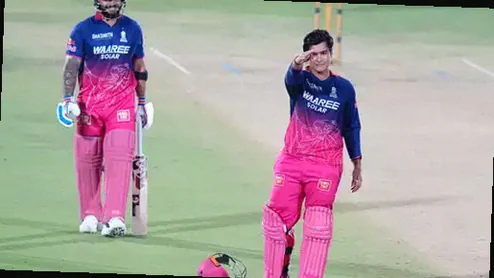
Vaibhav Sooryavanshi’s astonishing 36-ball century for Rajasthan Royals didn’t end with a win, but it left a lasting impression on even the opposition captain. The 15-year-old’s fearless hitting—highlighted by a first-ball six against SRH—has already begun to look like a permanent fixture in the league, with his confidence growing against some of IPL’s toughest fast-bowling names.
Sooryavanshi’s rapid landmark and Cummins’ admiration
Sooryavanshi struck a century off just 36 deliveries, a mark that ranks as the third-fastest hundred in IPL history. While Rajasthan couldn’t convert the momentum into victory, SRH captain Pat Cummins was visibly impressed by what the teenager is delivering so early in his career.
Cummins described the batter in enthusiastic terms, saying Sooryavanshi has quickly become his “new favourite player” because of the sheer power behind his shots and the excitement of watching him play. He also stressed the difficulty of bowling to a hitter like that, noting that if a bowler isn’t accurate, the ball can travel a long distance.
Confidence against top bowlers, plus Cummins’ context
In the same burst of praise, Cummins pointed out that Sooryavanshi has looked increasingly at ease against leading bowlers in the competition. The SRH captain cited matchups against Jasprit Bumrah, Bhuvneshwar Kumar, Marco Jansen, Josh Hazlewood and Arshdeep Singh, underlining that the teenager’s form isn’t limited to weaker bowling attacks.
Cummins also spoke about his own availability and timing, noting that this was his first appearance of the season after returning from rehab. That return made his assessment of the young batter’s impact feel even more direct, coming from a player who has been watching his peers closely and had to manage his own comeback rhythm.
IPL scoring debate: Cummins on run volume, flat wickets and balance
With the IPL continuing to produce high totals, Cummins joined the wider conversation about whether the tournament needs a better balance between bat and ball. He referenced the sheer volume of runs from the weekend, saying that on Saturday alone the two matches combined for 986 runs.
Still, Cummins didn’t sound overly concerned. He suggested the current scoring trend is simply part of cricket’s present structure—emphasising that T20 is only 20 overs per side, not a format where batters spend days at the crease on flat surfaces. In his view, since there are only a maximum of four overs for each bowler, the conditions naturally encourage aggressive batting.
He added that teams plan with that reality in mind. From a bowling perspective, the job is to limit runs rather than resist the concept of attacking batting. While match scores may look different compared to earlier IPL seasons, the overall idea remains the same.
Flat pitches, short boundaries and bowling pressure at the death
When asked how he approaches bowling to longer batting line-ups on flat pitches with shorter boundaries, Cummins framed it as a challenge rather than a frustration. He argued that even if a bowler has a difficult couple of overs, a strong finish—particularly in the death overs—can swing the match.
In fact, Cummins suggested that the pressure can be slightly different for bowlers when batting depth is strong, because a side may feel it can chase a big score if the bowlers manage key overs well. He also highlighted how crucial each over becomes in a high-scoring environment: taking a wicket in one spell or delivering one top-quality over can carry similar weight to a good bowling spell in a lower-total game.
Finally, Cummins said the tactical requirements don’t vanish in modern high-scoring IPL conditions. He believes teams still need five capable bowlers, and the league often still rewards flexibility—whether that means selecting an extra spinner or maintaining variety in the bowling attack.
