
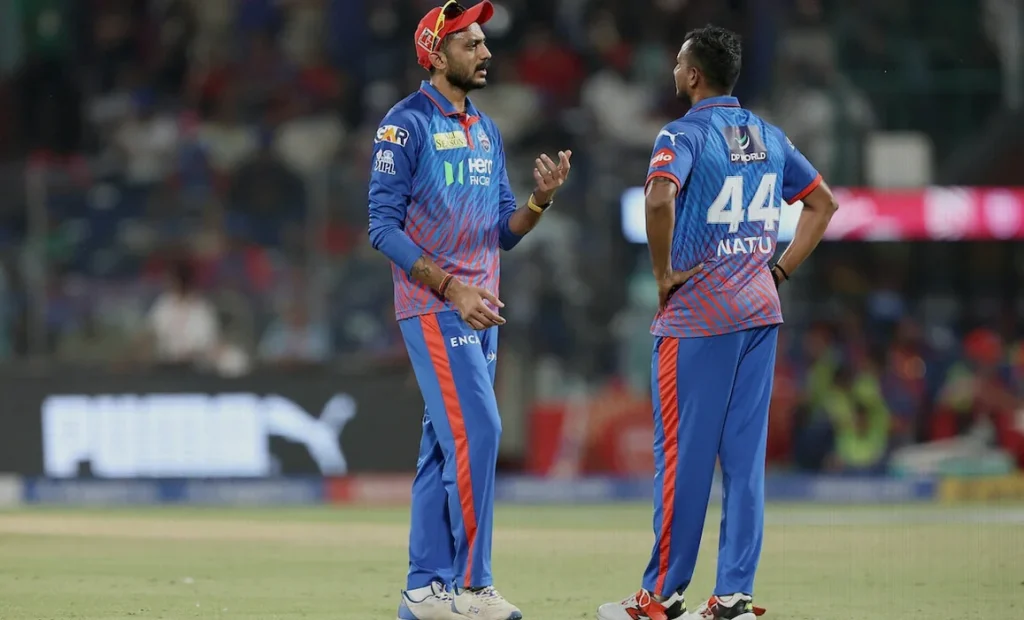
Former West Indies all-rounder Carlos Brathwaite felt Delhi Capitals (DC) didn’t bring enough urgency in the powerplay, a factor he believes kept Punjab Kings (PBKS) comfortably in front during their stunning run chase of 265 at the Arun Jaitley Stadium on Saturday. With a massive target sitting on the scoreboard, Brathwaite argued that DC’s bowling plans lacked the proactive mindset needed to force pressure early, especially when they had the luxury of defending a total of that size. He also questioned how rarely T Natarajan was used during the opening six overs, pointing to the effect it had on the tempo of PBKS’s innings.
“When you bat and score 200 and a lot, you don’t necessarily need to be defensive, but have a mindset that this can be scored. I saw Natarajan bowl just one over in the power play. They could have been a little bit more proactive,” Brathwaite said. The discussion around DC’s approach became more pointed when you consider the way PBKS responded to the bowling onslaught that was meant to be the foundation of the defence.
DC ended up defending 264 for 2, driven by KL Rahul’s unbeaten 152 and Nitish Rana’s 91. Yet, in the chase, DC handed four of their first five overs to Mukesh Kumar and Auqib Nabi. Together, those two conceded 87 runs across that burst, leaving PBKS with momentum rather than a problem to solve. Even Captain Axar Patel was taken for 20 in his over as PBKS raced to 116 without loss inside the powerplay.
Brathwaite believed DC missed a prime opening to apply pressure by not bringing their key options into the attack early enough. In his view, even if wickets don’t immediately fall, restricting the flow of runs during the first phase can shift the entire equation. He argued that PBKS would have required far more from that stage if DC had made bolder choices with their strike bowlers.
“Get Kuldeep on early. He may not get a wicket, but he may stem the flow of runs for an over. Natarajan took the pitch out of play. If Natarajan and Kuldeep had bowled three out of the first six overs, and PBKS had scored 65 in the powerplay, PBKS would have so much more to do,” he added. That plan, he said, never quite materialised, and PBKS’s start became the platform for the rest of their chase.
Left-arm wrist spinner Kuldeep Yadav was introduced only in the eighth over, by which point PBKS had already moved to 127. During that stretch, Prabhsimran Singh and Priyansh Arya played a dominant role, putting the chase into a comfortable rhythm before the ball had even fully settled into the middle overs. With such a base established, once captain Shreyas Iyer arrived after the openers fell in the seventh and eighth overs, the required rate stayed under control rather than ballooning.
Iyer then anchored the chase with an unbeaten 71 off 36 balls, steering PBKS to a sensational finish. Brathwaite pointed out that the powerplay had been so productive that Iyer could bat with freedom when he came in, something that would have been far harder if DC had forced the rate up early.
“They did so much in the powerplay that when Shreyas came in, he could be eight off his first eight balls,” Brathwaite said. He further explained why the early phase mattered so much for chasing a target of this magnitude. “That would never be possible if you need to score 19 or 20 per over, then everybody has to come in and go,” he added, highlighting how a slow start forces batters to change roles and urgency instantly.
Brathwaite also stressed that defending totals above 260 requires an aggressive, front-foot approach from the very first over, not just a defensive mindset later on. In his assessment, DC could have tried to gain control of the game sooner, either by taking wickets early or by pushing the chase into a higher run-rate bracket.
“I think DC could have structured their game a little bit better. You know, with 260, you have to go from ball one and have to get ahead in the power play. Try to get wickets in the powerplay or bowl your best bowlers in the powerplay to be defensive but also push the required run rate up to 20, 21, 22,” he said. The margins, as it turned out, were unforgiving once PBKS built momentum and the match shifted decisively in their favour.
DC’s issues didn’t end with their bowling. In the field, Karun Nair dropped Shreyas Iyer twice late in the innings, and Brathwaite noted that those missed chances proved costly. Those errors came at a stage when PBKS needed their captain to stay in and finish the job, and they ultimately did so—completing the highest successful chase in IPL history with seven balls to spare.
