
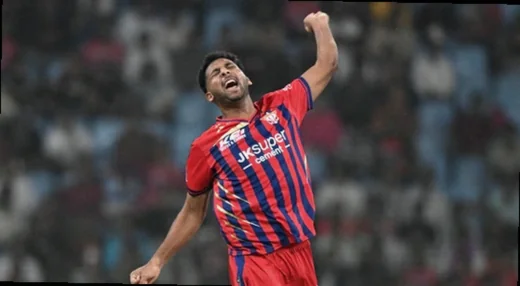
Lucknow Super Giants entered the 38th fixture of IPL 2026 with one priority: seize control from the outset. Facing a Kolkata Knight Riders top order that often needs its middle phase to repair the damage, Rishabh Pant opted to bowl first at Ekana—and placed the opening responsibility squarely on Mohsin Khan. The new-ball burst set the tone immediately, and by the time the Powerplay ended, KKR were struggling at 31 for 4.
How Mohsin Khan remade KKR’s Powerplay
- Mohsin’s opening spell numbers were 3-1-14-3, with the three early strikes coming alongside tight run prevention.
- His approach revolved around denying KKR the “easy” ball—no straightforward full deliveries to hit cleanly, and no loose short ones that invite relaxed pulls.
- The bowler repeatedly worked the hard length and the back-of-a-length areas, typically around off stump, with frequent attention to the fourth and fifth-stump channels.
- This forced KKR’s right-hand batters into a difficult choice: either play away from the body at the wrong moment, or manufacture scoring space on their own.
- Ajinkya Rahane was among the first to show the impact. Mohsin hit the pitch, kept the ball moving along middle and off, and made Rahane play across the line before he could settle.
- An attempted leg-before appeal on the third ball of the second over was not upheld after tracking showed the ball pitching outside leg, but the delivery still served its purpose by rushing Rahane into a heavy shot.
- Tim Seifert’s dismissal added a new layer. Mohsin alternated between a fuller length and the back-of-length corridor. At 1.5 overs, Seifert was beaten outside off when he tried to drive on the up.
- On the very next ball, Mohsin stayed in the attacking zone: full enough to tempt the drive, but not full enough to make it safe. Seifert leaned forward and struck a toe-ended drive that found cover, resulting in the wicket—another example of the plan being baited into execution.
- Rahane’s wicket was the sharpest moment of the spell. Mohsin had already taken away Rahane’s pace-on scoring options, then introduced a change-up at 124.6 kph on a good length around leg.
- Rahane backed away for room to lift over the bowler, but the ball turned the bat, sending up an edge that Aiden Markram took at mid-off. The wicket reflected tempo manipulation: Rahane wasn’t simply beaten for pace; he was made desperate to create pace and space on demand.
- Rovman Powell completed the break. The delivery wasn’t an obvious “unplayable”—it was short, into the body, around leg—but with KKR already damaged, Powell tried to pull from a cramped position.
- The shot only produced an inside edge into gloves, and Rishabh Pant held the catch. Pressure transformed a normal short ball into a wicket ball.
That spell’s real value was its structure. Mohsin didn’t depend on magic deliveries; he built a batting environment where even routine strokes became risky. The hard length denied front-foot freedom, the fourth-stump line invited unsafe drives, the shorter ball cramped the body, and the slower ball punished any premeditation. Together, the sequence dragged KKR away from their preferred rhythm and into a fight they were not ready to play.
From Powerplay damage to total control
KKR didn’t just lose wickets—they lost tempo and control within the first seven overs. Once the opening damage started, they kept hunting for release rather than absorbing the pressure. Mohsin’s discipline allowed LSG to keep both ends tight across the Powerplay, conceding only 14 runs in three overs, bowling a maiden, and striking once in each of his first three overs. It was the kind of scoreboard pressure that makes a chase feel out of reach before it fully begins.
Rishabh Pant didn’t stop at the start. He brought Mohsin back during the 11th over, when Cameron Green was beginning to look dangerous and threatening to push the total beyond a comfortable line for KKR’s opponents. Mohsin struck again: he removed Green and then followed it up immediately with the wicket of Anukul Roy on the next delivery.
In the end, Mohsin Khan finished with five wickets for 23 runs in his four overs — a spell that effectively knocked the energy out of Kolkata’s innings.
