
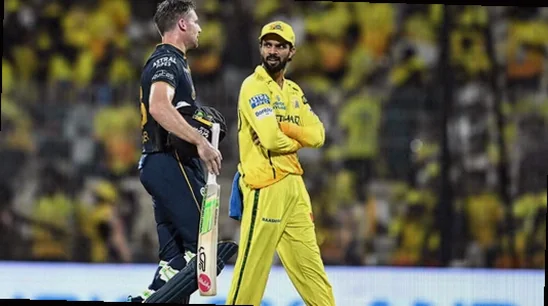
Chennai Super Kings were left searching for boundaries for most of their chase—until late in the innings—after Gujarat Titans’ attack arrived without Prasidh Krishna. With two quick wickets falling early, CSK couldn’t get going for the first 32 deliveries, and it took until the 12th over for the team to reach 50. Ultimately Ruturaj Gaikwad’s patient effort powered Chennai past the 150-mark, but Gujarat still got home with the chase completed in 16.4 overs.
Early pressure and a slow start from CSK
Gujarat Titans’ bowling unit, missing Prasidh Krishna, created an early squeeze. Chennai struggled to find any real rhythm in the opening phase, going 32 balls without a boundary after losing two wickets in quick succession. The scoring pace remained muted, and the half-century arrived only in the 12th over.
Gaikwad’s bat-through innings and the late acceleration
Ruturaj Gaikwad carried the innings, but his tempo in the opening stretch was restrained. In his first 42 deliveries, he made 35 runs, striking only twice for boundaries and facing 26 dot balls. The breakthrough to his next milestone came later—seven balls after that early phase—when he reached his first fifty of the season.
- Gaikwad’s fifty came off 49 balls, described as the slowest-ever half-century in the last three seasons.
- After the strategic time-out, CSK’s scoring rate noticeably improved, with the side piling on more than 108 runs in the final eight overs.
- Gaikwad finished unbeaten on 74, and his late surge included 39 runs from the last 18 balls.
- In that closing burst, he hit just four dot balls.
Even with the strong finish, the total wasn’t enough. Gujarat Titans chased the target down in 16.4 overs, denying Chennai victory despite the late burst.
Overton’s cameo and Gaikwad’s explanation after the loss
As Chennai pushed beyond 150, the captain’s innings received a boost from Jamie Overton as well. Overton contributed a brief but useful six-ball cameo of 18 runs, helping CSK build momentum in the latter stages.
Gaikwad, who found himself at the centre of criticism after the eight-wicket defeat at the MA Chidambaram Stadium, addressed his approach to the broadcaster. He acknowledged a positive start, but explained how the early wicket sequence forced a change in plans, with the pitch and match situation shaping his decision-making.
He said: “I got off to a really good start, 10 off 6, and then I thought I would keep that momentum going. But then you saw three quick wickets fall right in front of you. I felt a partnership was needed, as the wicket wasn’t playing well. After that, we were trying to target a particular bowler, but another wicket fell. Then I thought, okay, let’s just take my time, bat, and rotate strike. On any other day or pitch, I feel I would have rotated strike more, but as I said, I was trying. To see that on the scorecard—a lot of balls and very few runs—it is obviously frustrating.”
Gaikwad also elaborated on how the innings turned in the final overs. “Once I got hit, I just thought I would get going. I wanted to see how I could change the momentum, and even if I got out, there were still five or six overs left. So that was the moment I decided to start going,” he added.
Pitch misread and the powerplay setback
CSK’s captain suggested the team may have misjudged how the surface would behave. At the toss, Gaikwad indicated the wicket was dry and that defending would be possible, hinting that spin might become a factor later. However, what followed told a different story in the powerplay.
Gujarat Titans’ pace attack—led by Mohammed Siraj and Kagiso Rabada—made the most of the movement and bounce, reducing Chennai to 28 for three during the early phase.
- Gaikwad admitted they had little clarity on how the pitch would play this time, despite having some sense of conditions from earlier matches at the venue.
- He said they estimated they might understand the surface only “maybe 60-70%,” but that this match offered “no clue.”
- He added that by the time the team wanted to adapt and change, it was already too late, and even when they attempted adjustments, they “didn’t come off.”
Gaikwad’s post-match conversation was also long, but he still kept his humour intact, telling the commentators “no more questions,” leaving them smiling as they admitted they “did not hold back.”
