
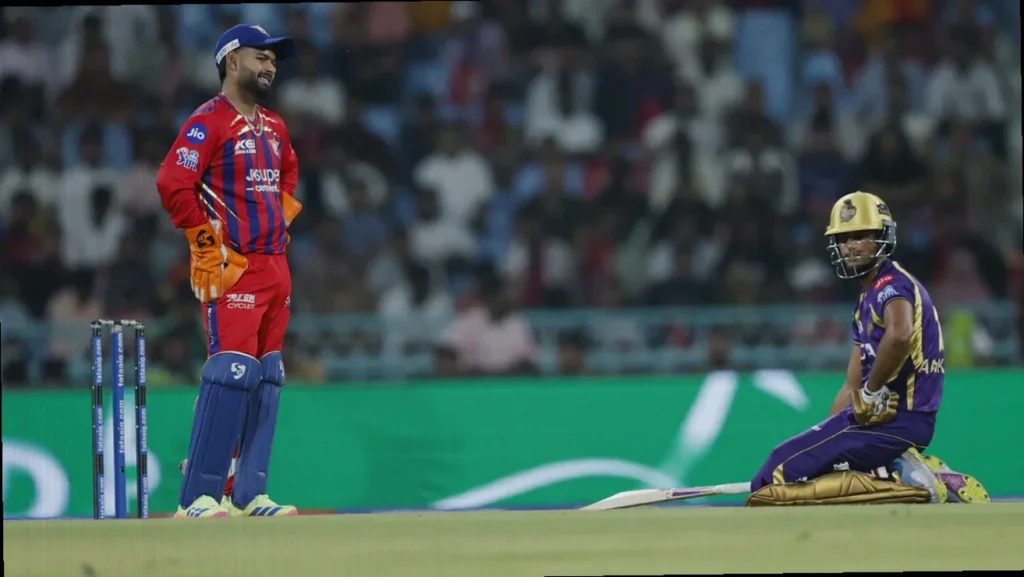
Angkrish Raghuvanshi was dismissed for obstructing the field against Lucknow Super Giants on Sunday, becoming only the fourth batter in IPL history over the past 19 years to receive that call. Even with the batter’s protests and visible disagreement from the Kolkata Knight Riders (KKR) coaching group, third umpire Rohan Pandit stood firm after reviewing the incident.
What made the moment especially instructive was that the decision-making process played out audibly during the broadcast. Pandit did not focus on any subjective question of intent; instead, he worked around two largely verifiable elements—whether Raghuvanshi had altered his running direction in a meaningful way, and whether he did so without a reasonable justification. Once both conditions were answered in the affirmative, the outcome followed with little room for an alternative ruling.
In fact, Pandit’s review went beyond the bare minimum. He checked additional angles and even considered whether Raghuvanshi was tracking the path of the throw, a step that can matter when assessing the presence (or absence) of “probable cause.” The logic was that a batter might be judged differently if there was a plausible reason for changing course—yet Pandit was not convinced that any such reason existed, particularly given his understanding of where the throw was heading.
The rule itself has a slightly unusual backdrop. The relevant wording appears to have been removed from the MCC website at some point, likely due to an inadvertent issue, but it remains present in the IPL 2026 playing conditions. Clause 37.1.4 states: “For the avoidance of doubt, if an umpire feels that a batter, in running between the wickets, has significantly changed his direction without probable cause and thereby obstructed a fielder’s attempt to effect a run out, the batter should, on appeal, be given out, obstructing the field. It shall not be relevant whether a run out would have occurred or not.”
From a replay perspective, the critical movement happened in the middle of the pitch and in line with the stumps. As Raghuvanshi moved towards the non-striker’s end, his head and focus stayed on the mid-off region. He appeared to hesitate and shift left toward the edge of the ground by the time he began accelerating, ending up well away from the cut strip. That alone represented a significant deviation of line. However, his actions did not stop there—he altered his path again as he went into a dive, this time closer to the stumps, and the follow-through placed him in the path of the throw.
Pandit may not have felt compelled to search so deeply into the “probable cause” angle, but he did, reached the conclusion that no justification existed, and therefore had to deliver the dismissal. In those circumstances, defending a not-out decision would have been extremely difficult given the nature of the change in direction and its timing relative to the throw.
It is also important to remember what the law does not require. The wording does not hinge on establishing the batter’s mindset or intention behind the movement. The umpire’s responsibility is not to determine whether the batter set out to obstruct; the focus is on what happened on the field—specifically whether there was a significant direction change without probable cause that impeded a fielder’s attempt to run out.
On many occasions like this, the frustration from batters comes from a feeling that they are being accused of something sinister. If Raghuvanshi and KKR were genuinely annoyed—particularly given the wide visibility of coach Abhishek Nayar’s heated exchange with the fourth umpire—it would still fall within the nature of how obstructing-the-field decisions tend to be received. In essence, it is a batter’s right to dispute the call, much like defenders of run-outs often argue that a batter leaving the crease is simply routine movement rather than a deliberate effort to thwart a dismissal.
The takeaway is straightforward once the wording is read carefully: a batter should not significantly alter their running direction while between the wickets unless there is a reason that can be viewed as probable cause. Whether the batter truly intended to block the throw, whether the delivery would have struck the stumps, or whether the ball would have resulted in the batter being short of the crease—none of that is decisive under this clause.
