
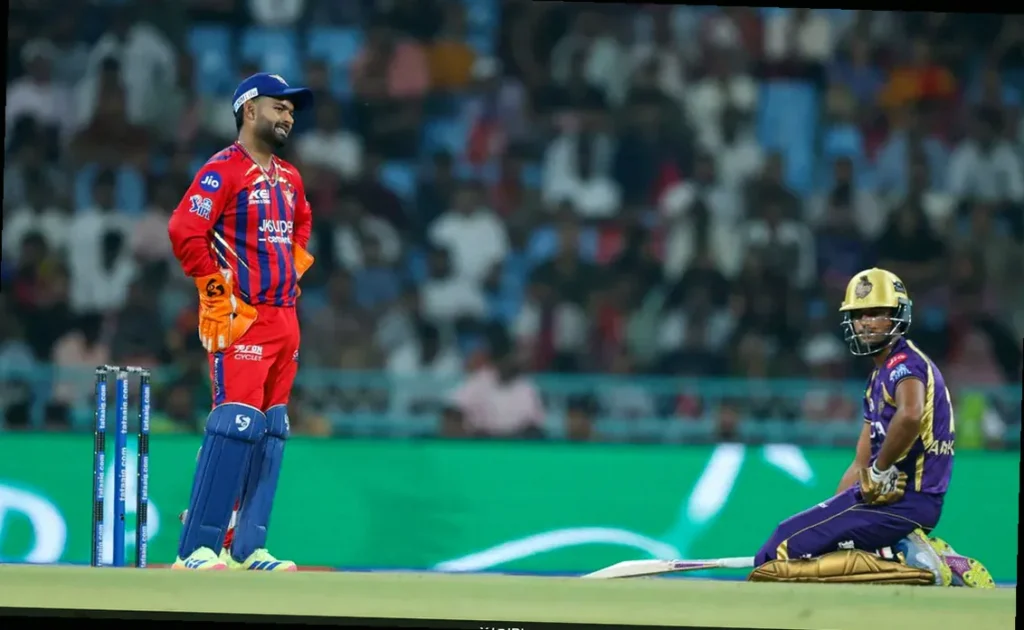
The IPL has been thrown into debate after Kolkata Knight Riders batter Angkrish Raghuvanshi was ruled out for obstructing the field during their contest against Lucknow Super Giants. In the IPL 2026 game on Sunday, Angkrish became only the fourth batter in the tournament’s history to be dismissed for that specific offence, with third umpire Rohan Pandit delivering the signal that sparked instant disagreement. While many believe the decision followed the laws as they stand, former India players Virender Sehwag and Rohan Gavaskar expressed clear reservations about whether Angkrish’s actions met the threshold for an out.
Match officials generally apply a straightforward test when “obstructing the field” is in question. The first part is whether the batter significantly altered the course of their running, and the second is whether that change happened without probable cause. In Angkrish’s case, the on-field and decision-making group concluded that both requirements were satisfied, leading to his dismissal.
On Cricbuzz, though, Rohan Gavaskar argued that the picture from the umpire’s perspective may not have justified a wicket. He pointed out that Angkrish’s eyes were not fixed on stopping the ball, suggesting the movement was driven by the natural flow of his run rather than an attempt to interfere. “I think it’s not out because of the way he turned, dived, and jumped. His eyes were not on the ball,” Rohan said, explaining how the batter appeared to be making an instinctive adjustment to the throw. He added that Angkrish did not look like he was trying to block contact; if that had been the intention, he would have stayed still—since he was already positioned in the path of the throw—so the ball would have struck him. Instead, the dive and jump, in Rohan’s view, indicated the action was unplanned. “So, I believe it’s not out,” he concluded.
Sehwag backed a similar line of thinking, stressing that brief glances at the fielder are routine for batters who are trying to assess the safest running direction and the incoming throw. For the former opener, even the dive itself could be explained as part of normal decision-making on the move. “Every batsman looks at the fielder when the ball goes to them. You take one run, you take two runs, and you see which end is safer,” Sehwag said. He argued that if the throw were coming to the bowling end, there would be little reason for the batter to dive. However, once the batter senses the throw is heading to the wicket-end, a dive becomes a logical response. “Your eyes will naturally go towards the fielder. It’s not that his eyes were on the fielder because he thought, ‘I am stopping something.’ He dived after that. So, I believe it’s not out,” Sehwag said.
Sehwag also offered a more detailed interpretation of the sequence. “When he turned, he was looking at the fielder to see where the ball was coming from. But after turning, he ran and jumped. He wasn’t looking at the fielder anymore, nor was his attention in front. In my opinion, a slightly harsh decision has been made here,” he added, underlining his belief that the action did not resemble purposeful obstruction.
The discussion then shifted to what the rule actually requires. The relevant wording from the MCC rulebook is referenced in the IPL 2026 playing conditions, specifically Clause 37.1.4. It states that if an umpire believes a batter, while running between the wickets, has significantly changed direction without probable cause and thereby obstructed a fielder’s attempt to effect a run out, the batter should be given out upon appeal for obstructing the field. Importantly, the clause adds that it does not matter whether a run out would have happened or not.
Other ex-cricketers also weighed in against the dismissal, suggesting that expecting a batter to make a full 180-degree change in direction is unrealistic, and that some amount of natural turning is inevitable when reacting to a throw. Sanjay Bangar and Carlos Brathwaite were among those who argued that the decision was harsh given the constraints of the batter’s movement, even as the rulebook allows for an out if the umpire judges both “significant change” and “no probable cause” to be present.
