
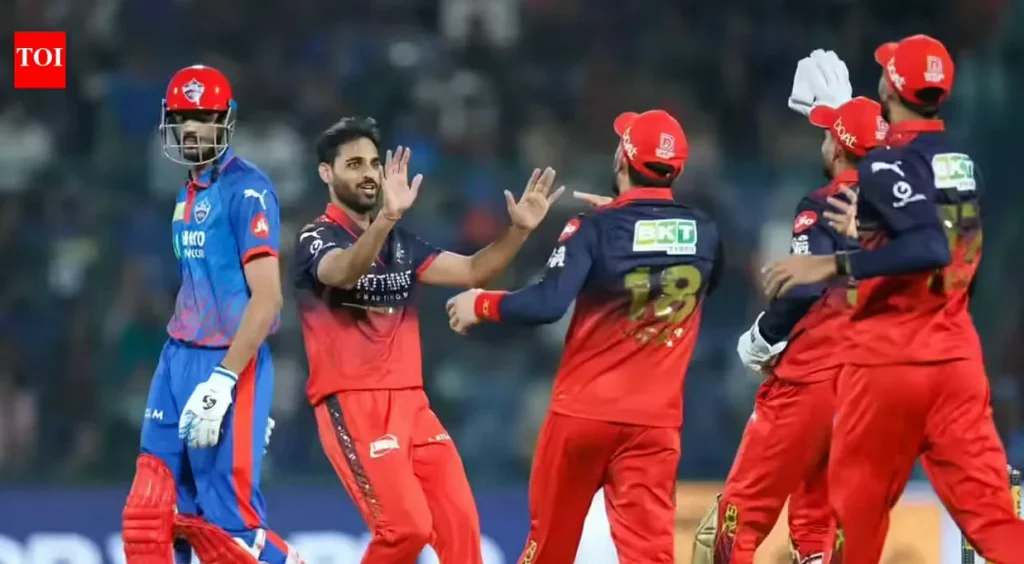
It turned into a nightmare night for Delhi Capitals at the Arun Jaitley Stadium as Royal Challengers Bengaluru’s fast bowlers tore through the home side’s batting in a Monday clash. Chasing a win after being sent in by RCB captain Rajat Patidar, DC’s innings unraveled from the very beginning, with the visiting seam attack turning early wickets into a full-blown collapse.
Key takeaways
- RCB captain Rajat Patidar opted to field first after winning the toss.
- Sahil Parakh was dismissed for a two-ball duck, caught early in the innings.
- Josh Hazlewood struck twice in two deliveries, removing KL Rahul and Sameer Rizvi to leave Delhi reeling.
- Bhuvneshwar Kumar added further damage, taking out Tristan Stubbs and Axar Patel in the same over.
- DC slumped to 8 for 6 inside four overs after Hazlewood dismissed Nitish Rana.
- The fall of the sixth wicket at 8 set a record-low mark in IPL history at that stage of an innings.
Early wickets set the tone for a Delhi collapse
Debutant Sahil Parakh endured a nightmare start, getting trapped in the second over when Bhuvneshwar Kumar bowled him for a two-ball duck. From there, the match swung sharply in Bengaluru’s favour as Josh Hazlewood produced immediate impact by striking twice in consecutive balls, sending KL Rahul and Sameer Rizvi back to the pavilion in quick succession.
The carnage didn’t stop. Bhuvneshwar continued his rhythm and removed Tristan Stubbs and then captain Axar Patel within the same over, intensifying the pressure on the DC middle and lower order. Hazlewood then returned to finish the damage by dismissing Nitish Rana, leaving Delhi with a shocking 8 for 6 inside four overs.
Record-low milestone at the fall of the sixth wicket
That 8-for-six situation became the lowest-ever total recorded at the fall of the sixth wicket in IPL history. The previous benchmark was 11 for 6, achieved by Kochi Tuskers Kerala against Deccan Chargers in 2011, and that earlier match took place on the same calendar date—April 27.
The unwanted list also features Delhi Daredevils’ 24 for 6 from 2017, RCB’s 28 for 6 from 2014, and Sunrisers Hyderabad’s 29 for 6 from 2013, highlighting how unusual and damaging the collapse was for Delhi on the night.
How Bengaluru’s seam plan dismantled the batting order
The downfall was driven by relentless seam movement and pressure. Bhuvneshwar’s inswinging yorker to Parakh established the early theme, while Hazlewood’s controlled line and length exposed how vulnerable the batters were under sustained bowling at the start. The Indian and Australian quicks combined swing, accuracy, and discipline to force mistakes from a rattled Delhi group.
Fielding moments also played a part in tightening RCB’s grip. Wicketkeeper Jitesh Sharma and slip fielder Devdutt Padikkal supported the bowling with sharp catches, ensuring that once wickets started to fall, DC couldn’t rebuild.
Patidar’s toss call and Axar’s post-match admission
Patidar’s decision to bowl first was shaped by the conditions at the Arun Jaitley Stadium, with the venue known for high-scoring games and the expectation that batting under lights would be more favourable later on. At the toss, he had said their intent was to apply pressure—an approach that Bengaluru executed with ruthless efficiency.
After the match, Delhi captain Axar Patel acknowledged that his side would have preferred to chase, pointing to improving pitch conditions. But the turnaround never arrived, because Bengaluru’s fast bowlers had already inflicted damage deep into the powerplay, delivering one of the most devastating new-ball spells in IPL history.
