
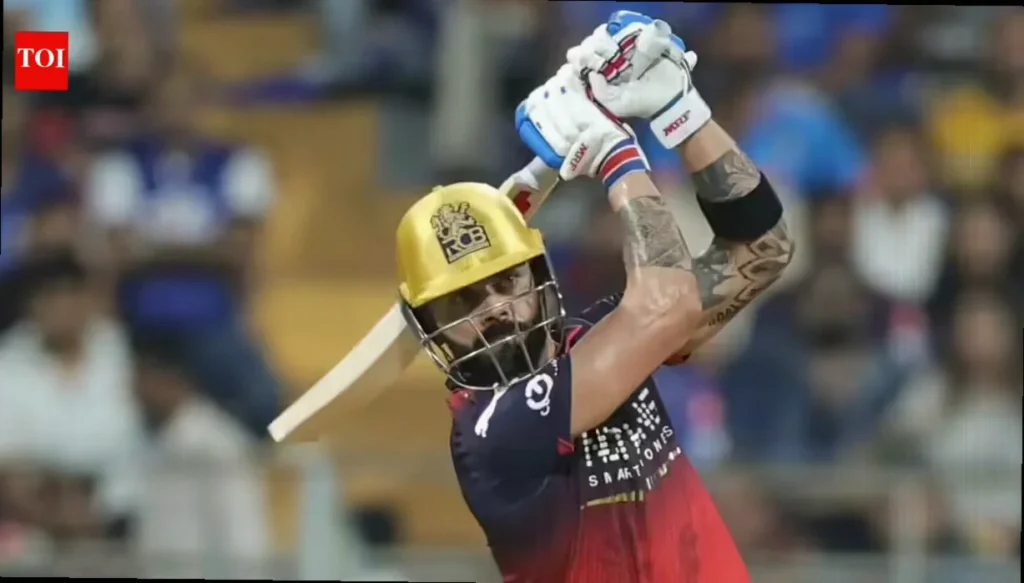
Royal Challengers Bengaluru’s batting narrative in IPL 2026 has been closely tied to the evolution of Virat Kohli, and few have framed that change more directly than former India batter Sanjay Manjrekar. The Bengaluru star’s latest landmark — becoming the first player in IPL history to reach 9,000 runs — has arrived alongside a deeper shift in how Kohli approaches T20 batting, one that Manjrekar says is rooted in a key mental realisation: he is “not indispensable” anymore.
Milestone moment at Arun Jaitley Stadium
- Kohli achieved the IPL 9,000-run milestone in the match where RCB faced Delhi Capitals at the Arun Jaitley Stadium on Monday.
- RCB chased a target of 76 comfortably, with Kohli remaining unbeaten on 23 off 15 deliveries.
- He capped the chase in emphatic fashion by striking consecutive sixes to finish the job.
With 9,012 runs from 275 IPL appearances at an average slightly above 40, Kohli remains one of the league’s most consistent run-makers. This season, his output has been particularly eye-catching: 351 runs at a strike rate of 162.50. Manjrekar pointed out that this is a noticeable jump from his career strike rate, which has hovered around the low 130s.
Manjrekar’s explanation: tempo over technique
Manjrekar believes the transformation is less about technical tweaks and more about a change in mindset. Speaking on Sportstar’s The Insight Edge podcast, he suggested Kohli is now choosing to bat at a quicker tempo than before. “You’re seeing Virat Kohli bat differently… it’s nothing that has changed,” Manjrekar said. “It’s only that he’s decided that he’s going to bat quicker.”
He also described how Kohli’s earlier approach often revolved around anchoring an innings. In that phase, Kohli would typically work on rotating the strike after boundaries and push himself to bat deep into the chase or set an innings for as long as possible. Manjrekar’s view was that Kohli felt he needed to be the batter facing most balls, partly because he didn’t trust the batting group lower down the order to carry the innings effectively.
In Manjrekar’s assessment, that earlier mindset limited RCB’s ceiling. “RCB changed when Virat Kohli at the top started batting a little quicker and didn’t make himself almost indispensable,” he said. “And that’s when the others also blossomed under him.”
Why the numbers suggest a new intent
The former India batter linked the reasoning to visible statistical trends. Over the past three seasons, Kohli’s strike rate has risen sharply: it was 154.69 in 2024, dropped slightly to 144.71 in 2025, and then surged to 162.50 in 2026. The pattern, in Manjrekar’s framing, reflects a deliberate focus on maximising scoring rather than preserving his wicket for the sake of longevity.
He further argued that modern T20 cricket demands aggression because teams work with a limited number of overs and a small batting window. With “eight batters for just 20 overs,” Manjrekar said, there is no practical room for taking ones and twos simply to stretch the innings. “You have to try and maximise,” he added, while warning that chasing individual milestones at the expense of team impact can be harmful.
“No one’s wicket is more important”
Manjrekar drew a comparison with KL Rahul to underline how pressure can shape a top-order batter’s tempo. He suggested that earlier, many leading batters carried the responsibility of being the “main man,” which in turn could slow down the scoring rhythm.
“T20 cricket is not about anybody thinking his wicket is important,” Manjrekar remarked. “If someone is worried about getting out and just extending innings, that player becomes a liability.”
Ultimately, Manjrekar’s message is that Kohli’s shift is about both trust and pace. Trust in the batting unit around him allows Kohli to play with greater freedom, and that freedom reduces the need for him to carry the innings alone. As RCB reap the benefits of that approach, the change is becoming a template for how modern T20 batting can be reshaped — with tempo and team confidence taking precedence over the old concept of indispensability.
