
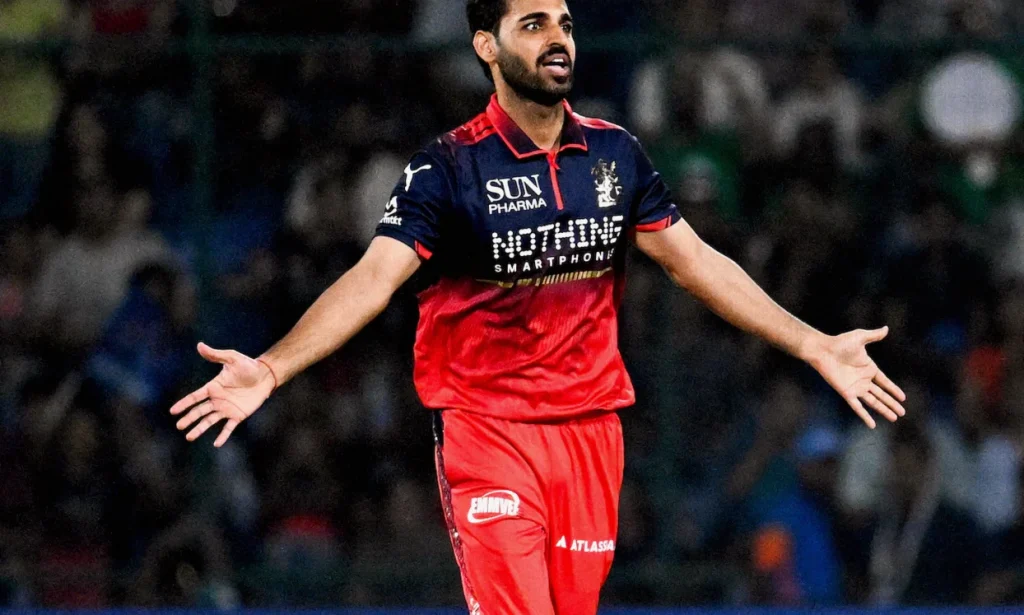
Royal Challengers Bengaluru’s veteran fast bowler Bhuvneshwar Kumar believes that, in today’s high-tempo T20 climate, bowlers must stay tactically stubborn even during the powerplay when the ball is offering movement. Speaking after his match-winning spell, Bhuvneshwar backed the idea that “defensive” does not mean passive—rather, it should translate into executing a plan and attacking specific batting weaknesses. In the IPL match at the Kotla on Monday, he produced sensational figures of 3 for 5, and together with Josh Hazlewood’s 4 for 12 helped dismiss Delhi Capitals for just 75 on a pitch described as lively, with bounce and swing. RCB chased down the target in 6.3 overs, finishing with nine wickets to spare.
Mindset shift for powerplay bowling
- Bhuvneshwar said the biggest change in modern T20 cricket is that batters no longer restrain themselves even when the ball is moving in the early overs.
- He noted that earlier teams showed more caution toward swing and seam in the powerplay, but the current trend is a consistently aggressive approach from the start.
- That is why, in his view, the bowler’s mindset needs to evolve—being defensive, he argued, is about bowling with a strategy rather than simply trying to limit runs.
- He added that a seamer often becomes more attacking when he senses the surface has something in it, because the ball is likely to do more than it would on a dead track.
- Bhuvneshwar explained that on flatter wickets with little assistance, a bowler should lean into control: restricting scoring, avoiding boundaries, and maintaining discipline against hitters who look to dominate.
- However, when there is clear help in the air, he said the focus should shift toward taking wickets and being more proactive rather than merely containing.
- He also stressed that even if wickets arrive due to edges or movement, the intent should remain attacking—creating chances instead of only trying to shut things down.
Why Bhuvneshwar and Hazlewood struck early
Discussing how his bowling unit delivered such impact, Bhuvneshwar said the difference lay in attention to detail. He pointed out that success comes from preparation and from understanding the match situation—down to small aspects of execution. Having experienced campaigners such as Josh Hazlewood in the side, he said, boosts effectiveness because on-field communication becomes crucial when adapting to what the pitch is offering at that moment.
Foundations of swing bowling
Bhuvneshwar, who is no longer part of the Indian national team, described swing bowling as a craft built on fundamentals. While he acknowledged that conditions and the ball matter, he emphasized that basics remain the most important elements: wrist position, alignment, and control over line and length. He credited a strong background in red-ball cricket for helping him master those technical requirements. In his words, playing the longer format helps you repeat your action and maintain consistency, and when the ball does move, that advantage should be exploited as fully as possible.
