
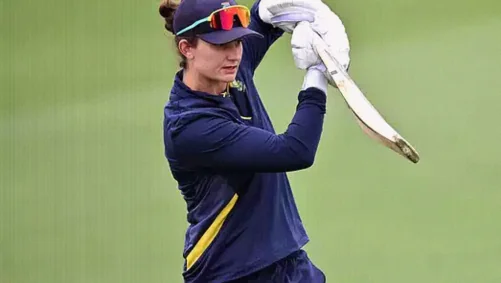
How do you plan for Laura Wolvaardt? That question sat squarely with India during a ten-day T20I series, and for the most part, the answer was simple: when Wolvaardt scored 50 or more, South Africa won; when she didn’t, India got the better of the contest. The pattern held throughout the rubber, with Wolvaardt delivering key knocks at several venues and in different match situations, leaving India chasing answers rather than control. In the opening stretch at Kingsmead, she struck 51 and 54 in the first two games. Then came a first Wanderers innings of 115, followed by 18 in the next outing at the same ground. In the series finale at Benoni, she remained unbeaten on 92 not out, ensuring South Africa ended the tour on a high. Across the series, she was the only batter to reach the 200-run mark, amassing 330 runs—nearly double the total of India’s top scorer, Harmanpreet Kaur, who made 169.
Wolvaardt’s influence was so pronounced that no woman has recorded more runs in a single series “rubber” format in T20 cricket, even allowing for the fact that some series have been longer by a couple of games. Yet after Monday’s match at Willowmoore Park, the South Africa batter also pointed to the circumstances that helped her. “I want to say that I did get the best of conditions; won all the tosses, was able to chase under lights in the first four games and batted first today on a slowish wicket,” she said. Those were valid observations, but what proved decisive was not only the surface or the timing of chases—it was how Wolvaardt managed the ebb and flow of her innings when momentum threatened to slip away.
She looked set to accelerate early in Monday’s game, moving to fifty off 30 balls and appearing on course for a second hundred in just three matches. Instead, her scoring rate dipped and she struggled to stay on strike for stretches, a phase that often triggers impatience from the other end. That kind of frustration can quickly become a wicket-taking opportunity for the bowling side. With the result effectively already settled—South Africa had wrapped up the series in the first three fixtures—Wolvaardt would have been forgiven for taking less risk. Instead, she bided her time, picking up runs where they were available and ensuring her team’s innings kept its structure.
When Deepti Sharma came in to bowl the 20th over, Wolvaardt had faced only 23 deliveries since reaching her half-century. She still found a way to change the tempo. On the first ball of the over, she swept a single to midwicket, then endured a brief spell trapped at the non-striker’s end as Sinalo Jafta managed three. With two balls remaining, Wolvaardt took control again—launching a six over wide mid-on and then hitting another, even more forceful, flatter six over long-on. Those last-over strikes took South Africa to 155/6.
India’s chase never truly ignited, despite the final target being within reach on paper. Eliz-Mari Marx, Nonkululeko Mlaba and Nadine de Klerk all played their part, with de Klerk producing the most telling spell—figures of 5/53 across ten overs—restricting India to 132/8. Without Wolvaardt’s late, non-negotiable hitting in the final over—particularly notable because it was not her signature cover drive—India’s chase could easily have been closer, and might have swung the other direction.
South Africa’s improvement against India stands out even more when placed against their earlier form on the tour. Before facing the Indian side, they were in New Zealand and lost six of their eight white-ball games. Wolvaardt herself was contained during the T20I portion there, scoring 97 runs across five innings. In the ODIs in New Zealand, she was South Africa’s top scorer with 154, but even when she did provide momentum, victories didn’t follow: she made 69 in each of the last two ODIs, and South Africa lost both.
Asked what had changed for her and the team, Wolvaardt offered a candid response. “I can’t really tell you what’s changed that much. The funny thing about cricket is that in New Zealand I scored nine off 14 in one game [the fifth T20I] and today I’m batting a lot better, and I don’t really know why.” Still, she did identify clear areas where South Africa had sharpened their approach, especially in powerplay batting and in death-over bowling. In New Zealand, the home side had outscored South Africa in all five powerplays, and consistently built run-rates in double figures after the 15th over on three separate occasions, with only one instance dipping below eight. Against India, the balance shifted: South Africa were ahead in the powerplay on four occasions, and in the remaining one they trailed by just a single run. Importantly, those post-15th-over gains stayed under better control as well—double-figure damage was limited to just two games, and in the other three matches South Africa kept the rate under eight.
Even with those improvements, the series also underlined a concern: South Africa will need a wider spread of contributions. Wolvaardt struck the only century of the India tour and essentially carried the bulk of her side’s scoring. Outside her, Sune Luus was the only other player to reach a fifty, and she did it twice. That level of dependence is difficult to sustain, particularly with the T20 World Cup approaching in England next month.
For all the emphasis on one individual’s brilliance, Wolvaardt finished Monday’s reflection with confidence about the bigger picture. “We have a bit of momentum heading into the tournament. Our performance [against India] tells us there’s a lot we’re doing right. There are still a few areas where we can be better. I’m excited to work on them before the tournament starts.” That work will face its sternest early test when South Africa take on India at the T20 World Cup at Old Trafford on June 21.
